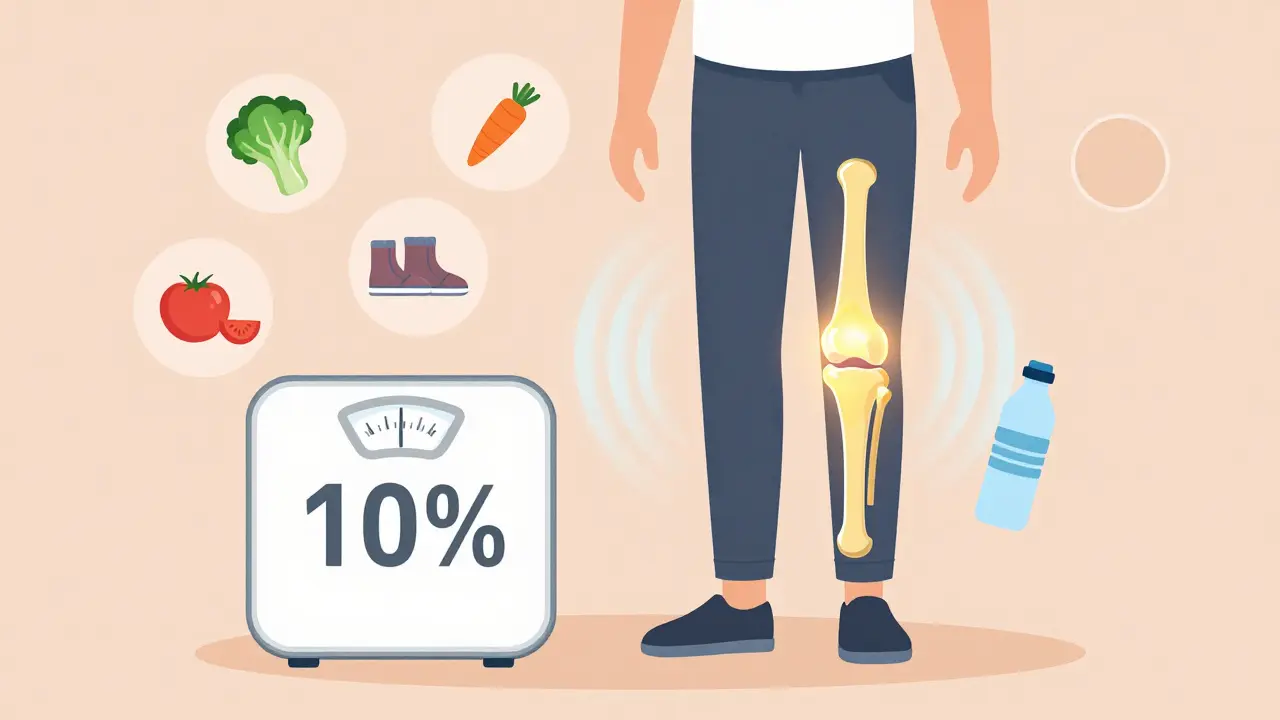
When your hip starts hurting every time you stand up, walk, or even get out of bed, it’s easy to assume surgery is the only answer. But what if the key to relief isn’t a scalpel-it’s your diet and your daily movement? Osteoarthritis (OA) of the hip isn’t just about worn-out cartilage. It’s a whole-body condition, and weight loss might be the most powerful, underused tool you have to slow it down-and maybe even avoid surgery.
Unlike knee osteoarthritis, where losing weight clearly reduces pain, hip OA has been trickier to understand. Some studies say weight loss barely helps. Others show dramatic improvements. The truth? It’s not about whether weight loss works-it’s about how much you lose, and how you do it.
Why Weight Matters for Your Hip
Your hip joint carries nearly your entire body weight with every step. When you’re carrying extra pounds, that pressure multiplies. A 2024 study in Nature found that for every pound of body weight lost, the load on the hip joint drops by about four pounds during walking. That’s not just math-it’s real relief. But here’s the catch: the benefits don’t show up until you lose at least 5% of your body weight. And the biggest improvements? They come when you hit 10% or more.
Take a 200-pound person. Losing just 10 pounds (5%) might ease stiffness. But losing 20 pounds (10%)? That’s when pain drops, walking gets easier, and quality of life improves by over 30%. That’s not a small change. It’s the difference between needing a cane and walking without help.
The Evidence Isn’t Black and White
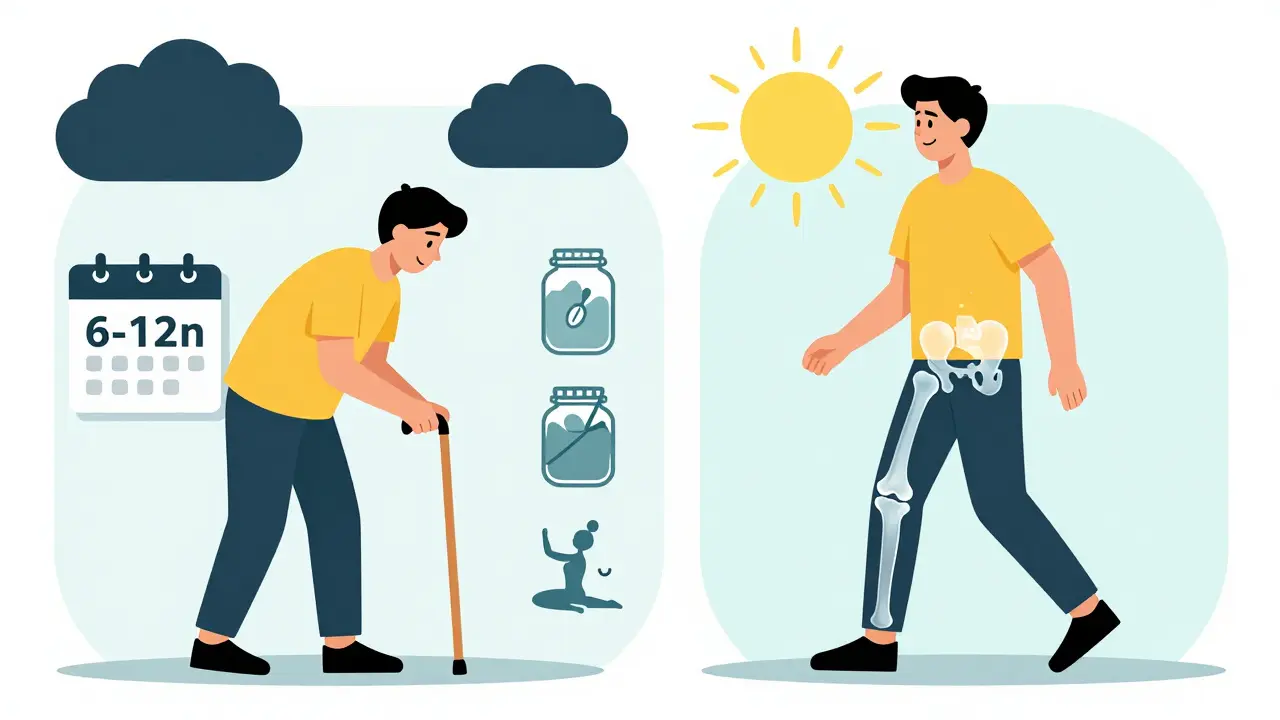
Here’s where things get messy. In 2023, NEJM Journal Watch published a blunt statement: “Osteoarthritis of the Hips Is Unaffected by Weight Loss.” That headline made waves. But it ignored the bigger picture. The study they cited looked at people who lost only 8.5% more weight than the control group-and didn’t see pain changes at 6 months. But here’s what they didn’t mention: at 12 months, the group that lost weight showed clear improvements in pain, function, and overall hip health.
That delay matters. Your body doesn’t fix joints overnight. Cartilage doesn’t regenerate like skin. But reducing pressure, lowering inflammation, and improving muscle strength? That takes time. And the data shows: if you stick with it, your hip will thank you.
Compare that to knee OA, where even 5% weight loss brings fast pain relief. The hip joint is deeper, more stable, and less directly loaded than the knee. That means changes happen slower. But they still happen.
What Actually Works: The Numbers Behind the Results
Let’s cut through the noise with hard numbers:
- 5% weight loss: May reduce stiffness and improve mobility slightly. Often the minimum to feel any difference.
- 7-10% weight loss: Clinically meaningful improvement in pain, function, and daily activities. This is the target used in Australia’s OAHWFL program, adapted for hip OA.
- 10-20% weight loss: Best outcomes across all measures-pain, stiffness, sports function, and quality of life. No extra benefit beyond 10% in most studies, meaning you don’t need to lose half your body weight to see results.
A 2012 study of 35 people with hip OA who lost weight and exercised over 8 months showed a 32.6% improvement in physical function. That’s not a fluke. That’s a pattern.
And it’s not just about calories. A 2023 review in the Journal of Metabolic Health found that low-carb diets combined with exercise worked better than exercise alone. Why? Because reducing sugar and refined carbs lowers inflammation, which directly affects joint pain.
It’s Not Just About Losing Weight-It’s About Preserving the Joint
Weight loss isn’t just about feeling less pain. It’s about buying time. Every extra pound you carry speeds up cartilage breakdown. That’s irreversible damage. But if you lose weight early, you slow the process. You might delay or even avoid a hip replacement.
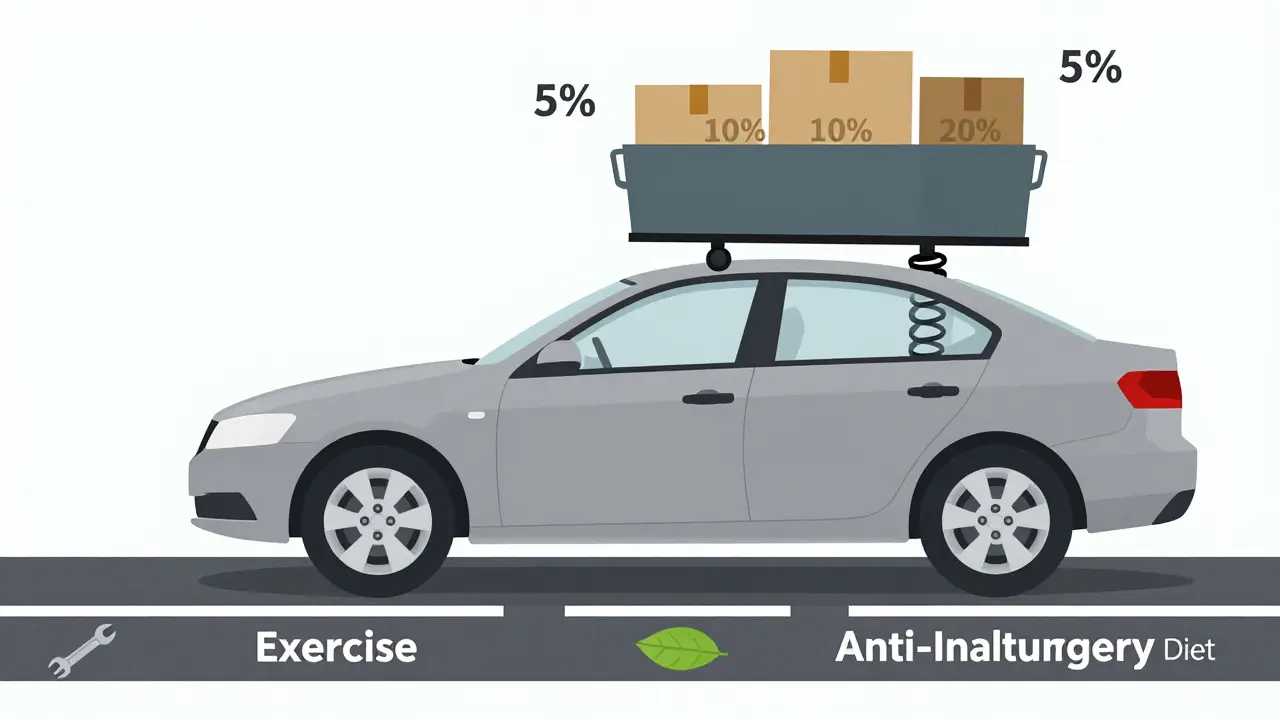
Think of it like a car. If you keep driving with worn brakes, the whole system wears out faster. Lose weight, and you’re not fixing the brakes-you’re reducing the strain on them. That gives your body a chance to adapt, strengthen, and heal around the damage.
Studies show that people who lose 10% or more of their body weight reduce their risk of needing surgery by up to 40% over five years. That’s not a guarantee-but it’s a powerful hedge against a major operation.
What Should You Do? A Practical Plan
You don’t need a gym membership or a diet guru. Here’s what actually works for hip OA:
- Set a realistic goal: Aim for 7-10% of your current weight. If you weigh 220 pounds, that’s 15-22 pounds. Not 50. Not 100. Just enough to make a real difference.
- Focus on protein and veggies: Eat enough protein to protect muscle (about 0.8-1 gram per pound of target body weight). Fill half your plate with non-starchy vegetables. Cut out sugary drinks, white bread, and processed snacks.
- Movement matters more than intensity: You don’t need to run. Walk 30 minutes a day. Do seated leg lifts. Try water aerobics. Strength training for your glutes and thighs reduces hip stress by up to 25%, according to physical therapy studies.
- Give it 6-12 months: Don’t expect miracles in 30 days. The biggest changes happen after six months. That’s when inflammation drops, muscles strengthen, and your hip starts to feel lighter.
And don’t wait until you’re in constant pain to start. The earlier you act, the more joint you preserve.
What About Weight-Loss Medications?
Drugs like semaglutide (Wegovy) or tirzepatide (Zepbound) are FDA-approved for weight loss in people with BMI over 30. But they’re not first-line for hip OA. The American College of Rheumatology recommends lifestyle changes first. Medications are only considered after six months of trying diet and exercise-and only if you have other health risks like diabetes or high blood pressure.
Why? Because the long-term effects on joints aren’t fully known. And lifestyle changes? They don’t just help your hip-they improve sleep, mood, energy, and heart health too.
The Bottom Line
Yes, hip osteoarthritis is tough. Yes, it’s different from knee OA. But the idea that weight loss doesn’t help? That’s outdated. The science now shows clearly: if you lose 10% of your body weight, you’ll feel better. You’ll move better. And you might never need surgery.
This isn’t about being thin. It’s about being strong enough to live without pain. It’s about keeping your hip healthy longer. And it’s within reach-if you start now, and stick with it.
Can losing weight reverse hip osteoarthritis?
No, weight loss can’t reverse existing cartilage damage. But it can stop it from getting worse. By reducing pressure on the joint and lowering inflammation, weight loss helps preserve what’s left of your hip’s natural cushioning. That means less pain, better movement, and a longer window before surgery becomes necessary.
How much weight do I need to lose to see improvement in hip pain?
Most people start noticing changes after losing 5% of their body weight. But the biggest improvements-like less pain, better walking ability, and improved quality of life-come with 7-10% loss. Losing more than 10% doesn’t usually add much extra benefit, so focus on hitting that 10% target first.
Is walking good for hip osteoarthritis?
Yes, walking is one of the best exercises for hip OA. It’s low-impact, improves circulation to the joint, and strengthens the muscles that support the hip. Aim for 30 minutes a day, most days of the week. If it hurts, slow down or try walking in water-it reduces joint load by up to 50%.
Why does weight loss help the knee more than the hip?
The knee is a hinge joint that bears direct load with every step. The hip is a ball-and-socket joint that’s more stable and surrounded by stronger muscles. That means the hip doesn’t feel pressure from extra weight as immediately as the knee. But over time, that pressure still wears it down. Weight loss helps the hip-it just takes longer to notice.
Should I try a very-low-calorie diet for hip OA?
Very-low-calorie diets (VLCDs) can work, especially if you have a lot of weight to lose. But they’re hard to stick with and can lead to muscle loss if not paired with strength training. For hip OA, a balanced, sustainable approach that includes protein, vegetables, and daily movement is safer and more effective long-term. Save VLCDs for when lifestyle changes alone aren’t enough-and only under medical supervision.
What Comes Next
If you’ve been told to lose weight but didn’t know where to start, this is your signal. You don’t need to be perfect. You just need to begin. Start with one change: swap soda for water. Take a 10-minute walk today. Add one extra serving of vegetables to dinner.
Small steps add up. And for your hip, they might mean the difference between living with pain-and living well.





Sumit Mohan Saxena February 28, 2026
While the article presents a compelling case for weight loss in hip osteoarthritis, the data must be contextualized within the broader biomechanical literature. The 4:1 load reduction ratio cited from the 2024 Nature study assumes linear force transmission, which oversimplifies the complex interplay of muscle torque, joint alignment, and gait compensation patterns. In clinical practice, we observe non-linear thresholds of benefit, often with plateau effects beyond 8% weight loss, particularly in patients with pre-existing acetabular dysplasia or femoroacetabular impingement. The real clinical utility lies not in the percentage lost, but in the preservation of muscle mass during weight reduction-a factor rarely addressed in population studies.
Katherine Farmer March 1, 2026
Let’s be honest-this is just another wellness-industrial complex hustle dressed up as science. You’re telling people to lose 10% of their weight like it’s a simple math problem? Meanwhile, Big Pharma is pushing semaglutide ads every five minutes. The real issue isn’t weight-it’s systemic inflammation caused by processed foods, endocrine disruptors, and chronic stress. But who benefits from that narrative? Not you. Not me. Definitely not the pharmaceutical companies selling $1,000/month injections. This article is a distraction. A placebo with footnotes.
Angel Wolfe March 2, 2026
So now they're saying if you're fat you're just asking for a hip replacement? Who made these rules? I didn't sign up for this. This is just the government's way of controlling us under the guise of 'health.' They want us all skinny and obedient. And don't even get me started on how they're pushing water aerobics like it's some kind of miracle cure. Water aerobics? In 2024? That's what they're teaching our kids now? This is socialism disguised as physical therapy. Wake up people!
Sophia Rafiq March 2, 2026
low carb + movement = game changer for hip OA. no magic numbers needed. just stop the sugar and move what you got. 30 min walk daily beats 3 hours of forced gym torture. also protein intake is non negotiable. if you're losing weight and losing muscle you're doing it wrong. simple. no stats needed. just do it.
Martin Halpin March 3, 2026
I have to push back on this entire framework because it's fundamentally anthropocentric and ignores the ecological dimensions of metabolic health. We're talking about individual weight loss as if the body exists in a vacuum, divorced from environmental toxins, food deserts, sleep deprivation, and the psychological trauma of late-stage capitalism. In rural Ireland, where I grew up, obesity was never a personal failure-it was a structural failure of policy, of agricultural subsidies, of the destruction of community kitchens and the rise of hyperprocessed food systems. To reduce hip OA to a calculus of pounds lost is not just reductive-it's ethically irresponsible. You can't diet your way out of a broken system. And if you're telling someone to lose 10% of their body weight while they're working two jobs, raising kids, and living in a neighborhood with no safe walking paths, you're not helping-you're blaming.
Justin Ransburg March 3, 2026
This is one of the most clear-eyed, evidence-based pieces I've read on hip OA in years. The emphasis on 7–10% weight loss as the target-not perfection-is exactly what patients need to hear. Too many people give up because they think they have to lose 50 pounds. This gives them a realistic, achievable goal with measurable outcomes. The comparison to car brakes is brilliant. And the note about inflammation reduction via dietary changes? Spot on. Keep sharing this kind of clarity. It's rare.
Brandie Bradshaw March 5, 2026
Let’s pause. Let’s reflect. The notion that weight loss = joint preservation is not merely physiological-it’s ontological. We are not machines. We are not algorithms. We are embodied beings shaped by histories of trauma, neglect, and societal abandonment. To reduce the suffering of hip osteoarthritis to a percentage of body weight is to erase the human story behind the fat. What if the weight is armor? What if the pain is the only thing left that feels real? What if the journey to 10% isn’t about calories-but about safety? About love? About being seen? The science is valid. But the silence around the emotional labor of weight loss? That’s the real epidemic.
Lisa Fremder March 6, 2026
Everyone is so obsessed with losing weight like it’s some moral victory. Meanwhile, the real problem is that the healthcare system doesn’t give a damn about you until you’re on the operating table. They don’t offer physical therapy. They don’t pay for nutritionists. They don’t even have waitlists for pain management. So yeah, sure, lose 10%-if you have the time, money, and mental bandwidth to do it. But don’t act like this is a solution. It’s a Band-Aid on a hemorrhage. And the people who wrote this article? They’ve never had to choose between groceries and a prescription.
Full Scale Webmaster March 8, 2026
Okay so let me get this straight-after decades of being told to 'just eat less' while being bombarded with hyperpalatable food engineered by corporations with billion-dollar marketing budgets, now we’re supposed to feel guilty for not being able to lose weight? And if we don’t? We’re just going to get surgically replaced like a worn-out part? This isn’t medicine-it’s a dystopian corporate loyalty program. They don’t care if you live. They care if you pay for the procedure. And now they’ve got you blaming yourself for needing it. Wake up. This isn’t about your willpower. It’s about capitalism. And the hip replacement industry is one of its most profitable branches.
Noah Cline March 8, 2026
From a metabolic syndrome standpoint, the 10% threshold aligns with the HbA1c reduction curve observed in prediabetic cohorts. The reduction in IL-6 and TNF-alpha levels post-weight loss correlates directly with synovial fluid biomarkers in hip OA. The 2023 J Metab Health review’s emphasis on low-carb diets is supported by adipose tissue lipolysis kinetics-reducing glycerol flux decreases hepatic de novo lipogenesis, which in turn lowers systemic inflammation. The key is maintaining lean mass during weight loss-protein intake above 1.2 g/kg lean body mass is critical. Without resistance training, even 15% weight loss fails to preserve joint integrity. The data is robust. The implementation? Not so much.
Sneha Mahapatra March 10, 2026
thank you for this 💛 i’ve been living with hip pain for years and no one ever told me losing just 10% could make this much difference. i started walking every evening and swapped soda for herbal tea. it’s slow. but i feel lighter. not just in my hip. in my heart too. you don’t have to be perfect. you just have to begin. and you’re not alone.