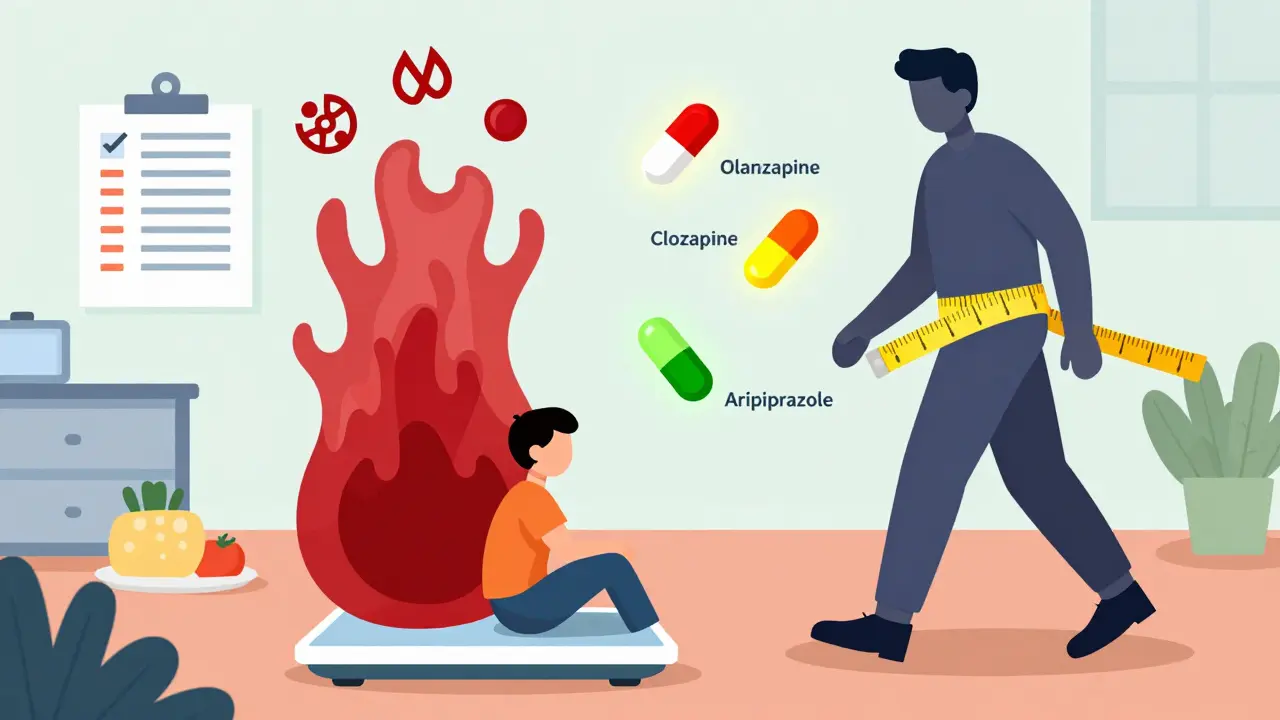
When someone starts taking an antipsychotic medication, the goal is clear: reduce hallucinations, calm delusions, and bring stability back to their life. But for many, that relief comes with a hidden cost-serious changes to their body’s metabolism. These aren’t just minor inconveniences. They can lead to weight gain, prediabetes, heart disease, and even shorten life expectancy. And the truth? Most patients don’t know how serious this is until it’s too late.
Why Some Antipsychotics Hit Your Metabolism Hard
Not all antipsychotics are created equal. The newer ones-called second-generation antipsychotics (SGAs)-were designed to be safer than older drugs by reducing movement disorders like tremors and stiffness. But in the 2000s, doctors started noticing a pattern: patients on these meds were gaining weight fast, developing high blood sugar, and seeing their cholesterol go haywire. By 2007, research confirmed it: SGAs like olanzapine and clozapine were linked to a 3-fold increase in diabetes, heart disease, and severe weight gain compared to people not taking them. The problem isn’t just about eating more. These drugs directly interfere with how your body handles sugar and fat. They block receptors in the brain that control hunger, making you feel constantly hungry. At the same time, they mess with insulin signaling, so your body can’t use glucose properly-even if you don’t gain weight. Some patients on olanzapine see their blood sugar rise within weeks, long before the scale moves.Which Medications Carry the Highest Risk?
If you’re on an antipsychotic, knowing which one you’re taking matters. The metabolic risk isn’t random-it follows a clear hierarchy.- High risk: Olanzapine and clozapine. These are the worst offenders. In the CATIE study, patients on olanzapine gained an average of 2 pounds per month during the first year. About 30% gained over 7% of their body weight. Clozapine is even more potent at triggering insulin resistance.
- Moderate risk: Risperidone and quetiapine. Still significant, but less extreme. About 20% and 10% of users, respectively, see major weight gain.
- Low risk: Aripiprazole, ziprasidone, lurasidone. These are the exceptions. Only about 5% of patients on aripiprazole gain 7% or more of their weight. Lurasidone and ziprasidone barely move the needle on blood sugar or cholesterol.
What Is Metabolic Syndrome-and Why Should You Care?
Metabolic syndrome isn’t a single disease. It’s a cluster of warning signs that scream: your body is in danger. The International Diabetes Federation defines it as having central obesity (a waist over 40 inches in men, 35 in women) plus two of these:- Fasting blood sugar ≥100 mg/dL
- Triglycerides ≥150 mg/dL
- HDL cholesterol below 40 mg/dL (men) or 50 mg/dL (women)
- Blood pressure ≥130/85 mmHg
How Often Should You Be Monitored?
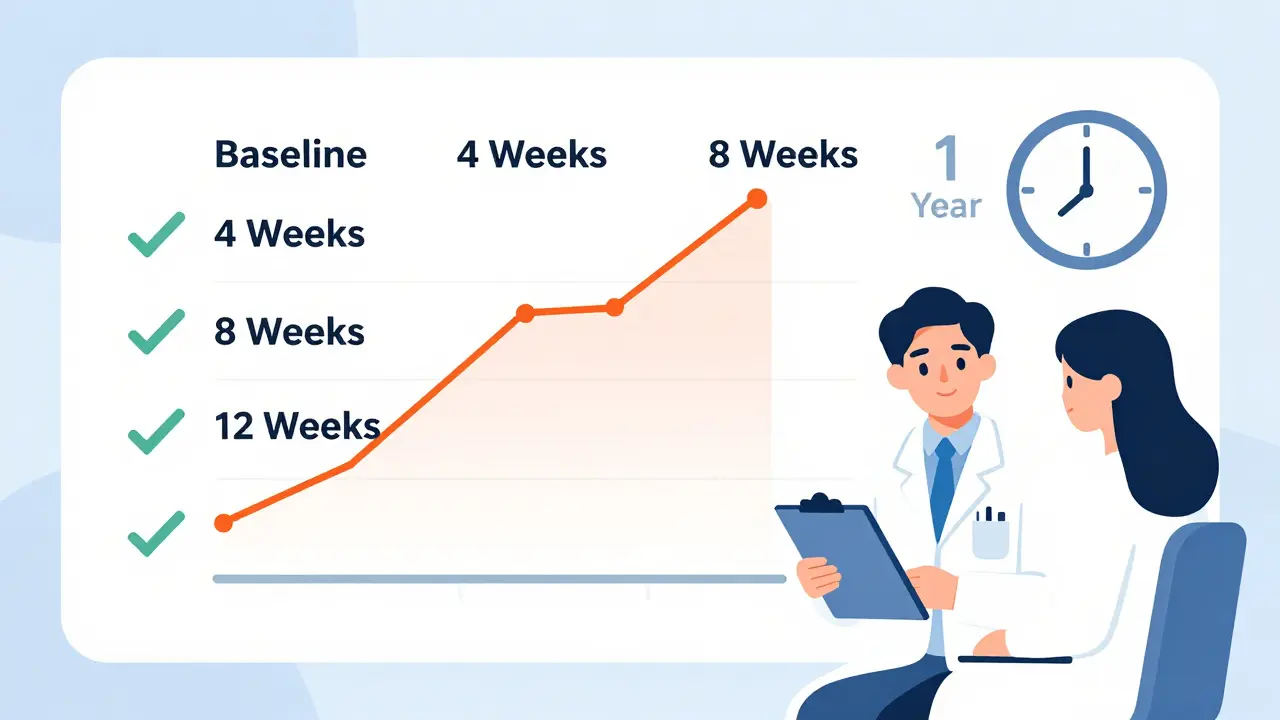
The American Psychiatric Association and the American Diabetes Association agree: every person starting an antipsychotic needs a full metabolic baseline-and ongoing checks. Not optional. Not "if you feel like it." Mandatory. Here’s what you need, and when:- Before starting: Weight, waist size, blood pressure, fasting glucose, and lipid panel (cholesterol and triglycerides).
- At 4, 8, and 12 weeks: Repeat all measurements. This is when most weight gain and glucose spikes happen.
- Every 3 months for the first year: Keep tracking weight and blood pressure. Blood tests every 6 months.
- After the first year: At least once a year. More often if you’re on high-risk meds or have other risk factors like family history of diabetes.
Real Stories: The Human Cost
On Reddit, a user named AnxiousMedUser wrote: "I gained 45 pounds in six months on olanzapine. I had to switch to aripiprazole-even though it didn’t control my psychosis as well-because I couldn’t stand how I looked or felt. My doctor never mentioned monitoring. I only found out I had prediabetes because I went to the ER for chest pain." A UK mental health charity shared similar stories. One woman stopped her medication because she gained 30kg in a year and developed prediabetes. Her psychiatrist never checked her blood sugar. But not everyone sees it as a dealbreaker. A 2022 survey of clozapine users found that 82% said the weight gain and health risks were "worth it" because their psychosis was finally under control. That’s the brutal trade-off: mental stability versus physical health.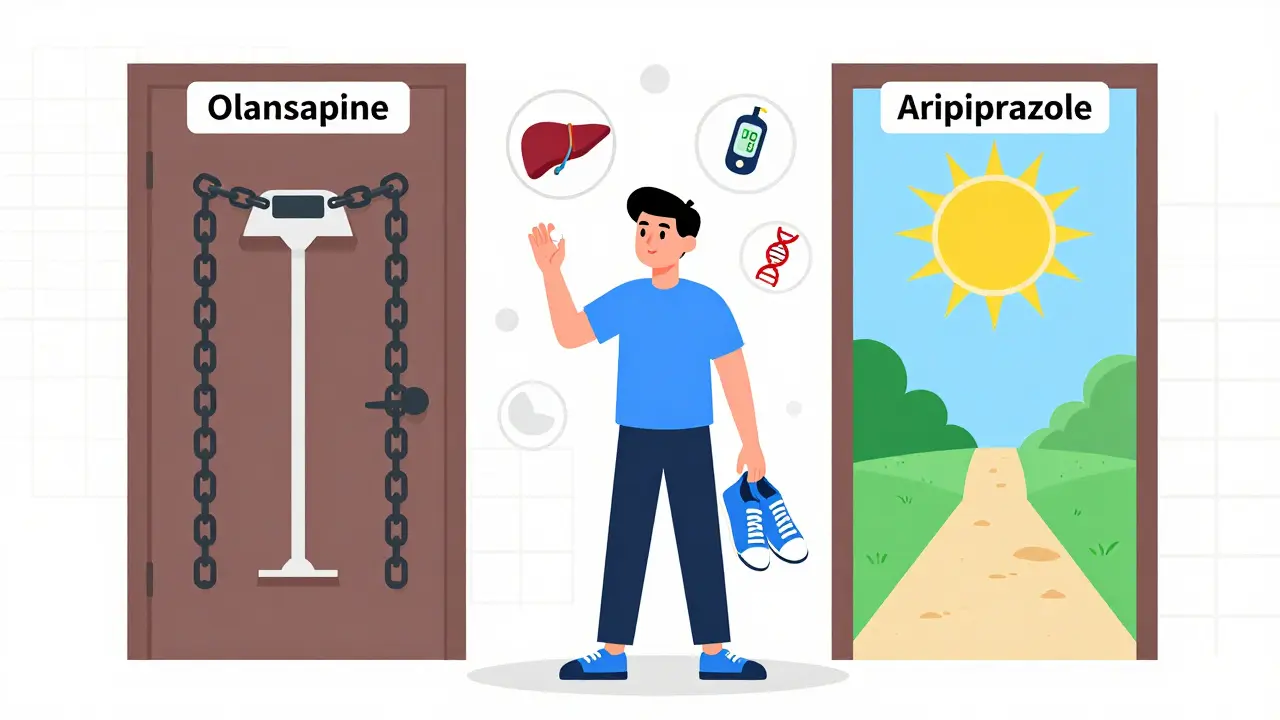
What Can Be Done? Solutions That Work
You don’t have to accept this. There are real ways to reduce the damage.- Switch meds: If you’re on olanzapine or clozapine and gaining weight fast, ask about switching to aripiprazole or lurasidone. The trade-off in symptom control is often smaller than people think.
- Lifestyle changes: A 2021 study in Massachusetts showed that combining regular exercise, nutrition counseling, and group support reduced weight gain by 50% in patients on antipsychotics. You don’t need to run a marathon-just 30 minutes of walking five times a week helps.
- Medication to help: Metformin, a common diabetes drug, has been shown to prevent or reverse weight gain and insulin resistance in people on antipsychotics. It’s safe, cheap, and often covered by insurance.
- Integrated care: The best results come when your psychiatrist works with your primary care doctor. One system, Kaiser Permanente, cut metabolic complications by 25% after setting up shared records and joint follow-ups.
The Future: New Drugs and Better Tools
There’s hope on the horizon. In 2023, the FDA approved lumateperone (Caplyta), a new antipsychotic with a metabolic profile similar to aripiprazole. In trials, only 3.5% of users gained weight-compared to 23.7% on olanzapine. This is the first major breakthrough in a decade. The National Institute of Mental Health is now funding a $12.5 million study to find genetic markers that predict who’s most likely to gain weight or develop diabetes on antipsychotics. By 2025, we might be able to match patients to the safest drug based on their DNA. But until then, the responsibility falls on you and your care team. If you’re on an antipsychotic, ask: "Have you checked my blood sugar? My waist? My cholesterol?" If the answer is no, push for it. Your mental health matters. But so does your heart.Do all antipsychotics cause weight gain?
No. While many antipsychotics do cause weight gain, the risk varies widely. Olanzapine and clozapine are the worst offenders, with up to 30% of users gaining 7% or more of their body weight. In contrast, aripiprazole, ziprasidone, and lurasidone cause minimal weight gain-often less than 5% of users. The difference comes down to how each drug interacts with brain receptors that control appetite and metabolism.
Can antipsychotics cause diabetes even if I don’t gain weight?
Yes. Some antipsychotics, especially olanzapine and clozapine, directly interfere with insulin signaling in the body. This means your cells can’t absorb glucose properly-even if your weight stays the same. Studies show patients on these drugs develop high blood sugar and insulin resistance independent of weight gain. That’s why checking blood sugar levels is critical, regardless of your body size.
How often should I get blood tests if I’m on an antipsychotic?
Baseline tests should be done before you start the medication. Then, repeat them at 4, 8, and 12 weeks. After that, check fasting glucose and lipids every 6 months for the first year. Once you’re stable, annual testing is the minimum. If you’re on a high-risk drug like olanzapine or have other risk factors (like family history of diabetes), your doctor should test you more often.
Is it safe to stop my antipsychotic because of weight gain?
Never stop taking an antipsychotic without talking to your doctor. Stopping suddenly can cause a dangerous relapse of psychosis. Instead, ask about switching to a medication with lower metabolic risk-like aripiprazole or lurasidone. Many patients find symptom control remains strong, even after switching. Your doctor can also help you manage weight gain with lifestyle changes or medications like metformin.
Can lifestyle changes really make a difference?
Absolutely. A 2021 program at Massachusetts General Hospital showed that combining nutrition counseling, regular physical activity, and group support cut weight gain in half among patients on antipsychotics. Even small changes-like walking 30 minutes a day, cutting sugary drinks, and eating more vegetables-can significantly lower your risk of diabetes and heart disease. Lifestyle isn’t a substitute for medication, but it’s a powerful tool to protect your body.
Why don’t more psychiatrists monitor metabolic health?
Many psychiatrists are focused on managing psychosis and don’t have the time, training, or systems to track metabolic health. Some don’t know the guidelines. Others assume patients will see their primary care doctor-but in reality, many patients don’t have regular access to primary care. Fragmented healthcare systems make it easy for these risks to fall through the cracks. That’s why it’s up to you to ask: "What are you checking?"




Milad Jawabra March 5, 2026
Yo, if you're on olanzapine and not getting checked for blood sugar, you're playing Russian roulette with your pancreas. 🤯 I've seen it firsthand - buddy gained 60 lbs in 8 months, started having chest pains, and his doc just shrugged. Switched to aripiprazole and his HbA1c dropped from 6.8 to 5.4 in 3 months. Stop accepting this as "normal." You deserve better. 🚨
Megan Nayak March 6, 2026
How ironic. We’ve spent decades pathologizing "obesity" as a moral failing, yet we hand out drugs that *cause* it - then blame the patient for not "eating less." The real diagnosis here isn't schizophrenia. It's capitalism. 🤡
Divya Mallick March 7, 2026
Let me tell you something - in India, we don't have this luxury. Our psychiatrists don't even have glucose monitors. They give you clozapine because it's the only thing that works, then say "eat less rice." 😂 Meanwhile, your cousin in Toronto is getting metformin, dietitians, and monthly labs. This isn't medical care - it's a global class war wrapped in white coats. 🇮🇳💔
RacRac Rachel March 9, 2026
Yessss this is so important!! 💖 I'm so glad someone finally broke this down. My sister switched from risperidone to lurasidone and lost 22 lbs in 4 months without changing a thing besides meds. She's finally sleeping again, not crying every morning. Please, if you're reading this - ask your doctor about alternatives. You're worth the effort. 🌈✨
Jane Ryan Ryder March 10, 2026
Wow. Who knew antipsychotics could be this dangerous? Next you'll tell me water can drown you.
Callum Duffy March 12, 2026
While the data presented is compelling and aligns with current clinical guidelines, one must consider the heterogeneity of patient populations and the limitations of observational studies. The correlation between SGA use and metabolic syndrome does not inherently imply causation without controlling for confounding variables such as socioeconomic status, diet, and pre-existing comorbidities. A more nuanced interpretation is warranted.
Chris Beckman March 13, 2026
lol i had olanzapine for 3 months and gained 15lbs. my dr said "just work out more" like im gonna run a marathon when i can barely get outta bed. also why is everyone on here acting like this is news? i've been telling people this for years. its not rocket science. also metformin is for diabetics not lazy people. 🤦♂️
Levi Viloria March 14, 2026
As someone who grew up in a household where mental illness was treated like a curse, I’ve seen how little we prioritize the body when we’re trying to fix the mind. The fact that we’re still treating psychosis like a war to be won - and the body like collateral damage - says more about our culture than our medicine. I’m not saying stop the meds. I’m saying: heal the whole person. Not just the symptoms.
Richard Elric5111 March 15, 2026
One cannot help but reflect upon the epistemological paradox inherent in contemporary psychiatric practice: the very pharmacological agents designed to restore cognitive coherence simultaneously induce systemic metabolic disarray. This represents not merely a pharmacological side effect, but a profound ontological tension between the Cartesian mind-body dualism and the emerging biopsychosocial paradigm. The patient, in this context, becomes both subject and object of medical intervention - a living contradiction.
Dean Jones March 15, 2026
Look, I’ve been on antipsychotics for 12 years. I started on risperidone, then moved to olanzapine, then quetiapine. I gained 80 pounds. I developed prediabetes. My blood pressure is now 148/92. My doctor said "you just need to eat better." I’m 34. I can’t climb stairs without gasping. I can’t fit into jeans. I can’t look in the mirror. I’ve tried walking. I’ve tried keto. I’ve tried intermittent fasting. Nothing works when the drug is actively blocking your body’s ability to metabolize food. And now you’re telling me to switch to aripiprazole? Fine. But what happens when it stops working? What’s next? Aripiprazole 2.0? This isn’t a treatment plan - it’s a revolving door of slow suicide. And the system doesn’t care because you’re "just" a psychotic. You’re not a person. You’re a diagnosis with a side effect profile.
Betsy Silverman March 15, 2026
This is such a vital post. I wish every psychiatrist read this. My best friend was on clozapine for years and never got a single blood test. She only found out she had metabolic syndrome when she collapsed at work. Now she’s on lurasidone, takes metformin, and goes to a weekly support group. She’s alive. And she’s happy. Please, if you’re reading this - don’t wait for a crisis. Ask for help. You’re not being dramatic. You’re being smart.
Ivan Viktor March 16, 2026
So... you're saying we should give people a drug that makes them gain weight, then give them another drug to fix the weight gain? Brilliant. Next up: giving people a pill to make them thirsty, then a pill to make them not thirsty. Classic medicine.
Zacharia Reda March 18, 2026
Just curious - if you’re on a high-risk antipsychotic and your doctor isn’t monitoring you, who’s responsible? The doc? The system? Or the patient who’s too scared to speak up? I’ve worked in mental health long enough to know: silence kills. And it’s not because people don’t care. It’s because they don’t know how to ask. So here’s your permission: ask. Again. And again. Until they listen.
Jeff Card March 19, 2026
I’m a former patient. I was on olanzapine. I didn’t know I was gaining weight until my mom cried when she saw me. I didn’t know I had prediabetes until I passed out at work. My doctor didn’t check anything. I didn’t know to ask. Now I’m on aripiprazole. I walk every day. I eat vegetables. I’m not "cured." But I’m alive. And I’m not alone. If you’re reading this - you’re not alone either. You matter. Your body matters. Ask. Please.