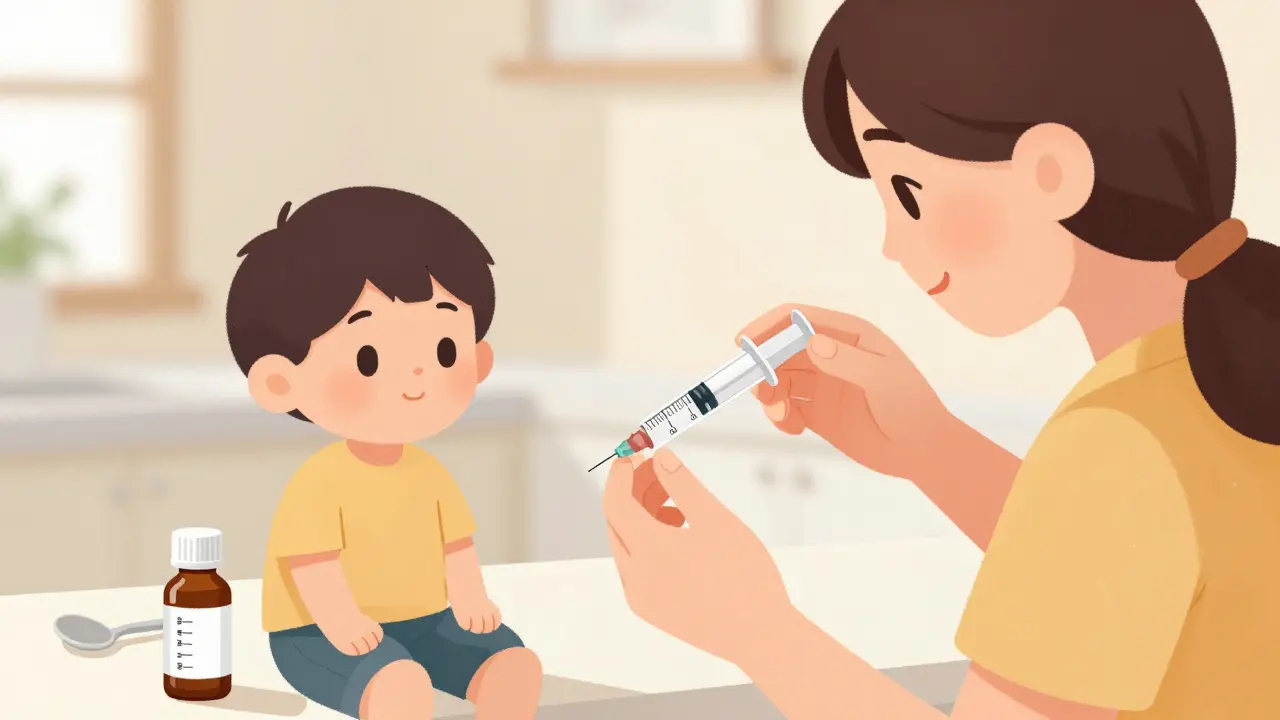
Getting the right dose of medicine for your child isn’t just important-it can be life-saving. Too little and the infection won’t clear. Too much, and you could send your child to the emergency room. The truth? Most parents don’t measure liquid medicine correctly. In fact, about 7 in 10 people make mistakes when giving kids liquid meds at home. And it’s not because they’re careless. It’s because the system is confusing.
Why Milliliters (mL) Are the Only Measurement That Matters
You’ve probably seen a bottle that says "give 1 tsp" or "2 tbsp." That’s a problem. Teaspoons and tablespoons aren’t exact. A kitchen teaspoon can hold anywhere from 3.9 to 7.3 milliliters-way off from the standard 5 mL. That’s why the CDC, the American Academy of Pediatrics, and every major pediatric pharmacy now say: use only milliliters (mL).Doctors and pharmacists are supposed to write prescriptions in mL. But too often, labels still mix in teaspoons. That’s dangerous. One study found that using tools marked only in mL cuts dosing errors by 42%. Why? Because parents don’t have to guess. No more confusing "tsp" with "mL." No more thinking "a spoonful is a spoonful."
And here’s the scary part: 0.5 mL is not the same as 5 mL. That’s a tenfold difference. A child who gets 5 mL instead of 0.5 mL of a strong antibiotic or fever reducer could suffer serious harm. That’s not a typo. That’s a real mistake that happens every day.
Which Tool Should You Use? Oral Syringe Wins Every Time
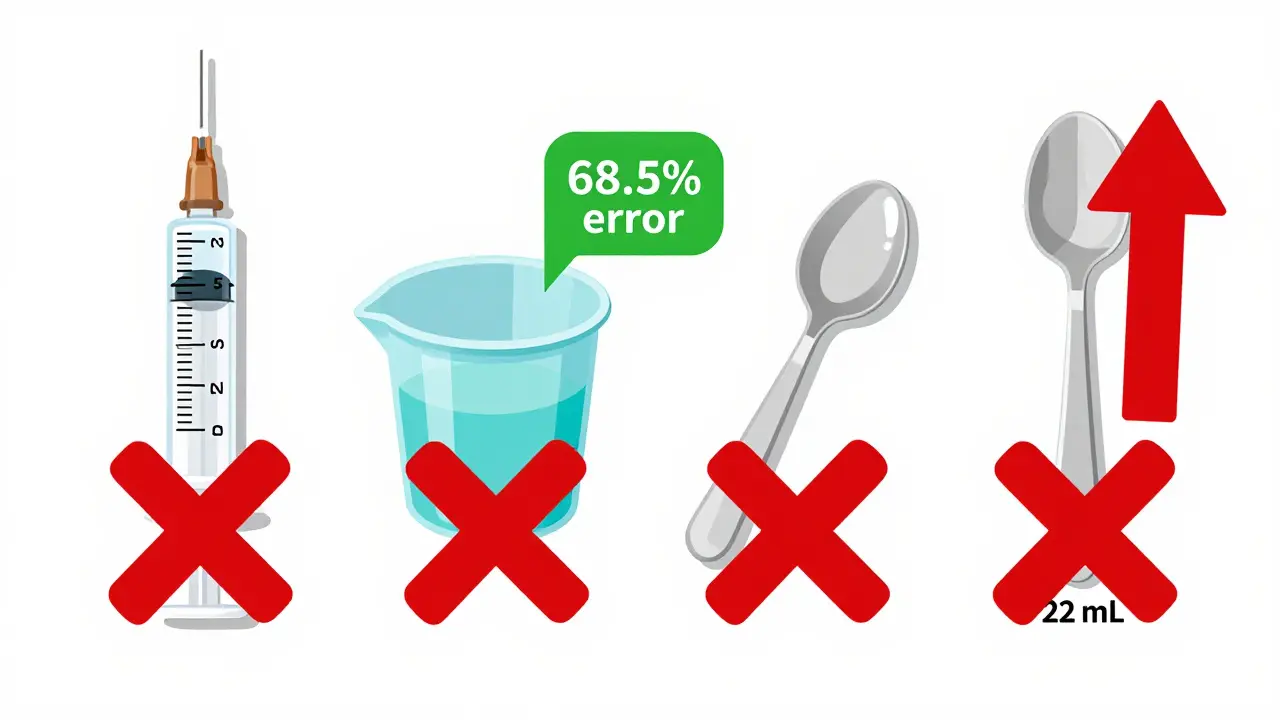
Not all measuring tools are created equal. Here’s what works best:- Oral syringe (1-10 mL): The gold standard. Accurate to within 2% when used properly. Best for doses under 5 mL. Works for babies and toddlers who can’t drink from a cup.
- Dosing cup: Okay for older kids who can drink directly from it. But error rates jump to 68.5% for doses like 2.5 mL. Too easy to spill or misread.
- Dosing spoon: Better than a kitchen spoon, but still inaccurate. Only about 82% accurate.
- Kitchen spoon: Never use it. A tablespoon can be 15 mL-or 22 mL. That’s a 50% error right there.
Studies show oral syringes are 94% accurate. Dosing cups? Only 76%. That’s a huge gap. If your child’s dose is less than 5 mL-like most antibiotics or fever reducers-use an oral syringe. Always.
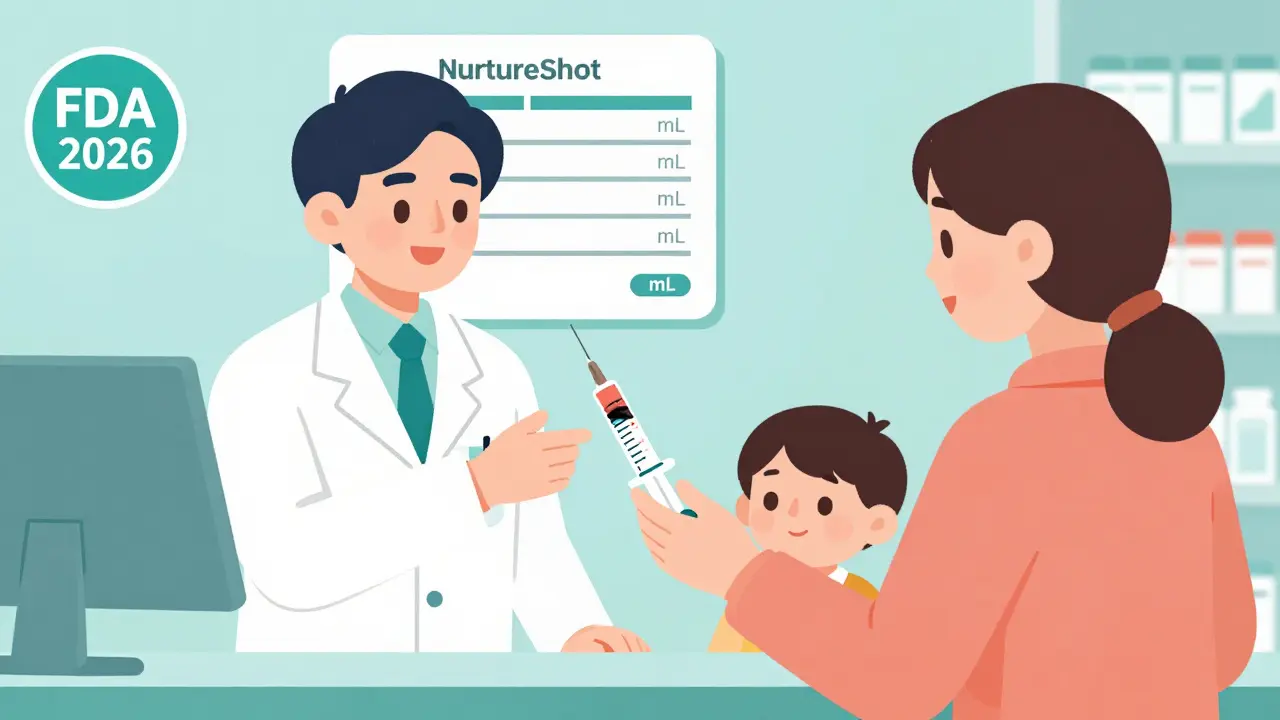
Some syringes come color-coded by dose (like NurtureShot), which helps reduce mistakes by over 60%. Hospitals are starting to hand these out at discharge. If yours didn’t, ask for one. They’re cheap-usually under $15-and often available at pharmacies for free.
How to Measure Liquid Medicine Like a Pro
Even the best tool won’t help if you don’t use it right. Here’s how to get it perfect every time:- Read the label. Is the dose written in mL? If it says "tsp" or "tbsp," ask the pharmacist to rewrite it in mL. Don’t guess.
- Use the syringe that came with the medicine. Don’t swap it out for another one. Each syringe is calibrated for that specific bottle.
- Shake the bottle. Liquid meds like antibiotics often settle. If you don’t shake, your child gets less medicine. One study found 30-50% under-dosing happened because parents skipped this step.
- Draw the medicine slowly. Hold the syringe upright. Pull the plunger until the top edge of the black ring lines up with your dose mark. Don’t look from above-get eye level.
- Check the meniscus. The liquid will curve slightly. Read the measurement at the bottom of that curve, not the top.
- Give it slowly. Put the tip of the syringe inside the cheek, not the front of the mouth. Gently push the plunger. This stops kids from spitting it out.
- Wash the syringe. Rinse with water after each use. Don’t soak it in hot water-some plastic syringes warp.
Pro tip: If your child gets the same dose every day, use a permanent marker to mark the syringe at that level. That way, you don’t have to read the numbers every time.
Weight-Based Dosing: What You Need to Know
Many children’s meds are dosed by weight-not age. That means you need to convert pounds to kilograms. Here’s the math:1 kg = 2.2 lb
Example: Your child weighs 22 pounds. Divide by 2.2 → 10 kg. If the doctor prescribed 40 mg per kg per day, that’s 400 mg total per day. If it’s split into two doses, each dose is 200 mg.
Now check the concentration on the bottle: "400 mg per 5 mL." So 200 mg = 2.5 mL. That’s your dose.
If you’re not sure how to calculate it, ask the pharmacist to write the dose in mL on the label. Don’t do the math yourself unless you’re confident. Many apps now do this for you-like MedSafety from Cincinnati Children’s Hospital. They use your child’s weight and the medication name to give you the exact mL dose.
What to Do When Your Child Refuses Medicine
About 68% of parents say their child spits out or refuses liquid meds. Here’s what works:- Use a syringe to squirt it into the cheek, not the tongue.
- Mix the dose with a small spoonful of apple sauce, yogurt, or pudding. Don’t mix it into a full bottle or cup-you won’t know if they drank it all.
- Try flavored versions. Some pharmacies offer custom flavoring (like grape or bubblegum) for a small fee.
- Don’t force it. If your child gags or chokes, stop. Try again later. Stress makes it worse.
Never hide medicine in a full drink like juice or milk. If they don’t finish it, they miss the dose. And never use a syringe to squirt it into the throat-it can cause choking.
Common Mistakes (And How to Avoid Them)
Here are the top errors parents make-and how to fix them:- Mixing up mg and mL: This is the #1 error. mg is the amount of drug. mL is the volume of liquid. They’re not the same. Always check both numbers on the label.
- Using a kitchen spoon: It’s not accurate. Throw it out. Use the syringe.
- Not shaking the bottle: The medicine sinks. Shake hard for 10 seconds before each dose.
- Using someone else’s syringe: Each syringe is made for one bottle. Don’t reuse one from another medicine.
- Forgetting to convert pounds to kg: If the dose is weight-based, you must convert. Use a calculator app if you need to.
Parents with lower health literacy are twice as likely to use dosing cups instead of syringes-not because they don’t care, but because they think cups are easier. But cups are less accurate. If you’re unsure, ask your pharmacist to demonstrate. They’ve seen this a hundred times.
What’s Changing in 2026? (And Why It Matters)
The FDA is moving toward a new rule: all pediatric liquid medications must come with a standard oral syringe marked only in mL. This is expected to roll out fully by 2026. Right now, only 78% of medications follow this standard. That number is climbing fast.Smart dosing cups with digital displays are coming soon-Philips Healthcare is testing them in hospitals. They’ll beep if you’ve drawn the wrong amount. But for now, the best tool is still the simple, cheap, plastic oral syringe.
And here’s the good news: If every family used an oral syringe and measured in mL, the U.S. could prevent over 65,000 emergency visits each year just from pediatric dosing errors. That’s not theory. That’s data from Health Affairs (2022).
Final Checklist Before Giving Medicine
Before you give your child any liquid medicine, run through this:- Is the dose written in mL? If not, call the pharmacy.
- Am I using the syringe that came with the bottle?
- Did I shake the bottle for 10 seconds?
- Am I reading the syringe at eye level?
- Did I convert weight from pounds to kg if needed?
- Is this the right medicine for my child’s symptoms?
If you answer yes to all of these, you’re doing better than 70% of parents. That’s not luck. That’s knowing how to do it right.
Can I use a kitchen teaspoon if I don’t have a syringe?
No. A kitchen teaspoon varies from 3.9 to 7.3 mL, while a standard teaspoon is 5 mL. That’s up to a 50% error. Never use kitchen utensils for children’s medicine. Use an oral syringe instead. They’re free or low-cost at most pharmacies.
What if the prescription says "1 tsp" but the bottle says "5 mL"?
Trust the mL. One teaspoon equals 5 mL, so if the label says 5 mL, that’s what you give. But ask the pharmacist to rewrite the label in mL only. Many pharmacies still use outdated labels. You have the right to ask for a clear, mL-only label.
How do I know if my child got too much medicine?
Signs of overdose include vomiting, drowsiness, trouble breathing, or unusual behavior. If you suspect an overdose, call Poison Control at 1-800-222-1222 immediately. Don’t wait for symptoms. Keep the medicine bottle handy when you call.
Can I use the same syringe for different medicines?
No. Each syringe should be used for one medicine only. Cross-contamination can cause dangerous reactions. Wash the syringe after each use, but don’t reuse it for another drug. Get a new one for each prescription.
Why do some pharmacies still use teaspoons on labels?
Because not all pharmacies have updated their systems. The FDA and CDC have pushed for mL-only labeling since 2011, but only 63% of labels follow this as of 2023. If your label still says "tsp," ask the pharmacist to change it. They’re required to provide clear instructions.



Pankaj Singh January 12, 2026
This article is pure gold. But let’s be real-most parents still use kitchen spoons because they’re lazy. 70% error rates? That’s not ignorance, it’s negligence. If you can’t measure 5 mL properly, maybe you shouldn’t be giving meds at all. Stop making excuses. Buy a $5 syringe. Or don’t. But don’t blame the system when your kid ends up in the ER.
Scottie Baker January 13, 2026
Bro. I gave my daughter amoxicillin with a measuring spoon once. She threw up for 12 hours. I thought I was being careful. Turns out, my ‘teaspoon’ held 8 mL. I almost killed her. Now I use the syringe. Every. Single. Time. And I scream at anyone who says ‘it’s just a little extra.’ It’s not. It’s poison.
Angel Molano January 14, 2026
Use a syringe. Only mL. Shake the bottle. Don’t be an idiot.
Vinaypriy Wane January 15, 2026
I’m so glad someone finally said this. I’ve been begging my pharmacist to rewrite my daughter’s prescriptions in mL-but they keep saying, ‘Oh, it’s the same.’ No, it’s not. It’s dangerous. I’ve had to go back three times just to get a clear label. Please, if you’re reading this: don’t accept ‘tsp’ on any pediatric med. Demand mL. Your child’s life isn’t a suggestion.
Diana Campos Ortiz January 16, 2026
Just wanted to say thank you for this. I’m a single mom and I was terrified of giving meds wrong. I used to wing it with a spoon. Now I use the syringe, shake the bottle like my life depends on it (because it kinda does), and read the label like a lawyer. I’m not perfect, but I’m way better than 70% of parents. That’s something.
Jesse Ibarra January 18, 2026
Let me be the first to say this: the FDA is 15 years too late. This isn’t innovation-it’s basic hygiene. Why are we still having this conversation in 2024? Because hospitals, pharmacies, and doctors are still stuck in the 1990s. I’ve seen labels that say ‘1 tsp’ and ‘5 mL’ side by side. That’s not incompetence-that’s malpractice. And if you’re still using a kitchen spoon? You’re not a parent. You’re a liability.
laura Drever January 19, 2026
synges r gud. spoons bad. shake it. lol.
jefferson fernandes January 19, 2026
To everyone who says, ‘I’ve never had a problem’-you’re lucky, not smart. This isn’t about luck. It’s about systems. We’ve known since 2011 that mL-only labeling reduces errors by 42%. And yet, we still let parents guess. That’s not healthcare-it’s Russian roulette with a toddler. If you’re a pharmacist, doctor, or parent: stop normalizing inaccuracy. Demand the syringe. Teach others. This isn’t optional. It’s a moral duty.
James Castner January 20, 2026
There’s a deeper philosophical layer here, one that transcends the mechanics of dosage measurement. We live in a culture that glorifies convenience over precision, intuition over science, and trust over verification. When we allow a kitchen spoon to become a medical instrument, we are not merely making a measurement error-we are surrendering our responsibility as caregivers to the seductive illusion of ‘close enough.’ The oral syringe, humble as it is, represents a return to epistemic humility: the recognition that our senses are fallible, our assumptions dangerous, and our love for our children must be expressed through discipline, not intuition. The 65,000 ER visits aren’t just statistics-they are the cumulative cost of a society that has forgotten how to be careful.
Rosalee Vanness January 22, 2026
I used to be the mom who just guessed. I’d eyeball it, shake the bottle half-heartedly, and pray. Then my son got sick for the third time in a month-and the pediatrician asked if I’d been shaking the medicine. I said, ‘What?’ Turns out, the antibiotic had settled. He was getting 30% less than he needed. That day changed everything. Now I have a little ritual: shake like I’m trying to win a dance-off, read the syringe at eye level, and give it in the cheek like a pro. I even marked my syringe with a Sharpie. My kid’s healthy now. And honestly? I feel like a superhero. You can do this too. You don’t need to be perfect-you just need to care enough to try.