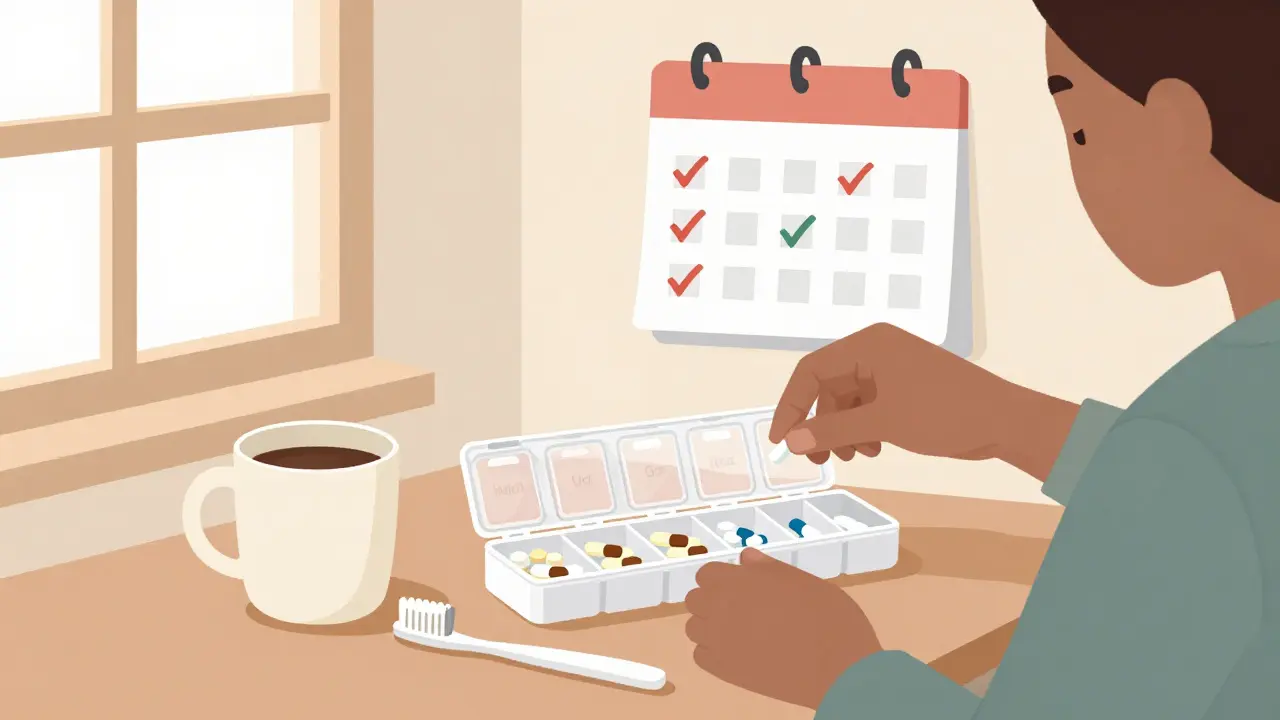
Setting goals for taking your meds isn’t just about remembering to swallow a pill. It’s about building a habit that fits into your real life - not the ideal one you think you should have. Too many people try to jump from never taking their medicine to a rigid 7-day-a-week routine. It rarely works. But when goals are achievable, specific, and tied to real progress, adherence improves - sometimes dramatically.
Why Most Medication Goals Fail
You’ve probably heard the advice: "Take your pill every day." Sounds simple, right? But if you work two jobs, forget things easily, or can’t afford to refill your prescription on time, that advice doesn’t help. Studies show that up to 50% of people with chronic conditions don’t take their meds as prescribed. And the biggest reason? Goals that are too vague, too big, or ignore real-life barriers.
Self-reported adherence is notoriously unreliable. People think they’re doing better than they are. One study found patients overestimate their pill-taking by 30-40%. That’s why tracking matters - not just to feel good, but to catch patterns before things fall apart.
Use SMART Goals - But Make Them Real
The SMART framework (Specific, Measurable, Achievable, Relevant, Time-bound) isn’t just for business. It’s been adapted for healthcare because it works. But here’s the catch: most people use it wrong. Let’s break it down the way real patients use it.
- Specific: Don’t say, "I’ll take my blood pressure pill." Say, "I’ll take my lisinopril 10mg at 7 a.m. with my morning coffee, right after brushing my teeth." Linking it to a daily ritual makes it stick.
- Measurable: What does success look like? Are you counting pills? Using a smart bottle that logs openings? Tracking refills? Pick one method and stick with it. Pharmacy refill records show 85% reliability. Smart pill bottles? 98%.
- Achievable: If you work nights, don’t set a goal to take meds at 8 a.m. Adjust the time. If you can’t afford refills, talk to your pharmacist about samples or discounts. A goal that ignores cost, transportation, or memory issues will fail.
- Relevant: Why does this matter to YOU? Not your doctor. Not your family. You. Maybe you want to stop feeling dizzy. Maybe you want to walk your dog without getting winded. Tie the goal to something personal.
- Time-bound: "I’ll take my meds every day" is too loose. Try: "I’ll hit 90% adherence for the next 30 days." Then, check in every Friday. Small windows work better than long, vague deadlines.
A 2023 study from Vozo Health showed patients who used SMART goals improved adherence by 35%. But only when they were co-created with the patient - not handed down.
Track Progress With Real Tools
You don’t need a fancy app. But you do need a way to see if you’re moving forward. Here are the most practical ways:
- Smart pill bottles: Devices like Hero or MedMinder log when the bottle opens. They send alerts if you miss a dose. Accuracy? Nearly perfect - 98%.
- Pharmacy refill records: Your pharmacy tracks when you pick up prescriptions. If you’re 10 days late on a 30-day supply, you’re falling behind. This is a silent, reliable metric.
- Simple paper tracker: Print a calendar. Put a checkmark for each day you take your meds. Seeing a streak builds motivation. A 2023 survey found 78% of patients preferred visual charts over text alerts.
- Digital health apps: Apps like Medisafe or MyTherapy send reminders and let you log doses. They sync with Apple Health or Google Fit. But if you’re over 65, 52% abandon them within 30 days. Simpler is better for older adults.
Don’t overcomplicate it. One method, used consistently, beats five apps you never open.
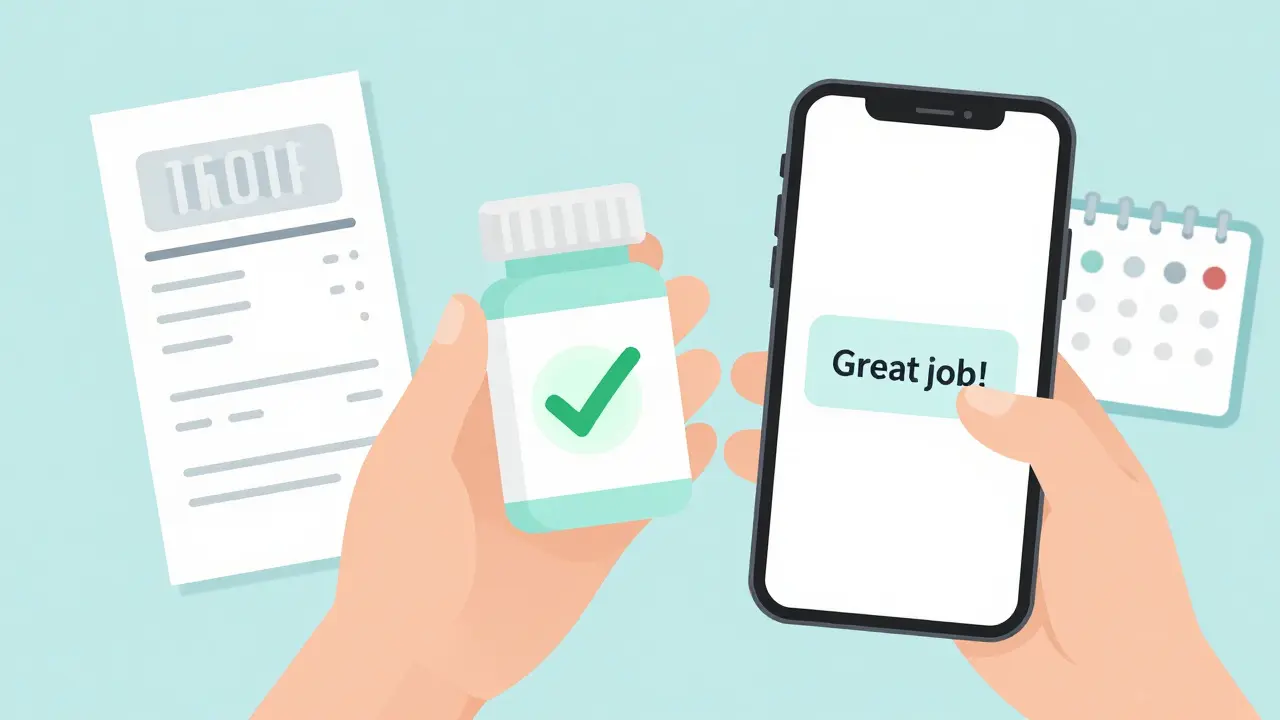
Start Small - Celebrate Tiny Wins
Trying to go from 20% adherence to 100% in a week? Impossible. Try this: aim for 70%. That’s 5 out of 7 days. If you hit it for a week, celebrate. Not with a cake - with a sticker, a note to yourself, or five extra minutes of quiet coffee.
A diabetes educator in Melbourne shared a story: Mrs. Johnson was supposed to lose 20 pounds. She couldn’t even weigh herself weekly. So they started with: "Weigh in twice this week." She did. They gave her a sticker. Next week, she weighed in five times. The goal didn’t change - the behavior did. Small wins build confidence. Confidence builds consistency.
Anticipate the Barriers - Before They Happen
Before you set a goal, ask: What’s stopping me?
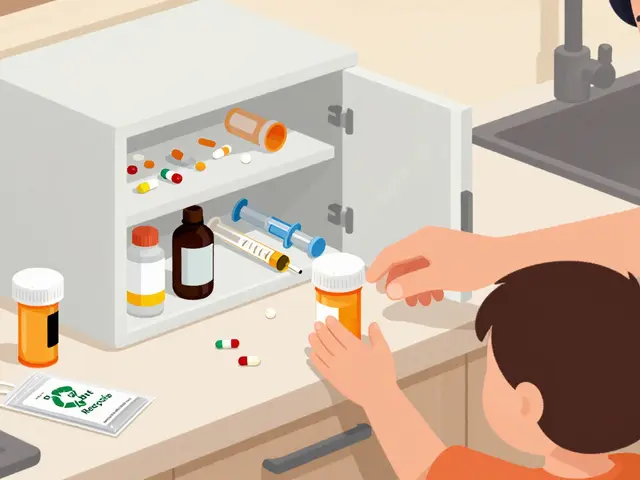
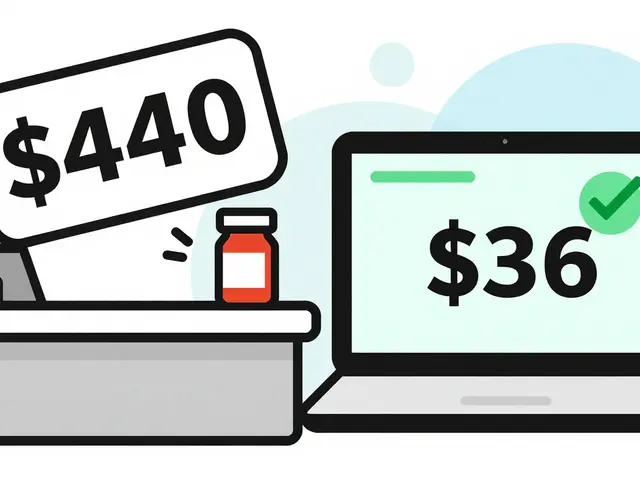
- Cost? Talk to your pharmacist about generic options or patient assistance programs.
- Side effects? Don’t quit. Talk to your doctor. Maybe the dose can be adjusted.
- Memory? Set alarms. Put pills next to your toothbrush. Use a pill box with days labeled.
- Transportation? Ask if your pharmacy delivers. Many do - especially for chronic meds.
- Confusion? Ask your doctor to write down instructions in plain language. No jargon.
There’s a newer version of SMART called B-SMART. The "B" stands for Barriers. You identify them first. Then you build the goal around them. It’s not about forcing yourself to fit the goal. It’s about fitting the goal to you.
What to Do When You Slip Up
You missed three days. You’re not failing. You’re human.
The goal isn’t perfection. It’s progress. If you miss a dose, don’t guilt-trip yourself. Ask: "What changed?" Did you run out of pills? Were you traveling? Did you feel too tired? Use that info to adjust your plan. Maybe you need a backup pill box in your bag. Maybe you need a refill reminder on your phone.
Studies show that people who respond to slip-ups with problem-solving - not shame - are 3x more likely to get back on track.
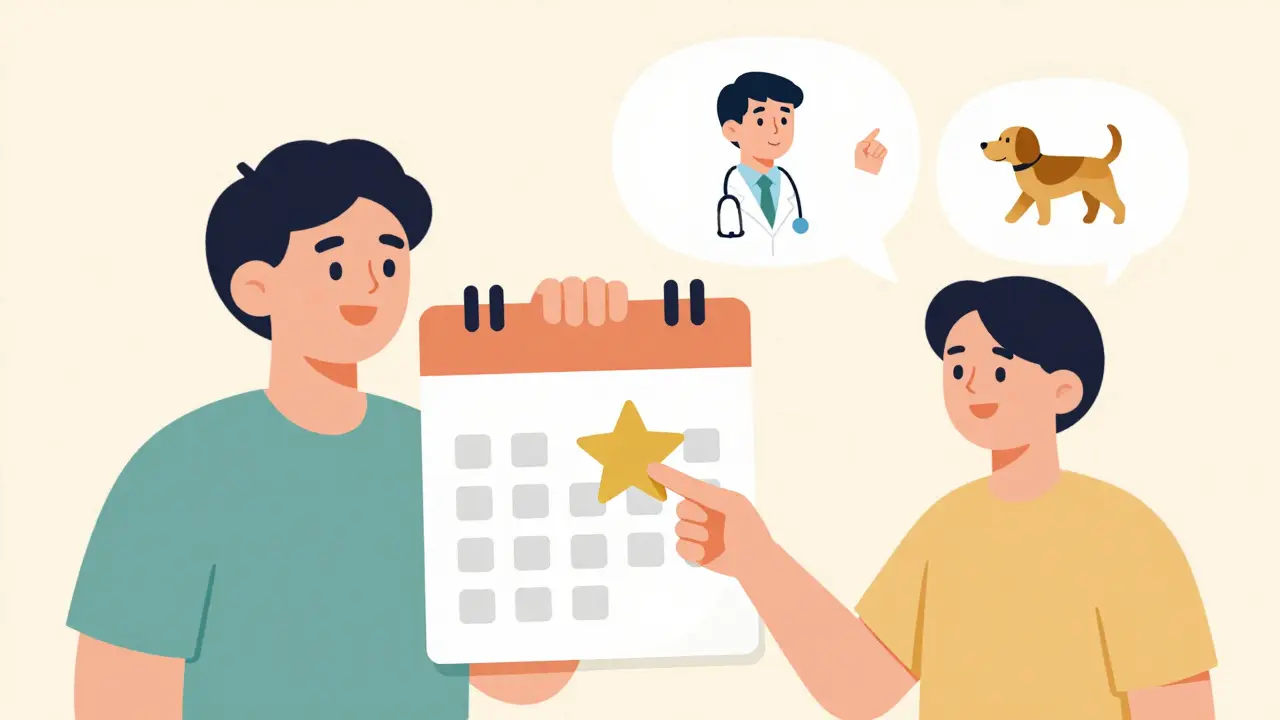
How Providers Can Help (Even If You’re on Your Own)
You don’t need to wait for your doctor to fix this. But if you’re seeing a provider, ask them:
- "Can we write down my medication goal together?"
- "What’s one way I can track this that’s simple?"
- "Are there tools or programs that help with refill reminders?"
Many clinics now use EHR-integrated tools that auto-track refill gaps and flag patients who are falling behind. But if yours doesn’t, you can still do it yourself. Bring your tracker to your next appointment. Show them your calendar. They’ll be impressed - and more likely to support you.
What’s New in 2026?
Technology is catching up. In 2025, AI tools started predicting when someone is likely to miss a dose - 14 days in advance - by analyzing patterns in refill timing, weather, and even local pharmacy wait times. By 2026, all major electronic health records (EHRs) will be required to include standardized fields for adherence goals. That means your doctor’s system will soon ask: "What’s your adherence goal?" - not just "Are you taking your meds?" Ingestible sensors are being tested in Australia. These tiny chips, swallowed with your pill, send a signal to a patch on your skin. They’re accurate - 94% - but still expensive. For now, smart bottles and refill tracking are more practical for most people.
Final Thought: It’s Not About Compliance. It’s About Control.
Medication adherence isn’t about obeying a doctor. It’s about reclaiming control over your health. When you set a goal you can actually reach, track it in a way that makes sense, and celebrate small progress - you’re not just taking pills. You’re building a life you can manage. And that’s worth more than any app or gadget.
What’s the best way to track if I’m taking my medication?
The best way depends on your lifestyle. For most people, a simple pill box with days of the week labeled + a calendar with checkmarks works better than apps. If you’re tech-savvy, a smart pill bottle like Hero or MedMinder logs every opening and sends alerts. Pharmacy refill records are also highly reliable - if you’re 10 days late on a 30-day supply, you’re behind. Avoid self-reporting - it’s inaccurate.
How do I set a goal if I can’t afford my meds?
Affordability is a real barrier - and it should be part of your goal. Talk to your pharmacist about generic versions, patient assistance programs, or mail-order options. Some pharmacies offer 90-day supplies at lower cost. Your goal shouldn’t be "take every pill" - it should be "get consistent access." That might mean switching to a cheaper drug, using samples, or applying for government aid. Don’t skip meds because you can’t pay. Ask for help.
Is it okay to use an app to track my meds?
Yes - if you’ll actually use it. Apps like Medisafe, MyTherapy, or even Apple Health reminders work well for people who already use smartphones daily. But if you’re over 65 or not comfortable with tech, a paper tracker or smart pill bottle is better. Don’t add stress by using something you’ll quit after a week. Simplicity beats sophistication.
What if I forget my meds one day? Am I failing?
No. Missing one dose doesn’t mean you failed. What matters is how you respond. If you missed because you were traveling, maybe you need a travel pill box. If you forgot because you didn’t link it to a habit, try taking it with breakfast or brushing your teeth. Use the slip-up to improve your system - not to feel guilty. Progress isn’t linear.
How long should I stick with a goal before changing it?
Give it 30 days. That’s long enough to form a habit, short enough to adjust if it’s not working. After a month, review: Did you hit your target? What got in the way? Adjust the goal, not your effort. If your goal was "take 5 days a week" and you hit 4, maybe try 4.5 - and celebrate that. Small, steady wins last longer than big, unsustainable pushes.
Do doctors really care if I track my adherence?
Yes - more than you think. By 2026, health systems will be required to track adherence for chronic conditions like diabetes and hypertension. Doctors aren’t judging you. They’re trying to avoid hospitalizations. If you bring your tracker to your appointment - even a handwritten calendar - they’ll see you’re engaged. That leads to better care, more time, and fewer tests.
Setting and tracking adherence goals isn’t about perfection. It’s about building a system that works for your life - not someone else’s. Start small. Track simply. Adjust often. And remember: every pill you take on time is a step toward feeling better - not just following orders.




Aisling Maguire March 2, 2026
I love how this breaks it down without the usual corporate fluff. I used a pill box with checkmarks for my BP meds and honestly? Seeing that streak grow felt like winning at life. No app needed. Just me, my coffee, and a Sharpie. 30 days in and I haven't missed one. Small wins, baby.
Sumit Mohan Saxena March 2, 2026
The application of SMART goals in clinical adherence is empirically validated. However, the emphasis on behavioral anchoring-linking medication intake to established diurnal routines-is supported by reinforcement learning models in behavioral psychology. Pharmacy refill data, as cited, demonstrates a 85% correlation with self-reported adherence, making it a robust proxy metric in longitudinal studies.
Brandon Vasquez March 2, 2026
I’ve helped dozens of patients set these kinds of goals. The key isn’t the tool-it’s the conversation. Ask them what matters. Not what the doctor says. What do they want? Then build from there. One step. One day. That’s how change sticks.
Vikas Meshram March 4, 2026
You people are too soft. If you can’t take your meds on time, you’re just lazy. No excuses. I take 7 pills a day, every single day, rain or shine. No apps. No stickers. Just discipline. Your ‘small wins’ are just enabling weakness. Get your act together.
Ben Estella March 6, 2026
This is why America’s healthcare is broken. You’re giving people candy-coated pep talks instead of real solutions. If you can’t afford your meds, get a second job. If you forget, get a smartwatch. Stop coddling people. Discipline. Not stickers.
Jimmy Quilty March 6, 2026
Smart bottles? Really? That’s just another way for Big Pharma to track you. I bet they’re selling your data to insurers. And ‘refill records’? That’s how they flag you as ‘non-compliant’ and raise your premiums. You’re being manipulated. The real solution? Get off the grid. Stop taking pills. Your body knows better.
bill cook March 6, 2026
I’ve been on 12 different meds for 8 years. I don’t care about goals. I don’t care about checkmarks. I just want someone to tell me why I still feel like crap. Why do I still wake up exhausted? Why do I still cry for no reason? You talk about progress but nobody talks about how this *feels*. I’m tired.
Byron Duvall March 8, 2026
AI predicting missed doses? 2026 EHR mandates? This is dystopia. They’re turning us into data points. Next thing you know, your fridge will beep when you skip a vitamin. They don’t want you healthy. They want you tracked. You’re being groomed for the next phase of the surveillance state. Wake up.
Katherine Farmer March 9, 2026
The notion that ‘simple is better’ is a dangerous oversimplification. While paper trackers have anecdotal appeal, they lack granularity. Real adherence requires granular temporal logging, contextual metadata (e.g., meal timing, stress indicators), and algorithmic feedback loops. Your ‘checkmark’ is a placebo for accountability. The future is wearable biosensors and EHR-integrated behavioral analytics.
Full Scale Webmaster March 10, 2026
I’ve been doing this for 15 years. I’ve seen it all. People think they’re being smart by using a calendar. But let me tell you-no one is tracking the emotional triggers. The missed doses aren’t about forgetting. They’re about shame. About feeling like a failure. About the 3 a.m. panic when you realize you haven’t taken your meds in two days and you’re too scared to say anything. The pill box doesn’t fix that. The sticker doesn’t fix that. Talking to someone who’s been there-that’s what fixes that. I’ve lost three friends to this silence. Don’t let it be you.
Brandie Bradshaw March 11, 2026
I think we're fundamentally misunderstanding the metaphysical dimension of adherence. It's not a behavioral problem-it's an existential one. We're conditioned to believe compliance = virtue. But what if the act of taking medication is, at its core, an act of surrender to a system that commodifies health? The goal isn't to 'track' more pills-it's to question why we need pills at all. Why must our bodies be regulated by corporate timelines, pharmacy algorithms, and doctor-imposed metrics? The real adherence is rebellion: choosing to live outside the script.
Martin Halpin March 11, 2026
You say ‘start small’? Nah. That’s the problem. You’re telling people to settle. I’ve got a cousin who took one pill a week and called it a ‘win.’ That’s not progress-that’s resignation. If you’re going to do this, do it right. 100% or nothing. No half-measures. No stickers. No ‘70% is good enough.’ Either you’re in control or you’re letting the system win. I don’t believe in ‘small wins.’ I believe in total commitment.
Charity Hanson March 11, 2026
This is beautiful! I’m from Nigeria and we don’t have smart bottles here-but we have community. My neighbors remind each other. We take pills together on Sundays. We laugh, we cheer, we celebrate. No app. No tech. Just us. You’re not alone. You’re part of a tribe. And that’s the real magic.
Noah Cline March 13, 2026
The B-SMART framework introduces a critical epistemic shift: the identification of structural barriers as primary variables in adherence modeling. This operationalizes the social determinants of health into actionable clinical parameters. The integration of cost, transportation, and cognitive load into goal-setting transforms adherence from a behavioral metric to a systems-level intervention. This is the future of precision medicine.