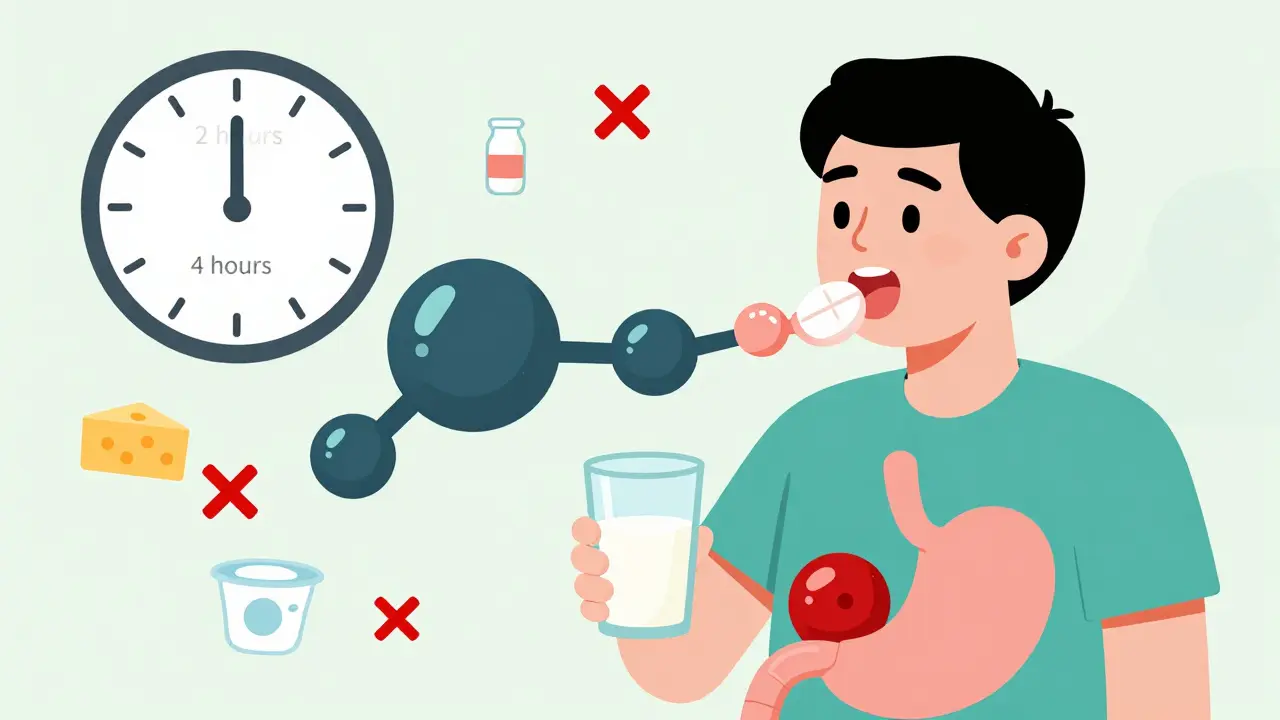
Antibiotic-Dairy Timing Calculator
Take your antibiotic with milk? You might be making a mistake that could keep the infection from going away. It’s not about allergies or digestion-it’s about chemistry. When you swallow an antibiotic like doxycycline or ciprofloxacin right after drinking a glass of milk, the calcium in that milk binds to the drug before it can get into your bloodstream. The result? You’re not getting the full dose. And if you’re not getting enough of the medicine, the bacteria might not die. That’s how resistant infections start.
Which Antibiotics Are Affected?
Not all antibiotics react the same way with dairy. The big ones to watch out for are the tetracyclines-like tetracycline, doxycycline, and minocycline-and the fluoroquinolones, such as ciprofloxacin and levofloxacin. These drugs have a chemical structure that grabs onto calcium like a magnet. When that happens, they form a solid clump in your gut that your body can’t absorb.Studies show that drinking milk with tetracycline can cut its absorption by 20% to 75%. With yogurt? It’s even worse-up to 92% less gets into your system. Fluoroquinolones aren’t far behind. Ciprofloxacin’s peak blood level drops by 30% to 36% when taken with dairy. That’s not a small drop. That’s the difference between the drug working and it not working at all.
On the other hand, many common antibiotics like amoxicillin, azithromycin, and most cephalosporins (like cefalexin) aren’t affected. You can take them with food-even with yogurt-without worrying. The problem isn’t food in general. It’s specifically calcium-rich dairy products.
Why Dairy Is the Problem (It’s Not Just Milk)
It’s not just milk. It’s everything made from cow’s milk: yogurt, cottage cheese, ice cream, sour cream, butter, whey protein shakes, even cheese on your sandwich. Yogurt is especially tricky because it has more bioavailable calcium than plain milk. That means your body absorbs the calcium faster, and it binds to the antibiotic even more aggressively.And it’s not just dairy from cows. Calcium-fortified plant milks-like almond, soy, or oat milk-can cause the same problem. If the label says “fortified with calcium,” treat it like cow’s milk. Same with antacids, calcium supplements, and even some multivitamins. They all contain calcium, and they all interfere.
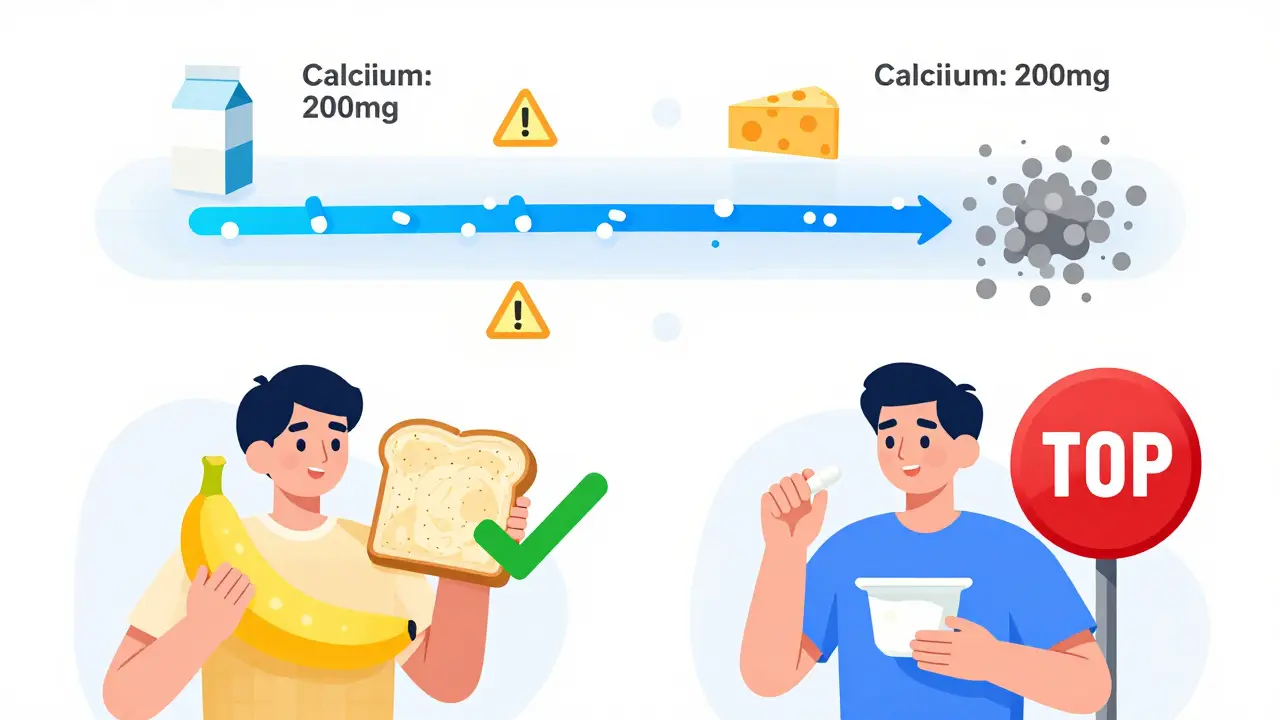
One study found that just 200 mg of calcium-about the amount in six ounces of milk-is enough to trigger this interaction. A single glass of milk or a small container of yogurt hits that mark. So even a little bit can make a big difference.
How Long Should You Wait?
Timing isn’t optional. It’s medical science.For tetracyclines, you need to wait at least 2 hours before eating or drinking dairy, and then wait another 4 hours after taking the pill. That’s right-four hours. If you take doxycycline at 7 a.m., don’t have your coffee with milk until 11 a.m. If you eat yogurt at lunch, don’t take your evening dose until after dinner, and wait four hours after eating.
Fluoroquinolones like ciprofloxacin need a slightly shorter window: at least 2 hours before or after dairy. Still strict. Still important.
Why the difference? Tetracyclines bind to calcium more tightly and form bigger, harder-to-break-down complexes. Fluoroquinolones are a bit less sticky, but still bad enough to warrant caution. The 2- and 4-hour rules aren’t guesses. They’re based on blood level studies where researchers measured exactly how much of the drug made it into the bloodstream at different time intervals after dairy consumption.
What Happens If You Ignore This?
You might not feel sick right away. But the infection won’t clear. The bacteria that survive because the antibiotic didn’t reach full strength? They’re the ones that become resistant. That’s how superbugs grow.According to the WHO, antibiotic resistance caused over 1.27 million deaths in 2021. Many of those cases involved people who didn’t take their antibiotics correctly-whether because they skipped doses, stopped early, or took them with the wrong foods.
For serious infections like Lyme disease, Rocky Mountain spotted fever, or pneumonia treated with doxycycline, a 50% drop in drug levels can be life-threatening. Even for mild infections, incomplete treatment increases the chance the infection will come back-and next time, it might need stronger, more expensive, or IV antibiotics.
One study found that 68% of patients who took tetracyclines with dairy ended up with subtherapeutic blood levels. That’s not a coincidence. That’s a pattern. And it’s preventable.
What About Side Effects? Nausea and Empty Stomachs
Yes, taking antibiotics on an empty stomach can cause nausea, stomach upset, or even vomiting. That’s why so many people reach for milk or food to feel better. But here’s the catch: you’re trading short-term comfort for long-term risk.Patients on Reddit and health forums say they’ve skipped doses or taken antibiotics with yogurt just to avoid feeling sick. One user wrote: “I took my doxycycline with my cereal and milk. I felt fine. But my sinus infection came back worse.”
There are better ways to handle nausea. Try taking the antibiotic with a small, non-dairy snack-like a banana, a few crackers, or toast with jam. Avoid anything with calcium. Stay hydrated. If nausea is a constant problem, talk to your doctor. There might be a different antibiotic that’s easier on your stomach.
What’s New? Are There Better Options?
Pharmaceutical companies know this is a problem. Newer versions of doxycycline-like doxycycline monohydrate (brand name Oracea)-are designed to be taken with food, including dairy. That’s because the formulation changes how the drug dissolves in your gut. But this doesn’t apply to all doxycycline brands. Always check the label or ask your pharmacist.Even newer antibiotics like sarecycline (Seysara), used for acne, show minimal interaction with calcium. These drugs are being designed with food interactions in mind. But they’re not yet widely used for all infections.
Right now, most of the antibiotics you’re prescribed are still affected. So the old rules still apply.

How to Get It Right Every Time
Here’s a simple plan:- Check the label or ask your pharmacist: Is this antibiotic affected by dairy?
- If yes, write down your dosing times and dairy-free windows. Example: Take pill at 7 a.m. and 7 p.m. No dairy from 5 a.m. to 9 a.m. or 5 p.m. to 11 p.m.
- Use a phone alarm to remind you when it’s safe to eat dairy again.
- When in doubt, wait longer. Four hours is safer than two.
- Remember: calcium supplements, antacids, and fortified plant milks count too.
Many pharmacies now give out “timing wheels”-visual tools that show when to take your pill and when you can eat dairy. Ask for one. It’s free and helps prevent mistakes.
What About Lactose Intolerance?
If you’re lactose intolerant, you’re already avoiding dairy. That’s one less thing to worry about. Studies show lactose-intolerant patients often have better antibiotic absorption simply because they don’t consume milk or yogurt. It’s not about the intolerance itself-it’s about what you’re not eating. If you take calcium supplements or drink fortified almond milk, you still need to follow the timing rules.Bottom Line
Antibiotics and dairy don’t mix-not because of tradition, not because of myths, but because of hard science. Calcium binds to the drug. The drug doesn’t get absorbed. The infection doesn’t go away. Resistance grows.This isn’t about being perfect. It’s about being smart. If you take your antibiotic correctly, you’re helping yourself-and you’re helping everyone else by stopping the spread of drug-resistant bacteria.
Don’t risk it. Wait. Your body-and the world-will thank you.
Can I drink coffee with milk after taking doxycycline?
No, not if you’ve just taken your doxycycline. Coffee with milk still contains dairy, and the calcium will bind to the antibiotic. Wait at least 4 hours after taking doxycycline before having coffee with milk. Black coffee without milk or cream is fine. The caffeine doesn’t interfere-only the dairy.
Is almond milk safe with antibiotics?
Only if it’s not fortified with calcium. Many almond, soy, and oat milks are enriched with calcium to mimic cow’s milk. Check the nutrition label-if it says “calcium carbonate” or “calcium phosphate,” treat it like dairy. Stick to plain, unfortified versions, or wait the full 2-4 hours after taking your antibiotic.
Can I eat cheese with antibiotics?
No, not if you’re taking tetracyclines or fluoroquinolones. Cheese is high in calcium, even hard cheeses like cheddar or parmesan. One ounce of cheddar has about 200 mg of calcium-the same amount as a glass of milk. Avoid all cheese during the 2-4 hour window around your antibiotic dose.
What if I accidentally take my antibiotic with yogurt?
If it was a one-time mistake, don’t panic. Don’t double your next dose-that’s dangerous. Just skip the dairy for the rest of the day and resume your normal schedule. If this happens often, talk to your doctor. They may switch you to an antibiotic that doesn’t interact with dairy, like amoxicillin or azithromycin.
Do all antibiotics need to be taken on an empty stomach?
No. Only certain ones-mainly tetracyclines and fluoroquinolones. Many antibiotics, like amoxicillin, azithromycin, and most cephalosporins, can be taken with food. In fact, some are better absorbed when taken with meals. Always check the label or ask your pharmacist. Don’t assume all antibiotics work the same way.






Adam Rivera January 13, 2026
Man, I used to take my doxycycline with my morning yogurt like it was cereal. Thought I was being smart-stomach didn’t cramp. Turns out I was just feeding resistant bacteria. Learned the hard way when my sinus infection came back twice. Now I’ve got alarms set for dairy-free windows. Life’s easier when you stop guessing and start timing.
Rosalee Vanness January 15, 2026
Can I just say how relieved I am that someone finally broke this down without sounding like a textbook? I’ve been giving my patients this advice for years, but half of them still ask if ‘almond milk counts’ like it’s a trick question. The calcium fortification thing? That’s the silent killer. I keep a little cheat sheet in my clinic: ‘If it’s white, creamy, and says ‘calcium’ on the label-wait 4 hours.’ Simple. Effective. Life-saving.
Gregory Parschauer January 16, 2026
Oh, so now we’re policing people’s breakfasts? How quaint. You act like this is some grand public health crusade, but let’s be real-most people aren’t dying from ‘subtherapeutic’ antibiotic levels. They’re dying from bad healthcare access, poverty, and systemic neglect. You’re blaming yogurt while the real villains-pharma greed, underfunded hospitals, and antibiotic overprescription-are sipping lattes in boardrooms. This isn’t science. It’s moral grandstanding dressed in lab coats.
lucy cooke January 18, 2026
Ah, the calcium-binding phenomenon-a beautiful metaphor for modern medicine’s obsession with reductionism. We isolate one molecular interaction, then treat it as cosmic law, ignoring the organism’s entire symphony of homeostasis. The body is not a beaker. It is a living, breathing, adaptive ecosystem. To fear dairy as if it were poison is to misunderstand the very nature of symbiosis. Perhaps the real resistance isn’t in the bacteria-it’s in our rigid, Cartesian view of physiology.
Trevor Whipple January 18, 2026
wait so like… if i take my cipro with a slice of pizza… does the cheese count? or just milk? i think i did this once and my UTI went away so… maybe its fine? also i think i read somewhere that yogurt has probiotics so it might help? idk just asking
Milla Masliy January 18, 2026
Hey, I just wanted to say thank you for this post. I’m a nurse, and I’ve had patients cry because they thought they were ‘doing something wrong’ by taking their meds with food. This clears up so much confusion. I’ve started printing out the 2-4 hour charts and handing them out. One lady told me she’s been avoiding dairy for 3 weeks straight just to be safe-and she’s now feeling better than she has in months. Small changes, big results.
Damario Brown January 18, 2026
you guys are missing the point. the real issue is that doctors don’t tell patients this. i took doxycycline with my protein shake (calcium fortified) for 10 days. my infection didn’t go away. i went back to the doc and they just gave me another script. no one asked if i was drinking almond milk. no one. so now i have a chronic UTI and i’m paying $200 a month for antibiotics. this isn’t about timing-it’s about negligent care. and you’re all just arguing about yogurt like it’s a reddit meme.
sam abas January 19, 2026
So let me get this straight-you’re telling me I can’t have my oat milk latte with my antibiotic, but I can have a whole block of cheddar cheese if I wait 4 hours? That’s not science, that’s arbitrary. And why are we pretending that 200mg of calcium is some magic threshold? Did someone just pull that number out of their ass? Also, what about people who take meds with coffee? Caffeine’s a diuretic. That’s way more dangerous than calcium. But nobody’s screaming about that. Hypocrisy much?
John Pope January 19, 2026
There’s a deeper truth here: we’ve turned medicine into a checklist religion. ‘Take at 7am, no dairy, wait 4 hours.’ But what about circadian rhythms? What about gut microbiome diversity? What about the fact that our ancestors didn’t have pill timers and still survived infections? We’re not just treating bacteria-we’re treating a culture of control. The real rebellion isn’t eating yogurt with your antibiotic. It’s questioning why we’ve outsourced our health to a system that reduces healing to time blocks and calcium thresholds.
Trevor Davis January 20, 2026
Just a quick note: I took doxycycline with a banana and a slice of toast this morning. Felt fine. No nausea. No dairy. And I’m still alive. Sometimes the simplest fix is the best one. Don’t overthink it-just avoid the milk, the cheese, the fortified stuff. Stick to fruit, crackers, or jam. Your gut and your bacteria will thank you.