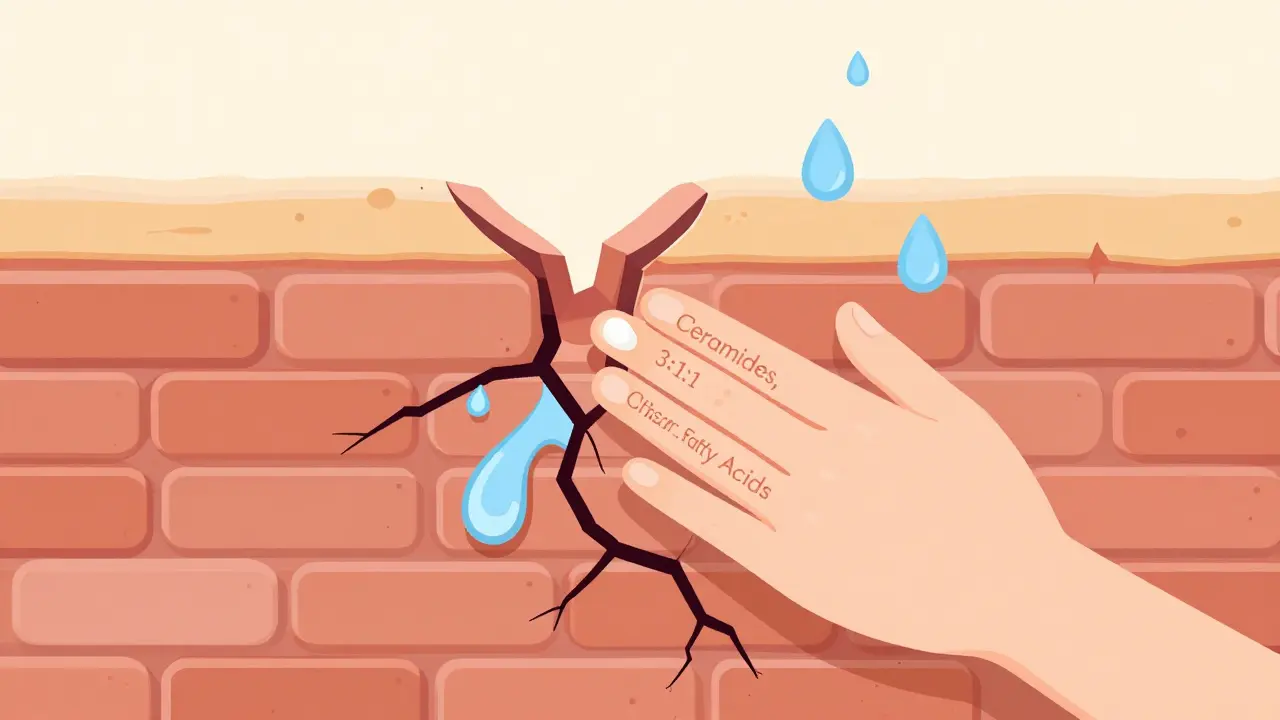
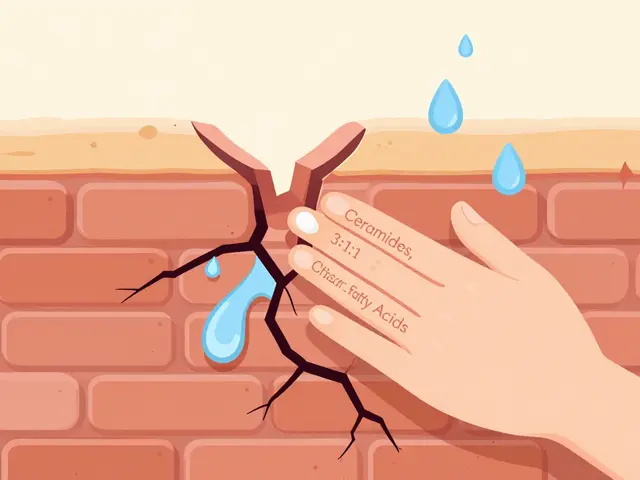
When your skin feels raw, tight, and constantly itchy, it’s not just a bad rash-it’s a broken barrier. In eczema, the outer layer of skin, called the stratum corneum, doesn’t work like it should. Think of it like a brick wall where the bricks are skin cells and the mortar holding them together is made of lipids-mostly ceramides. In healthy skin, this wall is tight and waterproof. In eczema, the mortar is cracked and missing. That’s why water escapes, irritants get in, and inflammation follows. The good news? You can fix it. Not with steroids alone, but by rebuilding the wall with the right ingredients and the right habits.
Why Ceramides Are the Missing Piece in Eczema
Ceramides make up about half of the skin’s natural lipid matrix. In people without eczema, the ratio of ceramides to cholesterol to fatty acids is a precise 3:1:1. This balance keeps the barrier strong and flexible. But in eczema, ceramide levels drop by 30% to 50%. Worse, the types of ceramides change. Short-chain ceramides like NP(18) and AP(18) increase, while the long-chain ones that actually hold the barrier together decrease. This isn’t just a symptom-it’s a core cause of the condition.That’s why regular lotions often fail. Petrolatum-based moisturizers just sit on top of the skin like a plastic wrap. They reduce water loss temporarily, but they don’t fix the broken mortar. Clinical studies show that ceramide-dominant emollients, like EpiCeram® and TriCeram®, reduce transepidermal water loss (TEWL) by 35% to 50% and repair the barrier for over 72 hours. These products contain the exact 3:1:1 ratio of lipids found in healthy skin. They’re not just moisturizers-they’re skin repair systems.
Not all ceramide products are created equal. Over-the-counter brands like CeraVe include ceramides, but many lack the full complement of lipids in the right proportions. A 2021 review in Cells found that physiological ceramide formulations (those matching natural skin lipids) repaired the barrier 40% better than petrolatum-based ones. If you have moderate to severe eczema, look for products that list ceramides, cholesterol, and fatty acids together-and avoid those with just one or two.
The Bathing Routine That Actually Helps-Not Hurts
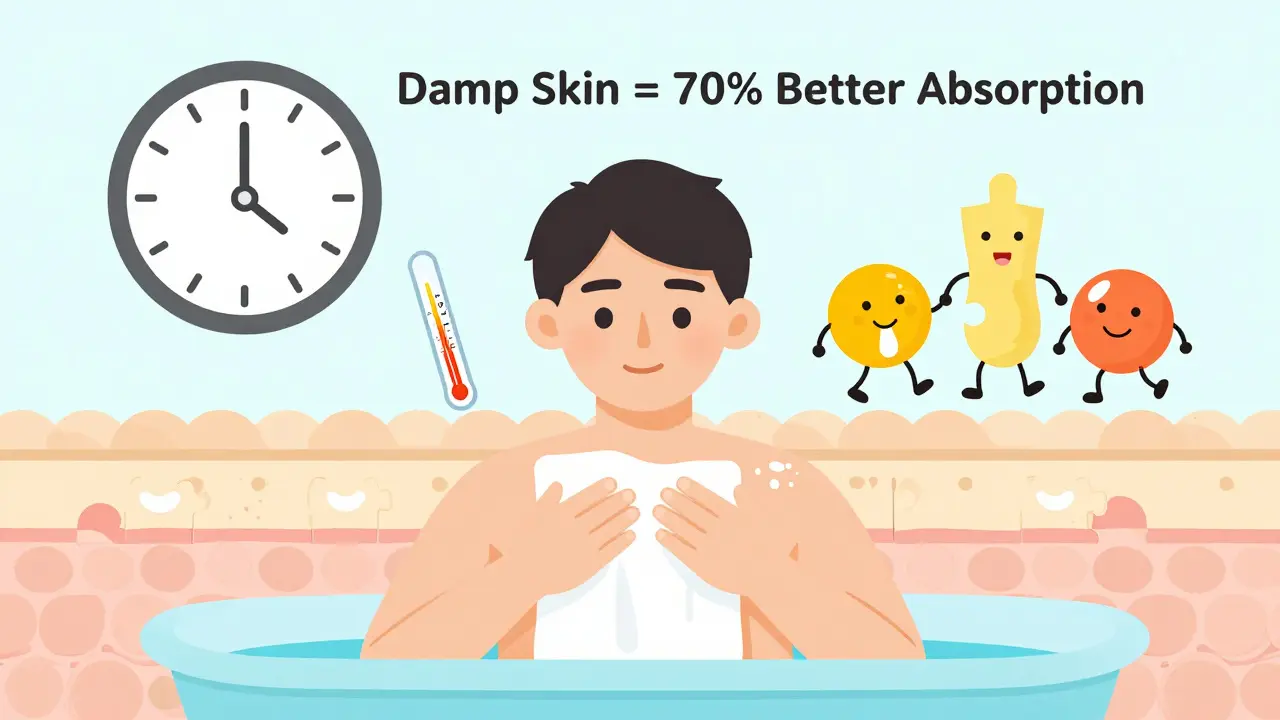
Bathing is one of the most powerful tools for eczema, but most people do it wrong. Hot showers, long soaks, and harsh soaps strip away what’s left of your barrier. The goal isn’t to clean the skin-it’s to hydrate and protect it.Follow the soak and seal method:
- Fill the tub or use a shower with lukewarm water-no hotter than 90°F (32°C). Hot water opens pores and dries skin faster.
- Soak for 10 to 15 minutes. No more. Longer soaks break down the skin’s natural oils.
- Use a gentle, fragrance-free cleanser with less than 0.5% sodium lauryl sulfate. Harsh surfactants increase TEWL by 25% to 40% within an hour.
- Pat your skin dry gently. Don’t rub. Leave it slightly damp.
- Within 3 minutes, apply your ceramide emulsion. Damp skin absorbs 50% to 70% more product than dry skin.
This simple routine is backed by research from Choi et al. (2016). The timing matters. Waiting even 10 minutes to apply moisturizer cuts absorption by nearly half. That’s why people who follow this method see faster results-often within two weeks.
Prescription vs. Over-the-Counter: What’s Worth the Cost?
Prescription barrier repair products like EpiCeram® and TriCeram® are formulated with pharmaceutical-grade lipids in the exact 3:1:1 ratio. They’re FDA-cleared as Class II medical devices, meaning they’ve been tested for efficacy. Clinical trials show they reduce redness 25% faster and improve hydration 30% more than standard moisturizers in moderate-to-severe eczema.But they cost $25 to $35 for a 200g tube. Compare that to CeraVe or Vanicream, which run $5 to $15. So which should you choose?
If you have mild eczema, or you’re just starting out, an OTC ceramide moisturizer is a fine place to begin. Many users report noticeable improvement. But if your skin is cracked, bleeding, or flaring often, prescription-grade products deliver measurable results. A 2021 case study in the Dermatology Online Journal showed a patient reducing steroid use from daily to once a week after eight weeks of EpiCeram®.
Market data shows that 60% of the OTC moisturizer market for sensitive skin is now ceramide-based. But only 35% of the prescription emollient market is made up of barrier repair products-suggesting many patients still aren’t getting the full benefit. If your dermatologist hasn’t recommended a ceramide-dominant product, ask why.
What Real People Say: Stories from the Front Lines
On Reddit’s r/eczema community, over 1,200 users shared experiences with ceramide products in 2022. Nearly 78% said they saw reduced itching and dryness within two to four weeks. One user, u/EczemaWarrior, wrote: “After trying 10+ moisturizers, EpiCeram reduced my nightly scratching from 8-10 times to 1-2 times within 3 weeks.”On Trustpilot, CeraVe has a 4.3/5 rating. Sixty-eight percent of 5-star reviews mention “barrier repair” specifically. But 22% of negative reviews say the product didn’t help their severe eczema. The pattern is clear: OTC works for maintenance. Prescription works for repair.
Common complaints? “Too greasy,” “too expensive,” and “too slow.” That last one is important. Unlike steroid creams that calm redness in days, ceramide repair takes weeks. It’s not a quick fix-it’s a long-term rebuild. If you stop using it because you don’t see instant results, you’ll never get there.
What to Avoid-And Why
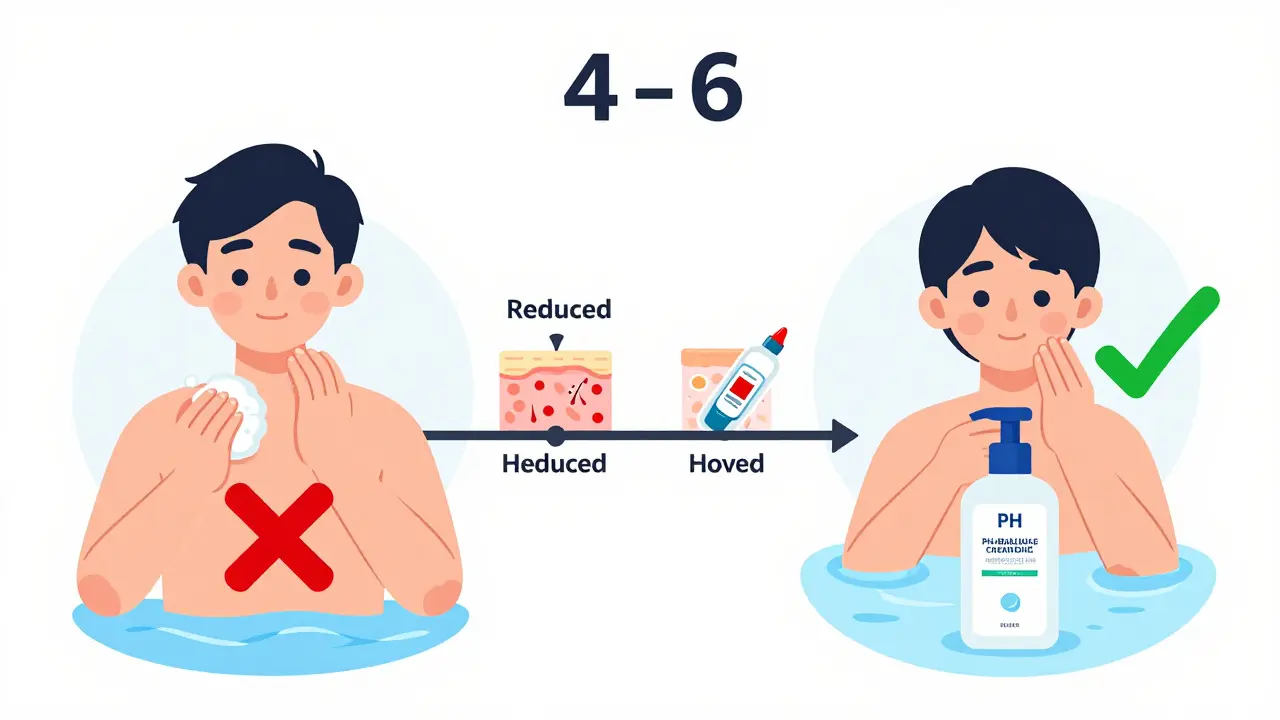
Some habits sabotage barrier repair. Here’s what to skip:- Hot baths-They strip lipids and increase TEWL.
- Scents and dyes-Even “natural” fragrances can trigger inflammation.
- Bar soaps-Most are alkaline (pH 8-10), which shuts down enzymes that make ceramides. Use pH-balanced cleansers (pH 5.5) instead.
- Applying moisturizer to dry skin-You lose half the benefit. Always apply to damp skin.
- Waiting too long between showers and moisturizing-The 3-minute window is critical.
Also, don’t rely on ceramides during a severe flare. They’re not meant to replace steroids in acute phases. Use steroids for quick relief, then switch to ceramide repair to prevent the next flare. It’s a team effort.
Long-Term Strategy: It’s Not Just About Moisturizing
Eczema isn’t cured by one product. It’s managed by a system. Think of it like fixing a leaky roof-you don’t just patch one hole. You reinforce the whole structure.Consistency is everything. Studies show it takes 4 to 6 weeks of daily use before you see real barrier improvement. That’s why most people quit too soon. Dermatologists recommend applying ceramide emulsions twice daily, and up to three times during flares. Use it every day-even when your skin looks fine. Prevention beats repair every time.
Future advances are coming. Companies like LEO Pharma are developing biomarker-guided ceramide formulas that target specific deficiencies-like low ceramide 1 levels. Phase II trials show 30% better results in patients with those specific imbalances. Within five years, this could become standard care.
For now, the best approach is simple: find a ceramide product with the full lipid trio, bathe smart, and apply it right after your shower. Do this every day, and your skin will thank you.
Can ceramides cure eczema?
No, ceramides don’t cure eczema. But they address the root cause-the broken skin barrier. By restoring the lipid matrix, they reduce flares, decrease itching, and lower dependence on steroids. Think of them as the foundation for long-term control, not a cure.
How long does it take for ceramide moisturizers to work?
Most people notice reduced dryness and itching within 2 to 4 weeks. But full barrier repair takes 4 to 6 weeks of daily use. Clinical trials show measurable improvement in TEWL and hydration after 28 days. Don’t stop if you don’t see results in a few days-it’s a slow rebuild.
Are all ceramide products the same?
No. Many OTC products contain only one or two lipids, not the full 3:1:1 ratio. Prescription products like EpiCeram® and TriCeram® are formulated with the exact proportions found in healthy skin. OTC versions can help, but they often lack the concentration or balance needed for moderate-to-severe eczema.
Should I use ceramide cream instead of steroid cream?
Use steroids for sudden, severe flares-they work fast. But use ceramide emulsions daily to prevent flares. Steroids treat symptoms; ceramides fix the cause. The best strategy is to use steroids briefly, then switch to ceramide repair for long-term stability.
Why does my skin feel tight after applying ceramide cream?
Some people feel a slight tightness in the first week. This is normal-it means the skin is rehydrating and restructuring. The sensation usually fades as the barrier repairs. If it turns into pain or redness, stop and consult your dermatologist.




Lorna Brown March 15, 2026
What’s wild is how this whole barrier repair concept flips everything we thought we knew about eczema. It’s not dryness-it’s a structural collapse. Like your house has termites in the walls, and you’ve been slathering on paint instead of calling a contractor. Ceramides aren’t a moisturizer-they’re the rebar and concrete. And the 3:1:1 ratio? That’s not marketing fluff. That’s biology. We’ve been treating symptoms like they’re the disease. This is like finally understanding that a fever isn’t the illness-it’s the immune system screaming for help.
Also, the bath timing thing? Mind blown. I used to think ‘moisturize whenever’ was fine. Turns out, waiting 10 minutes is like trying to water a plant after it’s already turned to dust. The science here is terrifyingly elegant.
Rex Regum March 16, 2026
Oh here we go. Another ‘science says’ lecture. Let me guess-next you’ll tell me the sun is hot and water is wet. Ceramides? Please. I’ve been using Vaseline since I was 12 and my skin’s fine. All this ‘lipid matrix’ nonsense is Big Dermatology trying to sell you overpriced jars so they can retire in Bali. You don’t need a PhD to know that grease = protection. If your skin’s cracking, you’re probably using too much soap and not enough elbow grease.
Kelsey Vonk March 16, 2026
OMG YES. I’ve been using CeraVe for months and I swear I’ve never felt this calm. 🥹 I used to scratch till I bled. Now? Just a little itch, like a whisper. And the soak-and-seal? Game changer. I even set a timer. 10 minutes. Lukewarm. Pat. Done. 3 minutes later-cream. It’s so simple, it feels like cheating. I cried the first time I slept through the night without scratching. Not a joke. I’m so emotional right now. 🫂
Emma Nicolls March 18, 2026
so like i tried the ceramide cream after reading this and honestly i was skeptical but like wow. my skin stopped feeling like sandpaper. and the bath thing? i used to take 20 min hot showers like a sauna. now i do 10 mins lukewarm and slap on the cream while i’m still damp. no more 3am scratching. i feel like a new person. also i didn’t know about the 3 min window. who knew time mattered so much??
Jimmy V March 18, 2026
Stop wasting money on half-measures. If you have moderate-to-severe eczema, OTC ceramides are placebo-level. The 3:1:1 ratio isn’t a suggestion-it’s a biological mandate. EpiCeram isn’t expensive-it’s an investment. You’re not buying cream. You’re buying back your sleep, your confidence, your life. And yes, it takes weeks. But so does rebuilding a collapsed foundation. Do you wait 3 days to fix a cracked foundation? No. You call the engineer. Same here.
Richard Harris March 20, 2026
Interesting stuff. I’ve been using Vanicream for years, and while it helps, I never thought about the lipid ratios. I’m in the UK and we don’t get EpiCeram here easily. Wonder if there’s a UK equivalent? Also, the 3-minute window-sounds right. I’ve always rushed after showers. Maybe that’s why I still get flares. Will try again. Thanks for the clarity.
Kandace Bennett March 21, 2026
Honestly, if you’re using anything less than prescription-grade ceramides, you’re just playing with your skin. 😏 I mean, really? CeraVe? That’s like using duct tape on a leaking submarine. If you can’t afford EpiCeram, maybe you should stop buying lattes and start investing in your health. I’m not being mean-I’m being real. Your skin is your largest organ. Treat it like royalty. Or don’t. But don’t come crying to me when it’s flaring again. 💅
Tim Schulz March 22, 2026
Wow. Just… wow. Someone finally wrote the truth without using 17 buzzwords. I’ve been using ‘ceramide’ products for 3 years. Turns out I was just slathering on marketing. 😂 The 3:1:1 ratio? That’s the key. And the bath timing? I thought it was a myth. Now I’m doing it. And guess what? My skin isn’t screaming at me anymore. Also-yes, it’s slow. But it’s the only thing that actually works. No steroids. No hype. Just science. And yeah, I’m a convert.
Jinesh Jain March 23, 2026
Interesting post. I have eczema too, from India. Here, people use coconut oil or aloe. But I tried CeraVe last year. It helped a bit. But I never knew about the lipid ratios or the 3-minute window. I always waited 15 minutes after shower. Maybe that’s why it didn’t work well. I’ll try again. Also, no hot water here anyway-too expensive to heat. So that part I already do. Thanks for sharing.
douglas martinez March 23, 2026
Thank you for this comprehensive, evidence-based overview. The distinction between symptomatic relief and structural repair is critical. The data on transepidermal water loss and lipid ratios is not merely anecdotal-it is clinically validated. I encourage all patients to approach barrier repair with the same rigor they would apply to managing hypertension or diabetes. Consistency, precision, and patience are non-negotiable. This is not a cosmetic regimen. It is a medical intervention.
Lorna Brown March 25, 2026
Jimmy V nailed it. And Richard Harris-your comment about UK alternatives? There’s a new one called Atopalm®. It’s not FDA-cleared like EpiCeram, but it has the 3:1:1 ratio and is available in the UK. I’ve got a tube on order. Also-Emma, your story? That’s why this matters. Not the science. The sleep. The peace. The quiet. That’s the real victory.