
Most people don’t think about earwax until it starts causing trouble-muffled hearing, a feeling of fullness, or even dizziness. But earwax isn’t dirt. It’s a natural, protective substance made by your body to trap dust, bacteria, and debris. The problem comes when it builds up too much and hardens into a blockage. That’s where cerumenolytics come in. These are ear drops designed to soften earwax so it can drain out naturally or be removed safely without poking or scraping inside your ear.
Why earwax becomes a problem
Your ears are self-cleaning. Normally, jaw movement from chewing and talking pushes old earwax out slowly. But sometimes, this system gets stuck. That’s especially common if you wear earbuds or hearing aids all day, use cotton swabs (which push wax deeper), or are older. Studies show up to 30% of adults over 65 have impacted earwax. And it’s not just discomfort-it can make you miss conversations, turn up the TV too loud, or even affect your balance.What cerumenolytics actually do
Cerumenolytics don’t dissolve earwax like a chemical cleaner. They soften it. Think of them like conditioner for your ear canal. Once softened, the wax becomes less sticky and can move out on its own, especially if you tilt your head and let it drain. Some also help break down the wax’s structure so irrigation (flushing with warm water) works better later.Types of earwax softeners and how they work
There are four main types of cerumenolytics you can find at your local pharmacy. Each has pros and cons.- Carbamide peroxide (Debrox, Murine): This is the most common OTC option. It breaks down into hydrogen peroxide and urea when it hits moisture. You’ll feel a gentle fizzing-that’s the wax softening. Use 5-10 drops twice a day for up to 7 days. Works best for moderate buildup.
- Hydrogen peroxide (3%): Dilute it with equal parts sterile water. Use 5 drops, wait 5 minutes, then let it drain. The bubbling helps lift wax. But don’t use it straight from the bottle-it can burn your skin. Best for wax with moisture content, like after swimming.
- Mineral oil, baby oil, or olive oil: These are gentle lubricants. Use 3-6 drops once a day for 3-4 days. They’re ideal for dry, hardened wax. No fizzing, no stinging. Just slow, steady softening.
- Baking soda solution: Mix 1.25 mL of baking soda with 10 mL of sterile water to make a 15% solution. Apply twice daily for 4 days. Effective but needs precise mixing. Seattle Children’s Hospital recommends this for kids and sensitive ears.
There’s also docusate sodium (Colace), a stool softener used off-label. One mL in the ear 15 minutes before irrigation can help. But it’s not FDA-approved for ears, so stick to the first four unless your doctor says otherwise.
Which one works best?
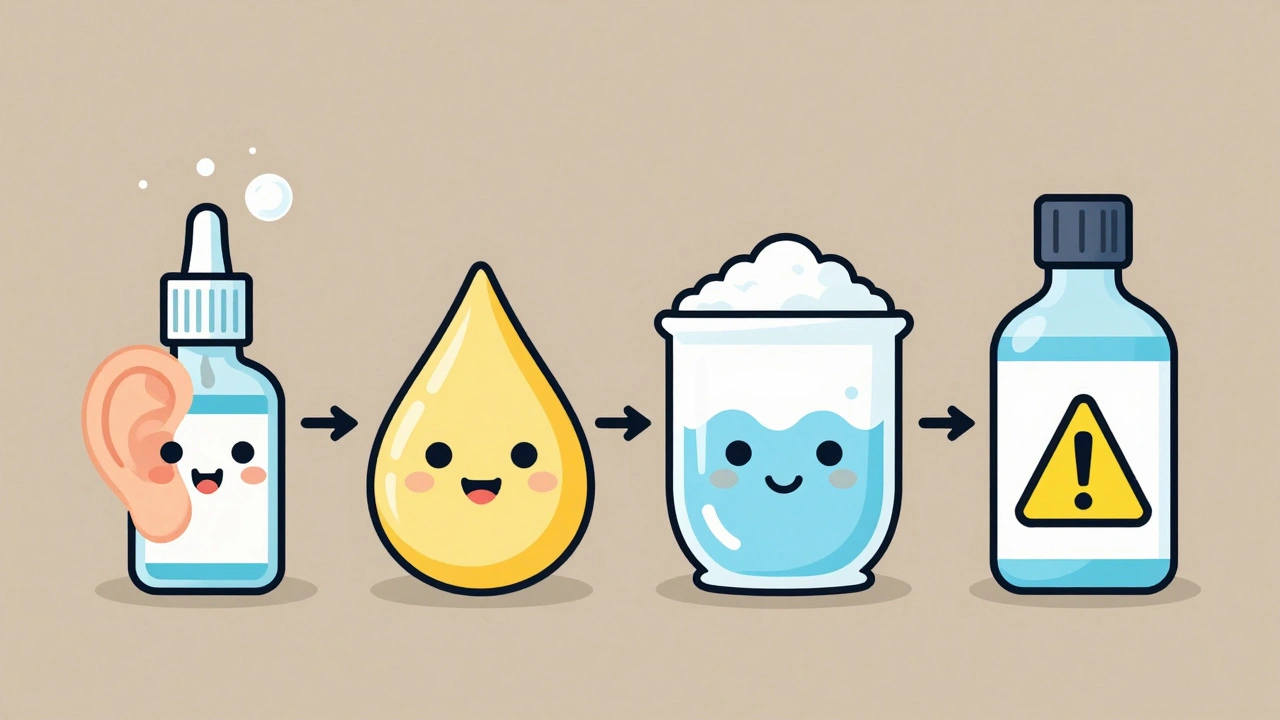
There’s no single winner. Studies show carbamide peroxide clears about 65% of blockages. Mineral oil clears around 58%. But the real difference isn’t the formula-it’s how you use it.A 2017 study in the Journal of Laryngology & Otology found people who left drops in for less than 5 minutes had a 40% lower success rate. That’s why timing matters more than brand. If you drop the solution in and immediately sit up, it just runs out. You need to lie on your side, let it soak in, then drain slowly.
How to use earwax drops correctly
Follow these steps every time:- Wash your hands.
- Warm the bottle in your hands for a minute. Cold drops can make you dizzy.
- Lie on your side with the affected ear facing up.
- Put in the number of drops your product recommends (usually 5-10).
- Stay still for 5-10 minutes. Gently tug your earlobe to help the drops go deeper.
- Turn your head to let the drops and softened wax drain into a towel.
- Do this once or twice daily for 3-7 days, depending on the product.
Don’t use a dropper, cotton swab, or any tool to push the drops in. Just let gravity do the work.
When it won’t work-and when to see a doctor
Cerumenolytics are great, but they’re not magic. If your ear is completely blocked, you’ve got pain, discharge, or hearing loss that doesn’t improve after a week, you need professional help. About 25% of home treatments fail because the wax is too hard or packed too tightly.Stop using drops immediately if you have:
- An ear infection (redness, swelling, pus)
- A perforated eardrum (you’ll know-you’ve had surgery, trauma, or chronic drainage)
- Recent ear surgery
Using any softener with these conditions can lead to serious infection or hearing damage. A doctor can remove wax safely with suction, curettes, or irrigation under direct vision. No guesswork.
What not to do
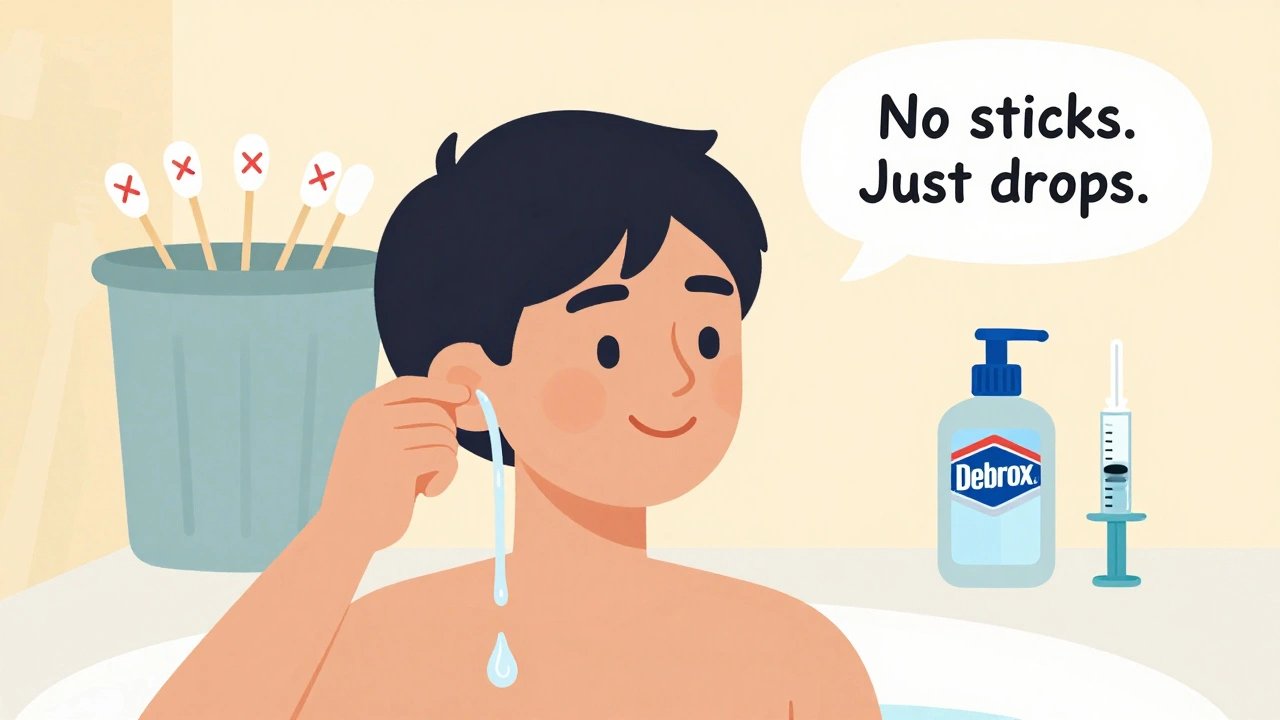
The biggest mistake people make? Using cotton swabs. Every year, over 12 million people in the U.S. go to the ER or doctor for earwax problems-and 65% of those injuries are from Q-tips. You’re not cleaning your ear. You’re packing wax deeper.Other bad habits:
- Using tap water for irrigation-it can carry bacteria.
- Using hydrogen peroxide straight from the bottle-it burns.
- Trying to scoop wax out with paper clips, bobby pins, or keys.
Stick to drops and let your body do the rest.
Real experiences from users
People who’ve tried this report similar results:- “Used Debrox for 5 nights. Felt bubbling, then a little gunk came out when I showered. Hearing came back.” - Reddit user, r/audiology
- “Olive oil every night for 4 days. No fizzing, no sting. Just quiet relief.” - 68-year-old Melbourne resident
- “Used peroxide straight from the bottle. Felt like fire for 20 minutes. Never again.” - Amazon review
Those who succeed usually follow the instructions exactly. Those who fail either didn’t wait long enough, used the wrong solution, or tried to force it out too soon.
Market and trends
The earwax softener market is growing. In 2023, Debrox held 38% of the U.S. market, Murine 29%. New products are coming out-like Debrox Max, which releases drops slowly over time. The FDA approved a new formula in 2022 combining hydrogen peroxide with glycerin to reduce irritation. And with more people using wireless earbuds daily, earwax issues are rising. ENT clinics report a 22% increase in cases since 2019.It’s not just about comfort. Impacted earwax costs the U.S. healthcare system $116 million a year in visits and procedures. Using cerumenolytics at home saves time, money, and pain.
Final tips for safe home use
- Always read the label. Dosage and duration vary by product. - Use sterile water if mixing your own solution. Boil tap water and let it cool. - Don’t rush. Most solutions need 3-7 days. - If you feel pain, stop. Don’t push through it. - After softening, you can gently rinse with warm water using a bulb syringe-but only if you’ve used drops for the full course and have no signs of infection. - Keep your ears dry after treatment. Moisture invites infection.Earwax isn’t something to fear. It’s part of your body’s design. But when it gets stuck, you don’t need to suffer or risk injury. With the right cerumenolytic and proper technique, you can clear it safely at home-no tools, no pain, no doctor visit needed.






Sarah Gray December 9, 2025
Let’s be honest-most people treat their ears like a trash can they can stick Q-tips into. The fact that carbamide peroxide is the most common OTC option says everything about our collective lack of biological literacy. You’re not ‘cleaning’ your ear; you’re administering a mild oxidizing agent to a delicate mucosal surface. And yet, here we are, treating earwax like a bug to be eradicated rather than a protective secretion evolved over millions of years. The real problem isn’t wax-it’s our arrogance.
Mineral oil? That’s the only choice that respects anatomy. No fizzing, no burning, no pseudoscientific ‘cleansing.’ Just gentle lubrication. It’s not sexy, but neither is a perforated eardrum.
And please, for the love of all that’s anatomical, stop using tap water for irrigation. You wouldn’t pour unsterilized water into a surgical wound. Why treat your cochlea like a garden hose attachment?
Michael Robinson December 11, 2025
Earwax is just your body’s way of saying ‘I’m trying to protect you.’ We forget that. We think clean means empty. But your ear doesn’t need cleaning. It needs space to do its job. The drops just help it along when it’s stuck. Simple. No magic. No fear. Just patience.
And no, you don’t need to be a doctor to use them right. Just lie down. Wait. Let go.
Suzanne Johnston December 13, 2025
It’s fascinating how we’ve turned something biological into a consumer product crisis. The market for earwax softeners grew 22% because we’re all glued to earbuds, but we didn’t evolve to wear them for 12 hours a day. Our ears are still designed for wind, speech, and chewing-not Bluetooth. The real innovation isn’t in the drops; it’s in the behavior change.
And yet, people still use bobby pins. Still use straight peroxide. Still think ‘more is better.’
I’ve seen patients cry because they thought they were ‘dirty’ for having wax. It’s not dirt. It’s not failure. It’s biology. We need to stop shaming the body and start listening to it. Even if it’s just a little gunk in the canal.
Also-baking soda solution for kids? That’s actually brilliant. Not because it’s trendy, but because it’s gentle. And we need more gentle solutions, not louder marketing.
ian septian December 14, 2025
Use oil. Wait 10 minutes. Let it drain.
Done.
Chris Marel December 15, 2025
I’ve been using olive oil for my dad-he’s 72, wears hearing aids, and hates the fizzing stuff. He says it feels like a warm hug in his ear. No drama. No panic. Just slow relief.
I’m from Lagos, and here, people use coconut oil for everything-ears, scalp, joints. I never thought it’d work for wax… until I saw it work. No pharmacy needed. Just a spoon, warmth, and patience.
It makes me wonder: are we overcomplicating what nature already gave us? Maybe the real solution isn’t a new formula. It’s remembering how to listen-to our bodies, and to older ways that still work.
Evelyn Pastrana December 16, 2025
So let me get this straight: we’ve spent millions on earwax drops, yet the only thing that actually works is… lying down and doing nothing?
And the FDA approved a new formula with glycerin to reduce irritation… because people kept burning their ears with peroxide straight from the bottle?
Y’all paid for a product that’s basically ‘don’t be an idiot’ in a bottle. Congrats, capitalism.
Also, I used Debrox once. Felt like a tiny soda pop party in my head. Then I remembered: I’m not a science experiment. I used oil. Now I hear my dog barking again. And I didn’t even need a PhD to figure it out.