You find a spot on your nose that won’t heal. Or maybe you notice a shiny bump on your chest that bleeds when you scratch it. These are not just annoying skin blemishes; they could be signs of nonmelanoma skin cancer, which includes two major types: basal cell carcinoma (BCC) and squamous cell carcinoma (SCC). While melanoma gets most of the headlines for being deadly, BCC and SCC are far more common, accounting for about 95% of all skin cancer cases in the United States alone.
The good news? Both are highly curable if caught early. The bad news? They look different, behave differently, and require different levels of urgency. Confusing one for the other can lead to delays in treatment or unnecessary anxiety. So, how do you tell them apart, and what should you do if you suspect you have one?
Where Do They Come From?
To understand the difference, you need to look at where these cancers start in your skin. Your epidermis-the outer layer of your skin-has several sub-layers. Think of it like a conveyor belt. New cells are born at the bottom and move up to the surface, eventually flaking off.
Basal cell carcinoma starts in the basal cells, located in the deepest part of the epidermis (the stratum basale). These are the factory workers constantly dividing to create new skin. Because they are deep down, BCC tends to grow slowly and stays localized for a long time.
In contrast, Squamous cell carcinoma begins in the squamous cells, which are found in the upper layers of the epidermis. As those basal cells move upward, they flatten out and become squamous cells. SCC arises from these flat, scale-like cells. Since these cells are closer to the surface and often exposed to cumulative sun damage over decades, SCC can be more aggressive.
Both types are primarily driven by ultraviolet (UV) radiation exposure. About 80% of these cancers appear on sun-exposed areas like the face, neck, ears, hands, and arms. However, the pattern of exposure matters. BCC is often linked to intense, intermittent sunburns (like those from vacations), while SCC is strongly associated with chronic, cumulative sun exposure over a lifetime.
What Do They Look Like?
Visual identification is tricky because both can mimic benign conditions like warts, cysts, or eczema. But there are distinct patterns doctors look for.
Basal Cell Carcinoma (BCC) Signs:
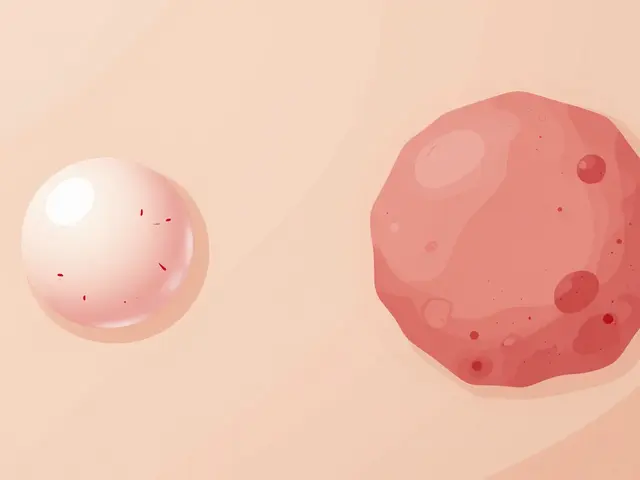
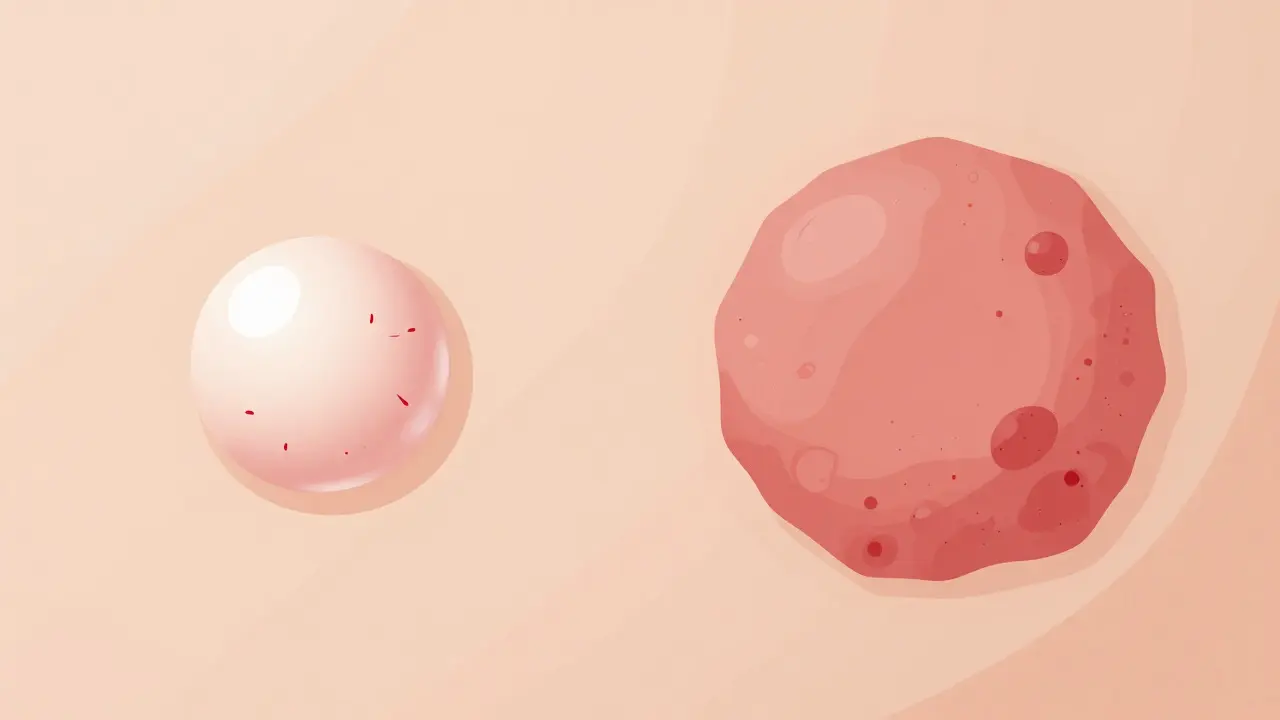
- Pearly bumps: This is the classic presentation, occurring in about 70% of cases. You might see a small, shiny, translucent bump that looks like a pearl or a dome. It may have tiny blood vessels crawling across its surface.
- Non-healing sores: Roughly 20% of BCCs present as open sores that crust over, bleed, heal, and then break open again. They rarely stay healed completely.
- Scar-like patches: In 10% of cases, BCC appears as a flat, yellowish, scar-like patch without a raised border. This type, called morpheaform BCC, is harder to spot and can be more invasive.
Squamous Cell Carcinoma (SCC) Signs:
- Firm, red nodules: About 45% of SCCs show up as firm, dome-shaped growths that feel hard to the touch.
- Scaly patches: Roughly 20% present as flat, scaly, reddish patches that might itch or hurt. These can look like psoriasis or actinic keratosis (a pre-cancerous condition).
- Wart-like lesions: Another 25% appear as rough, wart-like growths that may crust or bleed easily.
- Open ulcers: Similar to BCC, SCC can form open sores, but they tend to be more irregular and painful.
If you’re unsure, don’t guess. A dermatologist can often identify the type through a simple biopsy. Remember, any new growth that changes shape, color, or size, or any sore that doesn’t heal within three weeks, deserves a professional look.

Growth Speed and Aggressiveness
This is where the distinction becomes critical for your health outcomes. While both are considered "nonmelanoma" skin cancers, they are not equal in risk.
BCC is slow-growing. On average, it expands at a rate of 0.5 to 1.0 centimeter per year. It rarely spreads (metastasizes) to other parts of the body-fewer than 0.1% of cases ever metastasize. However, "rarely" doesn’t mean "never." If left untreated for years, BCC can burrow deep into tissue, destroying cartilage, bone, and nerves locally. This is why facial BCCs are taken seriously-they can cause significant disfigurement even if they don’t kill you.
SCC is faster and more dangerous. It grows about three times faster than BCC, averaging 1.5 to 2.0 centimeters per year. Some aggressive subtypes can double in size within just four to six weeks. More importantly, SCC has a real potential to spread. Approximately 2% to 5% of SCC cases metastasize to lymph nodes or distant organs. In high-risk locations like the lips or ears, this risk jumps to up to 15%.
Dr. John Zitelli, a leading expert in Mohs surgery, notes that while BCC is more common, SCC requires more urgent attention due to this metastatic potential. In fact, SCC is the second leading cause of skin cancer-related deaths after melanoma.
Risk Factors: Who Is Most Vulnerable?
You don’t need to check every box to get skin cancer, but having multiple risk factors increases your odds significantly.
| Risk Factor | Basal Cell Carcinoma (BCC) | Squamous Cell Carcinoma (SCC) |
|---|---|---|
| Skin Type | Fair skin, light eyes, blonde/red hair | Fair skin, light eyes, blonde/red hair |
| Sun Exposure Pattern | Intermittent, intense burns (e.g., childhood) | Cumulative, chronic exposure (e.g., outdoor work) |
| Age | Average diagnosis age: 67 | Average diagnosis age: 69 |
| Gender | Slight male predominance (55%) | Strong male predominance (65%) |
| Immunosuppression | 10-fold increased risk in transplant patients | 250-fold increased risk in transplant patients |
| Pre-existing Skin Conditions | Xeroderma pigmentosum, genetic syndromes | Actinic keratosis, chronic wounds, scars |
Notice the stark difference in immunosuppression risk. Organ transplant recipients are at extreme risk for SCC because their immune systems can’t keep mutated cells in check. Also, men are disproportionately affected by SCC, likely due to historical occupational sun exposure and lower rates of sunscreen use compared to women.
Treatment Options: What to Expect
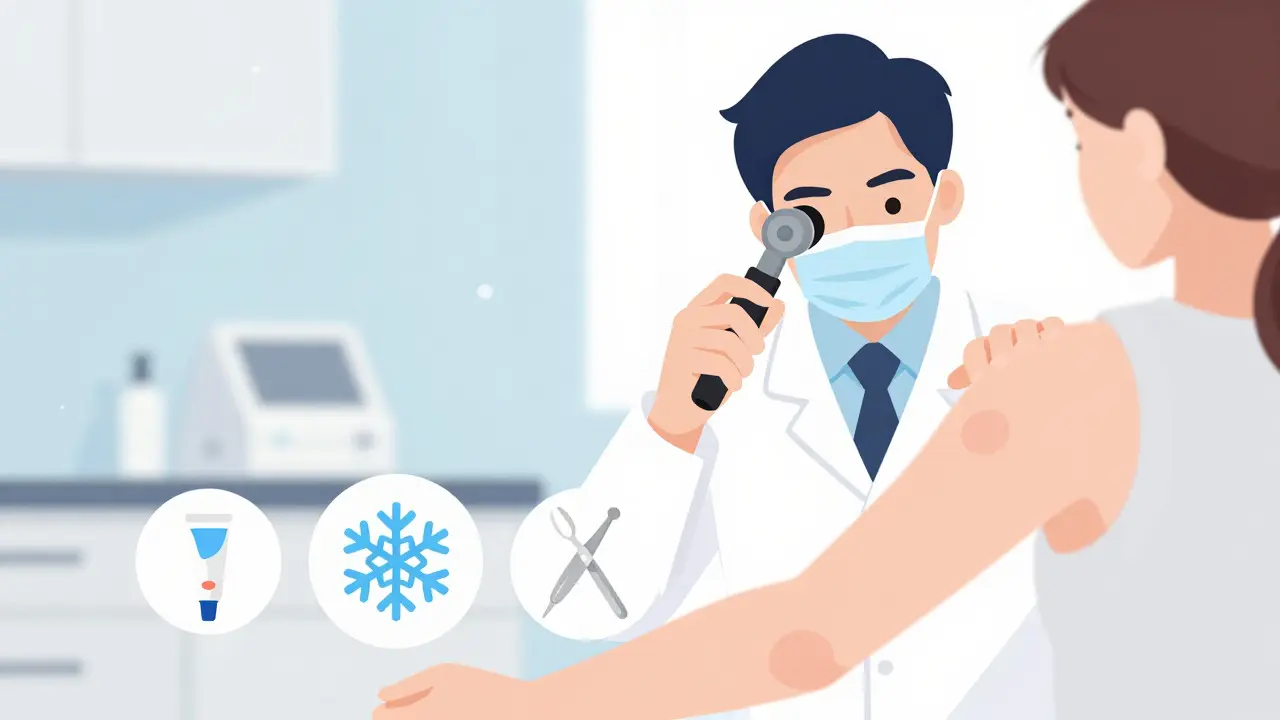
The treatment plan depends on the cancer’s size, location, depth, and whether it’s recurrent. Early detection means simpler treatments and better cosmetic outcomes.
For Basal Cell Carcinoma:
- Topical Medications: For superficial BCCs, creams like imiquimod or 5-fluorouracil can clear 60-70% of lesions without surgery.
- Cryotherapy: Freezing the tumor with liquid nitrogen is quick and effective for small, low-risk BCCs.
- Excision: Surgical removal with standard margins (3-5 mm) achieves cure rates of 95-98%.
- Mohs Micrographic Surgery: Reserved for high-risk areas (face, genitals) or recurrent tumors. It offers a 99% cure rate by checking margins layer-by-layer during surgery.
For Squamous Cell Carcinoma:
- Surgical Excision: Standard excision is common, but margins must be wider (4-10 mm) for high-risk SCCs to ensure all cancer cells are removed.
- Mohs Surgery: Highly recommended for SCCs on the head, neck, or hands due to higher recurrence risks. Cure rates are around 97% for primary tumors.
- Radiation Therapy: Often used for elderly patients who can’t undergo surgery or for tumors in difficult-to-reach areas.
- Immunotherapy: For advanced, metastatic SCC, drugs like cemiplimab (Libtayo) have revolutionized treatment, showing 47% response rates where chemotherapy previously failed.
SCC generally requires more aggressive treatment. Patients with SCC often need 1.8 procedures on average compared to 1.2 for BCC. Reconstruction may also be more extensive due to deeper tissue invasion.
Prevention and Monitoring
Prevention is your best defense. Daily broad-spectrum sunscreen (SPF 30+), protective clothing, and avoiding peak sun hours (10 AM-4 PM) can reduce BCC risk by 40% and SCC risk by 50%. Wear a hat. Seek shade. Check your skin monthly.
If you’ve had one skin cancer, you’re at higher risk for another. High-risk patients-including organ transplant recipients, those with fair skin, and people with a history of multiple skin cancers-should see a dermatologist every three to four months. Studies show that 73% of recurrent SCC cases are detected within 12 months of prior treatment, highlighting the need for frequent monitoring.
New technology is helping too. AI-assisted dermoscopy tools are now achieving 94% accuracy in distinguishing BCC from SCC in preliminary trials, potentially allowing earlier detection in primary care settings.
Is basal cell carcinoma or squamous cell carcinoma more serious?
Squamous cell carcinoma (SCC) is considered more serious than basal cell carcinoma (BCC) because it has a higher potential to spread (metastasize) to other parts of the body. While BCC rarely metastasizes (<0.1% of cases), SCC metastasizes in 2-5% of cases, and up to 15% in high-risk locations like the lips or ears. SCC also grows faster and is the second leading cause of skin cancer deaths after melanoma.
Can you have both BCC and SCC at the same time?
Yes, it is possible to develop both basal cell carcinoma and squamous cell carcinoma simultaneously or sequentially. People who have had one type of nonmelanoma skin cancer are at increased risk for developing additional skin cancers. Regular dermatological exams are crucial for monitoring new spots.
How quickly does squamous cell carcinoma grow?
Squamous cell carcinoma grows approximately three times faster than basal cell carcinoma, averaging 1.5 to 2.0 cm per year. Aggressive subtypes can double in size within 4 to 6 weeks. This rapid growth underscores the importance of prompt evaluation for any changing skin lesion.
What is the survival rate for squamous cell carcinoma?
When detected early and treated locally, the 5-year survival rate for SCC is over 95%. However, if the cancer metastasizes to distant organs, the survival rate drops significantly to between 25% and 45%. Early detection through regular skin checks is vital.
Does sunscreen prevent basal cell carcinoma?
Yes, daily use of broad-spectrum sunscreen reduces the risk of basal cell carcinoma by approximately 40%. It is even more effective against squamous cell carcinoma, reducing risk by 50%, as SCC is more strongly linked to cumulative sun exposure. Sunscreen should be part of a broader sun protection strategy including hats and shade.
Who is at highest risk for squamous cell carcinoma?
Organ transplant recipients are at the highest risk, facing a 250-fold increased chance of developing SCC compared to the general population. Other high-risk groups include individuals with fair skin, a history of severe sunburns, chronic sun exposure (e.g., outdoor workers), and those with pre-existing skin conditions like actinic keratosis.