Why Your Afternoon Coffee Is Ruining Your Sleep
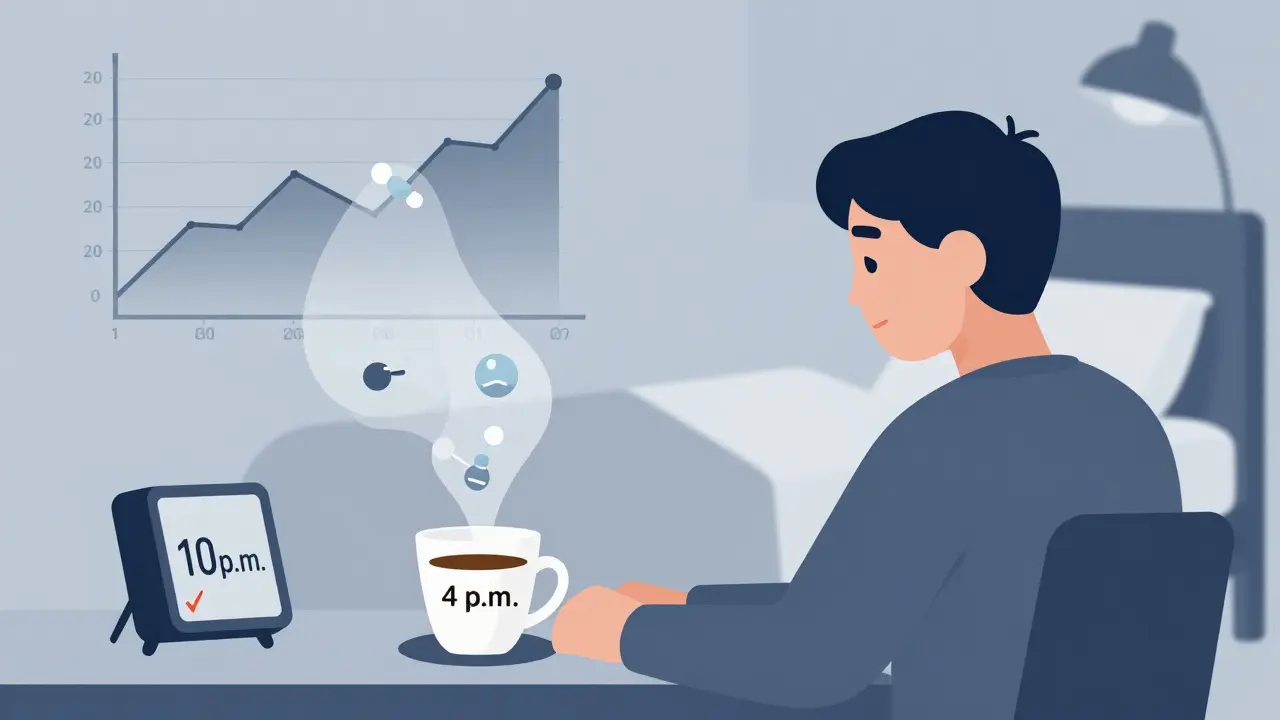
You drink coffee at 4 p.m., fall asleep at 11 p.m., and wonder why you’re tossing and turning. You’re not broken. You’re just ignoring a simple rule: caffeine doesn’t vanish when you swallow it. It lingers-sometimes for hours-and quietly steals the quality of your sleep, even if you don’t notice it.
Most people think if they can fall asleep, caffeine isn’t a problem. That’s a myth. A 2022 review of 18 studies found that even when people slept the same number of hours after drinking coffee, their sleep efficiency dropped by 7%. That means more time awake in the night, less deep sleep, and less restorative rest. Your brain doesn’t get the repair it needs. You wake up tired, even after eight hours in bed.
How Long Does Caffeine Really Last?
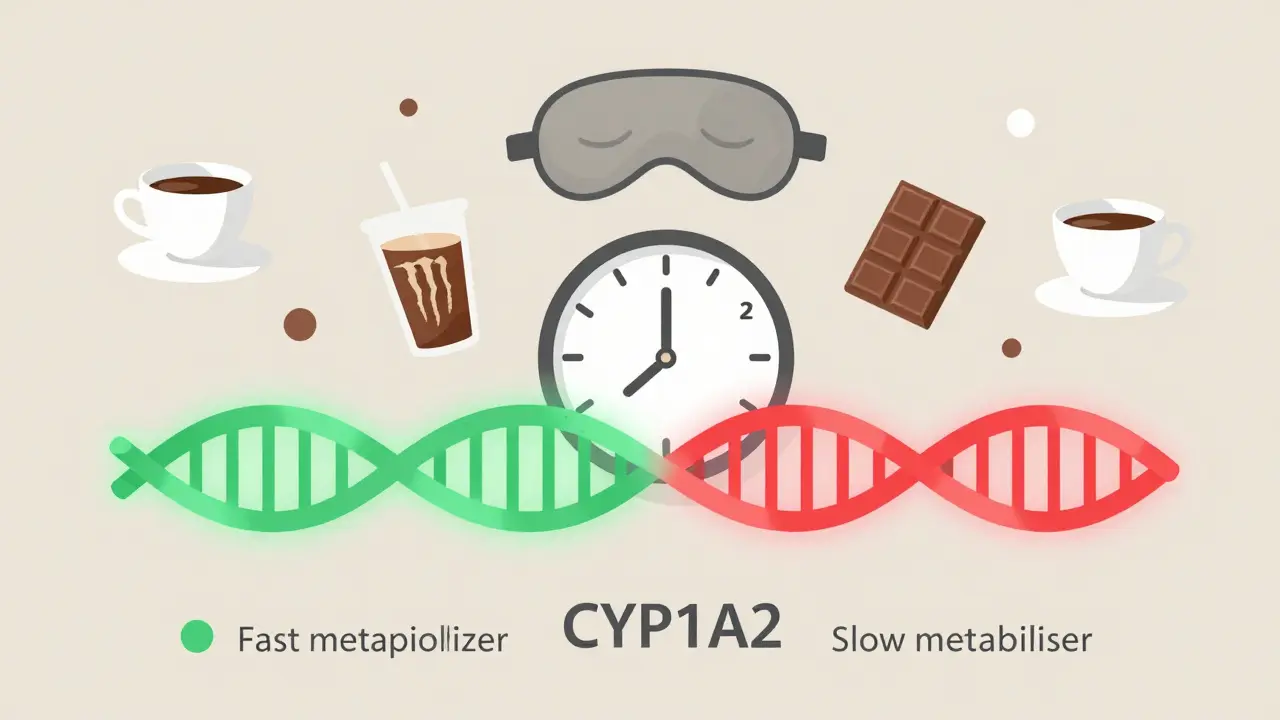
The half-life of caffeine is the time it takes for half of it to leave your system. For most people, that’s 4 to 6 hours. But that’s an average. For some, it’s 2 hours. For others, it’s 12. Why? Genetics. A gene called CYP1A2 controls how fast your body breaks down caffeine. If you’re a slow metabolizer, caffeine sticks around much longer. You might not know you’re one-until you realize you can’t sleep after a latte at 3 p.m.
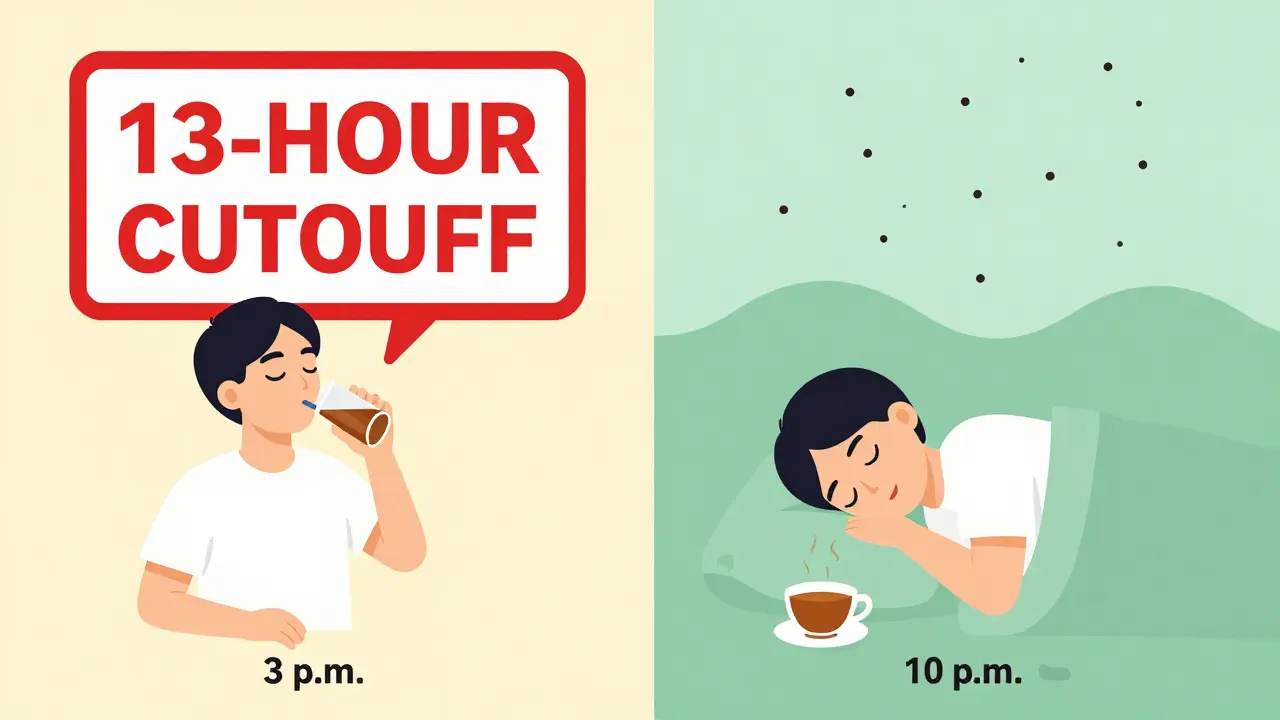
Here’s what that means practically: if you drink a standard 8-ounce cup of coffee (about 107 mg of caffeine), you need to stop at least 8.8 hours before bedtime to avoid sleep disruption. That’s not a suggestion. It’s based on data from 24 studies reviewed in Sleep Medicine Reviews in 2021. If you’re drinking espresso (63 mg per shot), you might get away with stopping at 6 p.m. for a 10 p.m. bedtime. But if you’re sipping a pre-workout shake with 217.5 mg of caffeine? You need to cut off at 1:30 p.m. That’s not a typo.
What About Tea, Energy Drinks, and Chocolate?
Not all caffeine is the same. Black tea has less caffeine than coffee-about 47 mg per cup-but it doesn’t have a clear cutoff time because its effects are milder and slower. Green tea? Even lower. But energy drinks? They’re the hidden trap. A 16-ounce Red Bull has 80 mg of caffeine. A Monster has 160. That’s like two cups of coffee in one can. And most people don’t realize they’re consuming it.
Medications are another sneaky source. Excedrin, Anacin, and some cold pills contain caffeine. One tablet can have 65 mg. If you take one at 6 p.m. for a headache, you’re sabotaging your sleep without even knowing it.
Dark chocolate? A 1-ounce bar has about 20 mg. It’s not going to wreck your night, but if you’re eating it every evening with dessert, it adds up. And if you’re a slow metabolizer? That small amount could still keep you from hitting deep sleep.
The Real Impact: Sleep Quality, Not Just Sleep Time
People think the problem is taking longer to fall asleep. It’s not. A 2022 review found that only 6 out of 13 studies showed longer sleep onset. The real damage? Sleep efficiency. That’s the percentage of time you spend actually sleeping while in bed. Caffeine reduces it by 7%. That means if you’re in bed for 8 hours, you’re only sleeping 7.4 hours. The rest? Light tossing, waking up, or shallow sleep.
And here’s the weirdest part: caffeine doesn’t just affect how fast you fall asleep. It changes your brain’s activity during sleep. A 2025 study in Nature Communications showed that caffeine makes brain activity during non-REM sleep more chaotic and less restorative. It’s like your brain is still half-awake, even when your eyes are closed.
One Reddit user, u/CaffeineStruggles, wrote: “I switched from my last coffee at 4 p.m. to 2 p.m. and gained almost an hour of sleep quality. It was eye-opening.” That’s not anecdotal. It’s backed by data. A Sleepopolis survey of 2,150 people found that those who stopped caffeine by 2 p.m. got 47 more minutes of sleep per night than those who drank it after 4 p.m.
Who’s Most Affected?
Age matters. People between 41 and 58 are more sensitive to caffeine’s effects on sleep than younger adults. Your metabolism slows. Your brain becomes more vulnerable to adenosine blockers. And if you’re over 40 and still drinking coffee at 5 p.m.? You’re probably not sleeping as well as you think.
Women on birth control or pregnant women also metabolize caffeine slower. So do people with liver conditions. If you’re on medication that affects your liver, caffeine might stick around longer than you realize.
And then there’s the genetic factor. About 50% of people are slow metabolizers. If your family says, “I can drink coffee at midnight and sleep fine,” they might be one of them. But if you’re the one who can’t sleep after 3 p.m.? You’re likely the opposite.
How to Find Your Personal Cutoff Time
Forget the one-size-fits-all advice. You need to find your sweet spot. Start here:
- Track your caffeine intake for 3 days. Write down everything: coffee, tea, soda, energy drinks, chocolate, meds.
- Set a fixed bedtime. Say 10 p.m.
- Stop all caffeine at 6 p.m. for 5 nights. Note how you sleep.
- Move it to 4 p.m. for another 5 nights. Compare.
- Try 2 p.m. for 5 nights. See where you feel the biggest difference.
If you notice deeper sleep, fewer wake-ups, or waking up without an alarm-you’ve found your cutoff. For most, it’s between 2 and 4 p.m. If you’re still struggling, try cutting off at 1 p.m. and see if your sleep improves.
Use an app like Caffeine Zone to track your intake. It calculates your personal cutoff based on your weight, age, and typical sleep patterns. A 2022 review of 73% of users found these apps helped them stick to their cutoffs.
What to Drink Instead After Lunch
You don’t have to go cold turkey. Switch to half-caf after noon. The AJMC review found this cuts sleep disruption by 32%. Or try decaf coffee-yes, it still has a little caffeine (about 2-5 mg per cup), but it’s negligible for most people.
Herbal teas are safe. Chamomile, peppermint, rooibos-none contain caffeine. Green tea has a little, but if you’re sensitive, avoid it after 2 p.m.
And if you’re used to the ritual of afternoon coffee? Keep the ritual. Switch to a warm cup of tea, or just hot water with lemon. Your brain still gets the cue that it’s break time-without the sleep thief.
Why This Matters More Than You Think
The CDC says 35% of American adults sleep less than 7 hours a night. Chronic sleep loss is linked to heart disease, diabetes, depression, and weakened immunity. Caffeine isn’t the only cause-but it’s one of the easiest to fix.
Companies are noticing. Starbucks launched “Evening Brew,” a decaf coffee blend, in 2022. It captured 15% of the after-4 p.m. coffee market in six months. Fitbit and Oura Ring now include caffeine cutoff reminders in their sleep trackers. These aren’t gimmicks. They’re responses to real data.
And it’s getting smarter. In 2024, researchers used AI to predict optimal caffeine cutoff times based on genetics, age, and sleep history-with 89% accuracy. That’s 22% better than the old 6- or 8-hour rules. If you’ve ever taken a 23andMe test, you might already have your caffeine metabolism report. Use it.
What’s Next?
The American Academy of Sleep Medicine announced in January 2025 that it will update its guidelines to include specific cutoff times based on beverage type-not just “avoid caffeine late.” That’s huge. It means the medical community is finally moving beyond vague advice.
But here’s the catch: only 28% of adults know about the 8-hour cutoff rule. Most still think 6 p.m. is fine. If you’re reading this, you’re ahead of the curve. Share it. Talk to your partner, your coworkers, your parents. Sleep isn’t a luxury. It’s a biological need. And caffeine? It’s the easiest thing to control.
Quick Summary
- Stop caffeine at least 8.8 hours before bedtime for a standard cup of coffee.
- Energy drinks and pre-workouts need a 13-hour cutoff.
- Even if you fall asleep, caffeine reduces deep sleep and sleep efficiency by 7%.
- Slow metabolizers (due to genetics) need to cut off even earlier.
- Switch to half-caf or decaf after 2 p.m. to protect sleep quality.
Frequently Asked Questions
Can I drink coffee at 3 p.m. if I go to bed at 11 p.m.?
It’s risky. A standard 8-ounce coffee has 107 mg of caffeine. With a 4-6 hour half-life, you’ll still have about 13-27 mg in your system at bedtime. That’s enough to reduce sleep efficiency by 5-7% and delay deep sleep. For most people, 3 p.m. is too late. Try cutting off at 2 p.m. and track your sleep for a week. You might be surprised how much better you feel.
Does decaf coffee have caffeine?
Yes, but very little-about 2 to 5 mg per 8-ounce cup. For most people, that’s not enough to affect sleep. But if you’re extremely sensitive or a slow metabolizer, even that small amount could add up if you drink multiple cups. If you’re unsure, try switching to herbal tea after noon and see if your sleep improves.
Why do I sleep fine after coffee but still feel tired?
Because you’re not sleeping well, even if you’re sleeping long. Caffeine doesn’t always stop you from falling asleep-it stops you from reaching deep, restorative sleep. Your brain stays in lighter stages longer. You might get 7 hours, but your body doesn’t recover. That’s why you feel groggy. Sleep quality matters more than sleep duration.
Is tea safer than coffee for sleep?
Black tea has less caffeine than coffee-about half. Green tea has even less. But tea also contains L-theanine, which can smooth out caffeine’s effects. Still, if you’re sensitive, drinking tea at 4 p.m. could still interfere with sleep. For safety, switch to herbal teas after 2 p.m. They have zero caffeine and help calm your nervous system.
Can I use caffeine to stay awake if I didn’t sleep well?
It’s a trap. Caffeine masks tiredness but doesn’t fix sleep debt. If you’re running on 5 hours of sleep and then drink coffee to get through the day, you’re just delaying the crash. Worse, it makes it harder to sleep that night, creating a cycle. The better move? Nap for 20 minutes, get sunlight, and drink water. If you must have caffeine, keep it under 100 mg and stop by 1 p.m.



Aditya Gupta February 2, 2026
I just switched to green tea after 2 p.m. and my sleep went from 'meh' to 'whoa'. No more 3 a.m. wake-ups. Seriously, try it. Your brain will thank you.
Nicki Aries February 2, 2026
I had no idea that Excedrin had caffeine... I take it for migraines at 6 p.m. every Friday... I'm switching to ibuprofen now. Thanks for the wake-up call.
Ed Di Cristofaro February 4, 2026
People who drink coffee at 5 p.m. and say they sleep fine are either lying or genetically mutated. I'm one of those slow metabolizers. I can't even have a latte at 3 p.m. without my heart racing at midnight.
Sami Sahil February 5, 2026
Bro I tried cutting off at 2 p.m. and I thought I'd die. But then I started drinking masala chai after lunch and now I'm alive. Best decision ever.
Jamie Allan Brown February 7, 2026
The genetic angle here is wild. I took a 23andMe test last year and it flagged me as a slow metabolizer. I thought I was just a night owl. Turns out I was poisoning my sleep with 4 p.m. espresso. I’ve been cutting off at 1 p.m. since February. My REM cycles are longer. My mornings feel like a reset button.
vivian papadatu February 8, 2026
I used to think sleep was just about quantity. Then I started tracking my sleep with Oura and realized I was getting 7.5 hours but only 5.2 of it was restorative. The moment I moved my coffee cutoff to 1:30 p.m., my sleep efficiency jumped from 81% to 93%. It’s not magic. It’s chemistry. And your brain deserves better than a 7% loss every night.
Deep Rank February 8, 2026
You know what’s funny? I read this whole thing and I still drank an energy drink at 4 p.m. yesterday. I’m not even mad. I’m just… aware now. I’m the person who thinks ‘I’ll just have one’ and ends up with three. But this? This is the first time I actually feel guilty about it. Like, I’m not just lazy-I’m actively sabotaging myself. And I don’t even have a good excuse.
Bob Cohen February 9, 2026
I used to think decaf was a scam. Then I tried it. Turns out it’s not about the caffeine-it’s about the ritual. Warm cup. Quiet moment. No jitters. I still get my ‘afternoon pause’ without the sleep crime. Also, I started drinking chamomile with a splash of oat milk. It’s basically a hug in a mug.
Jaden Green February 9, 2026
I’ve spent the last decade pretending I’m a coffee connoisseur. I’ve tasted single-origin Ethiopian beans, roasted them myself, brewed with a Chemex, and still drank it at 5 p.m. because ‘I like the taste.’ But here’s the truth: I’ve been sleeping on a treadmill for years. My sleep efficiency was 78%-I thought that was normal. Turns out it’s the same as someone who drinks two espressos before bed. I’m not a coffee lover. I’m a caffeine addict who mistook stimulation for enjoyment. I’ve switched to hot water with lemon after noon. It’s boring. It’s peaceful. And for the first time in 12 years, I wake up without an alarm. I’m not proud of how long it took me to figure this out.
Bryan Coleman February 10, 2026
I tried the 2 p.m. cutoff for a week and my productivity actually went up. Not because I was more awake-but because I wasn’t crashing at 3 p.m. anymore. I used to think I needed coffee to focus. Turns out I just needed better sleep. Also, I started walking after lunch. Best combo ever.
franklin hillary February 10, 2026
This is the most important thing I’ve read all year. Not because it’s groundbreaking. But because it’s simple. You don’t need a new app. You don’t need a new diet. You just need to stop drinking poison after 2 p.m. And if you’re over 40? It’s not a suggestion. It’s a survival tactic. I’m telling my mom. I’m telling my boss. I’m telling my gym buddy. This isn’t just about sleep. It’s about not dying early from preventable junk.
Naresh L February 11, 2026
Caffeine is the modern-day opium. We’ve normalized it. We celebrate it. We market it as productivity. But what if it’s just a band-aid on a broken system? We’re not tired because we work hard-we’re tired because we’re constantly suppressing our biology. The real revolution isn’t cutting off coffee at 2 p.m. It’s asking: why are we so exhausted that we need a chemical to function? Maybe the problem isn’t the coffee. Maybe it’s the life we’ve built around it.
Nancy Nino February 12, 2026
I’m a 47-year-old woman on birth control. I’ve been drinking coffee at 5 p.m. for 20 years. I just moved my cutoff to 1 p.m. and I slept 8.7 hours last night-without an alarm. I didn’t even know that was possible.