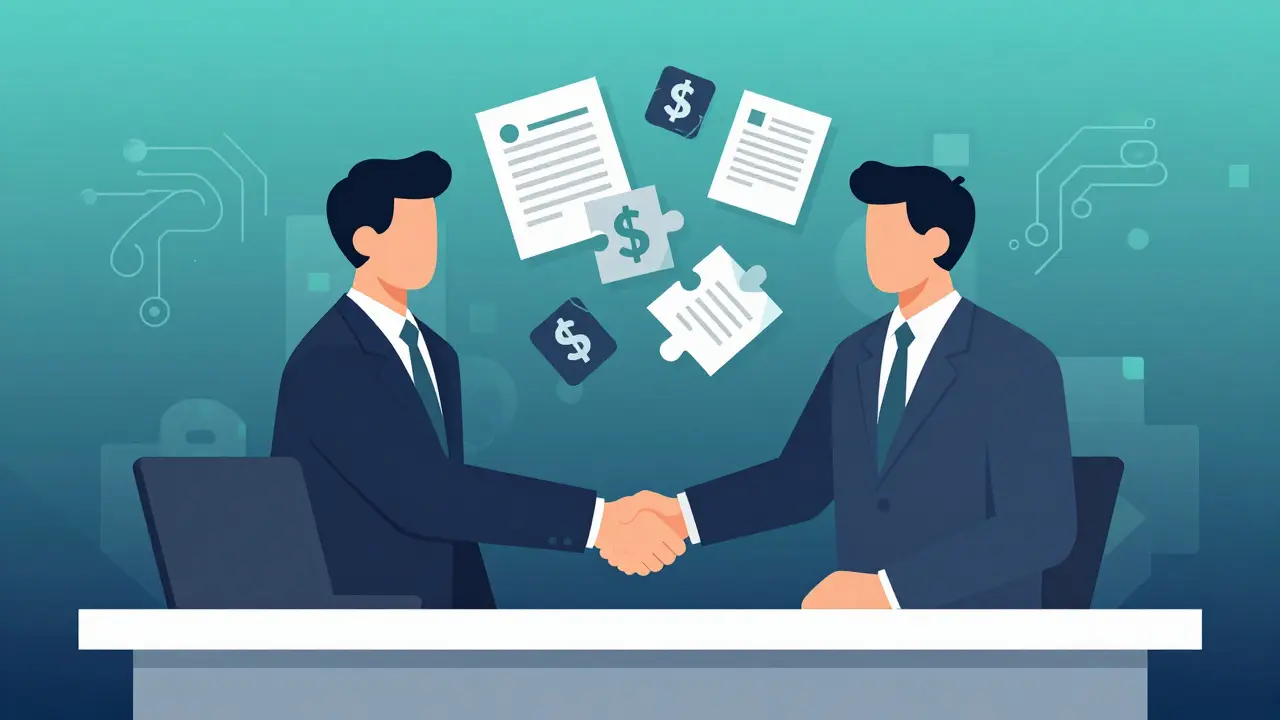
When two big companies are fighting over a patent, they’re not just arguing about who invented what. They’re weighing millions in legal fees, market share, and future innovation. Most of these fights don’t end in court. They end in a quiet room with lawyers, engineers, and executives making deals. That’s the real story behind patent settlements - and how companies negotiate entry into each other’s markets without blowing up their balance sheets.
Why Most Patent Cases Never Go to Trial
You’d think patent lawsuits would be common. After all, tech companies hold thousands of patents. But here’s the truth: 85.7% of patent disputes settle before trial. That’s not luck. It’s strategy. Going to court costs between $3 million and $5 million on average - and that’s just for cases under $25 million in damages. For a company selling smartphones or medical devices, that’s not a cost. It’s a risk. And risk is something smart companies avoid when they can buy certainty instead. The real goal isn’t to win. It’s to control the outcome. A settlement lets you decide how much you pay, what rights you get, and when you can launch your product. No jury. No appeal. No surprise verdicts. Just a contract.The Anatomy of a Patent Settlement
A good settlement doesn’t happen by accident. It’s built on three pillars: clarity, leverage, and trade-offs. First, companies need to know exactly which patents are in play. In high-stakes cases, that’s usually 3 to 15 key patents - not the whole portfolio. They pull out the claims, map them to the accused product, and test whether those patents can even hold up. A 2021 USPTO study found that nearly 40% of patents asserted in court were later invalidated. If your strongest patent is weak, you don’t have leverage. You have a liability. Second, they build a claim chart. This isn’t legal jargon. It’s a simple table showing: Here’s your patent. Here’s our product. Here’s how they match. It’s the visual proof that turns a vague accusation into a concrete negotiation point. Third, they run a validity stress test. What prior art could kill this patent? Is there an old textbook, a failed product, or a 1990s patent that already covered this idea? Companies spend $150,000 to $300,000 on this step before even sitting down. Why? Because if you don’t know your weaknesses, the other side will find them - and use them to crush your offer.How Settlements Actually Work
There are three main ways companies settle:- Lump-sum payments: One company pays the other a fixed amount. Simple. Common in cases involving non-practicing entities (NPEs), or “patent trolls.” Median payout? Around $1.2 million.
- Royalty deals: The infringing company pays a percentage of sales. For standard-essential patents (like 4G or 5G tech), that’s usually 1.5% to 5% of device revenue. Ericsson and Samsung settled for 0.5% to 2.5%, depending on phone price.
- Cross-licensing: Both sides give each other rights to their patents. This is huge in tech. In 2023, 73% of disputes between major electronics firms ended this way. It’s not about who wins. It’s about who can keep building.
When Negotiations Fail - And Why
Not every deal closes. And the reasons are telling. One big problem? Anchoring. If you start by asking for $50 million, you’re more likely to get $20 million than if you started at $15 million. A 2022 University of Chicago study showed plaintiffs who asked for three times their target ended up with 28% more money. It’s psychological. But it also burns bridges. Companies that overreach often end up in court anyway - and lose credibility. Another trap? Thinking patents are like real estate. You can’t just slap a price on them. A patent’s value changes based on validity, enforceability, and market relevance. A patent covering a dying technology? Worthless. One tied to a 5G chip used in 100 million phones? Gold. And then there’s trust. Traditional settlements rely on it. If one side hides a weak patent, or misrepresents its product, the deal collapses. That’s why cross-licensing works better between companies with long-term relationships - like Intel and MEDIATEK. After their 2018 settlement, they didn’t just sign a license. They co-developed 5G tech together. That deal saved them over $200 million in R&D.The New Tools Changing the Game
Patent negotiation isn’t stuck in the 2000s. New tools are reshaping how companies prepare. The USPTO’s Patent Evaluation Express (PEX) program, launched in 2023, gives companies a fast, low-cost way to get a non-binding opinion on whether a patent is likely to hold up. It costs 60% less than a full post-grant review. Already, 17% of new settlements use it as a bargaining chip. AI tools like PatentSight’s Freedom-to-Operate analyzer cut weeks off portfolio reviews. Instead of 3-4 weeks of manual searching, engineers get results in 3-5 days. But don’t trust them completely. A 2023 study in Nature Machine Intelligence found AI still misses nearly 19% of key prior art. Human experts still win - but only if they use AI to do the heavy lifting. And soon, payments might be automated. IBM and Microsoft are testing blockchain-based smart contracts that adjust royalty payments in real time based on actual sales data. No more audits. No more disputes over quarterly reports. Just code that pays when it should.
What Happens After the Deal?
Settlements aren’t the end. They’re the start of a new relationship. In Europe, the Unified Patent Court opened in June 2023. Now, one decision affects 17 countries. That’s changed everything. Companies used to settle separately in Germany, France, and the UK. Now, they negotiate one deal that covers the whole region. Cross-border settlements in Europe jumped 22% in the first six months. In the U.S., companies with over 1,000 patents settle 89% of disputes. Smaller firms? Only 63%. Why? Because big companies can afford to wait. They can outlast a lawsuit. They have teams of 7-8 patent specialists on staff. Small companies? They hire lawyers by the hour - at $350 to $950 an hour - and hope they don’t get crushed. And then there’s regulation. If a patent covers a standard everyone uses - like Wi-Fi or cellular tech - you’re bound by FRAND rules: fair, reasonable, and non-discriminatory. Qualcomm got fined €242 million by the European Commission for using settlements to block competitors. That’s the line you can’t cross.Who Wins in Patent Settlements?
The real winners aren’t the lawyers. They’re the companies that treat patents like business tools, not weapons. Apple and Samsung spent years in court over phone designs. But in the end, they didn’t settle by paying each other. They settled by cutting the number of disputed patents from 10 down to 5. That’s not compromise. That’s focus. They stopped fighting over everything and started negotiating over what mattered. The same logic applies today. In AI, quantum computing, and biotech, a single product can touch 500+ patents. No one can fight all of them. The smart move? Negotiate. License. Collaborate. Patents aren’t about ownership. They’re about access. And the companies that understand that - the ones who see settlement not as surrender, but as strategy - are the ones who keep building, keep innovating, and keep winning.What percentage of patent disputes end in settlement?
About 85.7% of patent disputes settle before trial, according to a 2022 Stanford Law School study of 10,000 cases from 2010 to 2020. Most settle between the Markman hearing and summary judgment - often within 6 to 9 months of filing.
How much do patent settlements typically cost?
Settlement values vary widely. Non-practicing entity (NPE) cases average $1.2 million. Competitor disputes average $8.7 million. Royalty deals usually range from 1.5% to 5% of product revenue. High-low settlements set fixed floors and ceilings, often between $1 million and $10 million depending on the case.
What’s the difference between a licensing deal and a cross-license?
A licensing deal means one company pays the other for the right to use a patent. A cross-license means both companies give each other rights to their own patents. Cross-licensing is common in tech industries like semiconductors and telecom, where both sides hold valuable patents and want to avoid litigation.
Why do some patent settlements fail?
Settlements often fail when one side overvalues their patents, hides weaknesses, or uses aggressive tactics like injunctions. NPEs rarely settle successfully under high-low structures because they don’t care about your business - only cash. Poor preparation, lack of trust, and anchoring too high in initial offers also derail deals.
Are patent settlements regulated?
Yes, especially for standard-essential patents (SEPs). Companies must offer licenses on FRAND terms - fair, reasonable, and non-discriminatory. The European Commission fined Qualcomm €242 million in 2018 for using settlements to block competitors. Antitrust laws prevent companies from using patents to monopolize markets.
How long does a patent settlement negotiation take?
Most large-company negotiations take 6 to 9 months. The process usually starts after the Markman hearing, where the court interprets patent claims. About 68% of settlements happen between that stage and summary judgment. Smaller cases can resolve faster, especially with mediation or the USPTO’s Patent Evaluation Express program.



Molly McLane January 4, 2026
It's wild how patent fights are less about who invented what and more about who can afford to play the long game. I've seen startups get crushed because they didn't realize a big company could just outlast them in court. The real win isn't the settlement-it's knowing when to walk away or when to partner up.
And honestly? The USPTO's PEX program is a game-changer for small teams. No more begging for legal aid just to get a basic opinion. It's like giving the little guys a flashlight in a room full of elephants.
Katie Schoen January 5, 2026
So let me get this straight-we spend millions to avoid a trial, just so we can all sit in a room and pretend we’re not just haggling over who gets to use the same tech? Classic capitalism.
Also, ‘high-low’ settlements? That’s not strategy. That’s just corporate poker with a spreadsheet. And don’t even get me started on NPEs. They’re the guys who buy patents like baseball cards and wait for someone to sneeze the wrong way.
Lily Lilyy January 7, 2026
It is so important to remember that patents are meant to help innovation, not stop it. When companies use them as weapons, we all lose. But when they work together, like Intel and MEDIATEK did, that is true progress.
Let us choose collaboration over conflict. Let us build the future, not just protect the past. Every child deserves to grow up in a world where ideas are shared, not locked away.
Thank you for sharing this thoughtful look at how business can be done with heart and wisdom.
Harshit Kansal January 9, 2026
Bro, I work in a startup and we got hit with a patent letter last year. We didn’t even have a lawyer on payroll. Just sent them a meme of a crying lawyer and they backed off. No joke. Sometimes the best defense is making them feel dumb.
Brian Anaz January 9, 2026
These ‘settlements’ are just corporate surrender. America built this tech empire on hard work and legal muscle-not backroom deals with some Indian firm paying pennies to license our IP. If you can’t fight for your rights, you don’t deserve them.
And why is everyone acting like cross-licensing is noble? It’s just collusion with a fancy name. We’re letting foreign companies walk all over our innovation. Wake up.
Venkataramanan Viswanathan January 9, 2026
Patent settlements are not merely legal transactions; they are strategic maneuvers embedded in the architecture of global innovation ecosystems. The notion that litigation avoidance equates to weakness is a profound misunderstanding. In fact, the ability to negotiate with precision reflects institutional maturity.
Moreover, the emergence of the Unified Patent Court has introduced a new dimension of legal harmonization, which, while complex, is ultimately beneficial for multinational enterprises operating across jurisdictions.
Vinayak Naik January 10, 2026
Yo, the part about AI missing 19% of prior art? That’s wild. I saw a tool last week that said a patent was ‘original’-turns out it was just a 1987 Nokia phone spec repackaged. Human eyes still beat bots, but man, the bots are getting scarily good.
Also, cross-licensing is how real tech bros play. No drama. Just ‘you use my wifi chip, I use your battery algo.’ Simple. Clean. No lawyers needed. Except when they are. Always except when they are.
Matt Beck January 12, 2026
Isn’t it just… poetic? We’ve built a civilization where the most powerful minds spend years crafting inventions… only to trade them like baseball cards in a boardroom while the world burns?
Patents were supposed to be the spark of genius… now they’re the handcuffs of capitalism. We don’t need more settlements. We need a revolution. A new covenant. A world where knowledge isn’t owned-it’s breathed.
And blockchain royalties? That’s not progress. That’s just automation of exploitation. We’re outsourcing our ethics to code. And code… doesn’t care.
...I’m not even mad. I’m just… disappointed.
Ryan Barr January 13, 2026
Settlements are the default. Innovation is the exception.