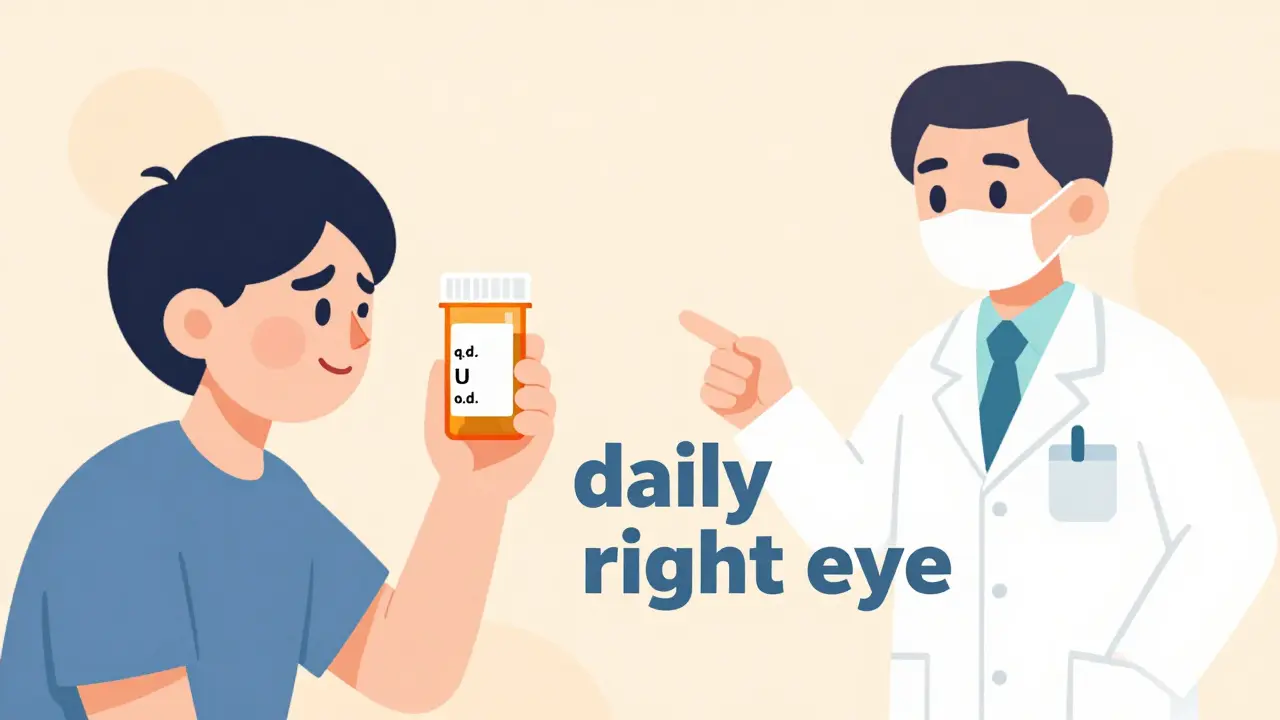
Ever looked at your prescription label and felt like you’re reading a secret code? You’re not alone. That tiny q.d. or o.d. might seem harmless, but misreading them can lead to serious mistakes - even death. These aren’t just random letters. They’re Latin abbreviations that have been used for over 400 years, and while they were meant to save time, they’re now one of the biggest hidden dangers in medicine.
Why These Abbreviations Still Exist
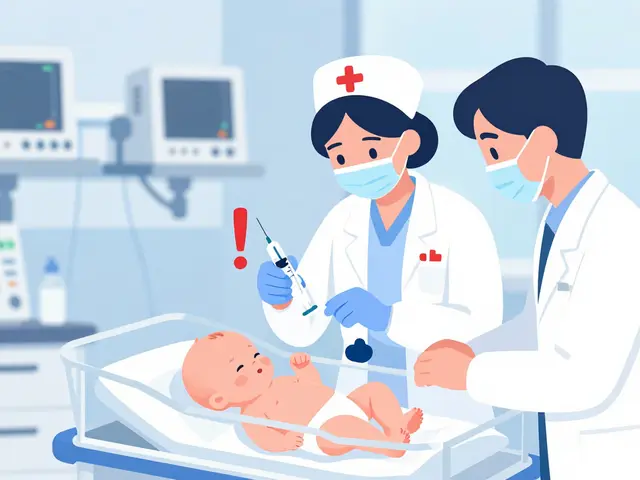
The symbol Rx - the one you see at the top of every prescription - comes from the Latin word recipe, meaning "take." It’s been around since the 1500s. Back then, doctors wrote in Latin so their prescriptions could be read across Europe. Today, it’s not about language anymore - it’s about habit. Many doctors still use these shortcuts because they’ve always done it that way. But here’s the problem: what’s fast for them can be dangerous for you.According to the Institute for Safe Medication Practices, about 6.8% of all medication errors in U.S. hospitals are caused by confusing abbreviations. That’s not a small number. It’s thousands of mistakes every year - some leading to overdoses, wrong dosages, or even giving the wrong drug entirely.
The Most Dangerous Abbreviations You Need to Know
Some abbreviations are so risky they’ve been banned in hospitals and pharmacies across North America. But you won’t always see the ban on your label. Here are the top offenders:- U for units - This one has killed people. A handwritten "U" can look like a "4" or an "0." One mistake, and someone gets 10 times the dose they should. That’s why it’s now required to write out "units."
- q.d. for daily - Sounds simple, right? But it’s often misread as q.i.d. (four times a day). The Joint Commission banned q.d. in 2004 because of this exact error. Now, it must say "daily."
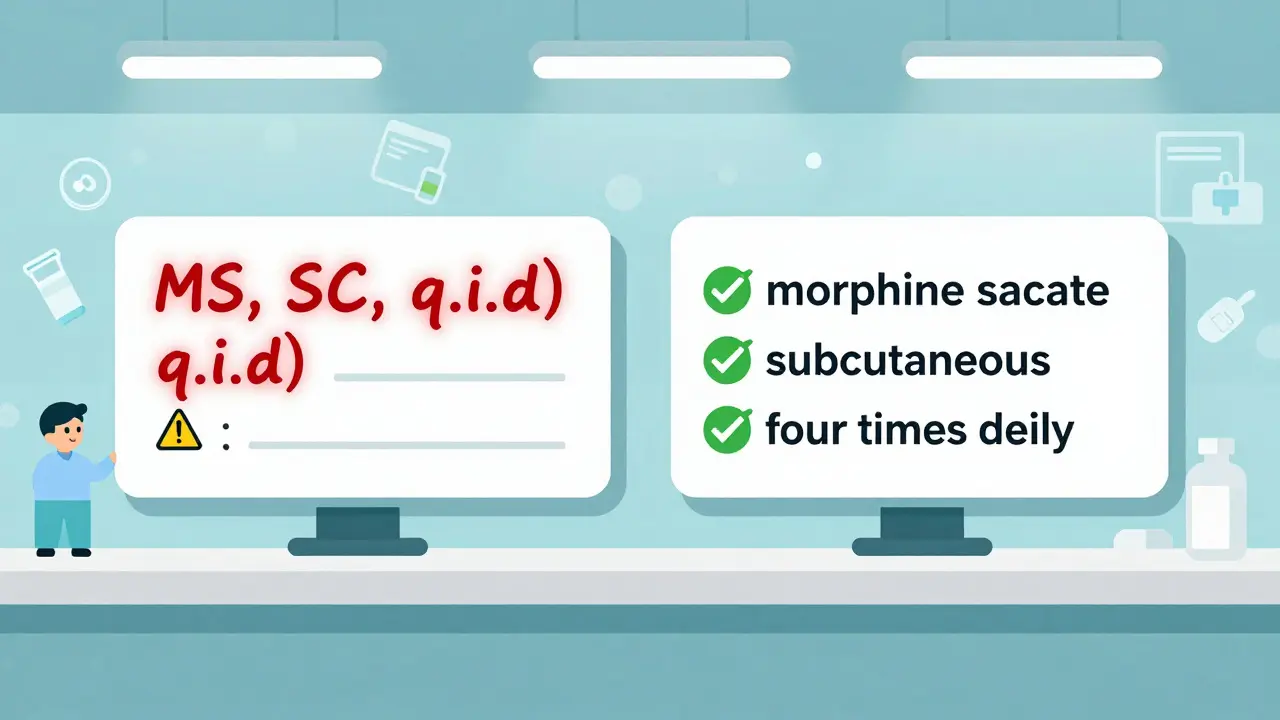
- MS for morphine sulfate - But it could also mean magnesium sulfate. These are two completely different drugs. One is for pain. The other is for heart rhythm. Mixing them up can be deadly. Most hospitals now require full spelling: "morphine sulfate."
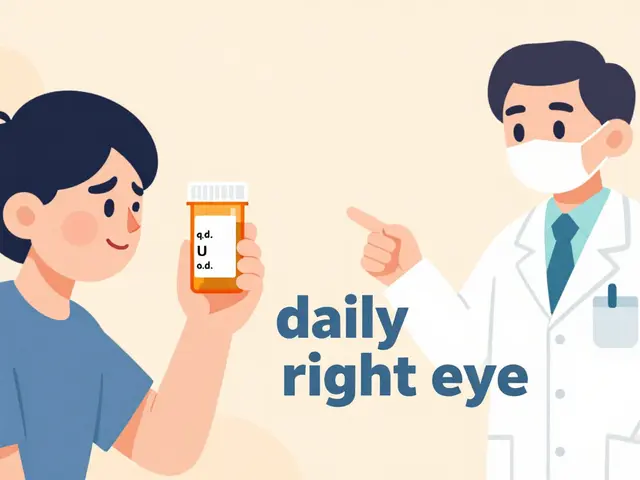
- o.d. and o.s. - These stand for right eye and left eye. But patients and even some staff read them as "overdose." In 2022, the American Academy of Ophthalmology reported over 2,100 cases where "o.d." was mistaken for "overdose." That’s why many pharmacies now print "right eye" and "left eye" on the label.
- SC or SQ for subcutaneous - This is how insulin is given. But if it’s misread as "SL" (sublingual), someone might swallow the shot instead of injecting it. That’s happened. And it’s dangerous.
These aren’t theoretical risks. In 2023, the American Hospital Association documented over 14,000 incidents tied to these exact abbreviations. The most common? "OD" read as overdose. "SC" read as SL. "1.0 mg" read as 10 mg.
What You’ll See on Your Prescription Label Today
Pharmacies are changing. Most big chains - CVS, Walgreens, Walmart - now convert all abbreviations on patient labels into plain English. So if your doctor wrote "b.i.d.", you’ll see "twice daily." If it says "t.i.d.", it’ll say "three times a day." This isn’t optional anymore. It’s a safety rule.Here’s what you should actually see on your label now:
- q.d. → daily
- b.i.d. → twice daily
- t.i.d. → three times daily
- q.i.d. → four times daily
- p.o. → by mouth
- p.r. → rectally
- o.d. → right eye
- o.s. → left eye
- a.d. → right ear
- a.s. → left ear
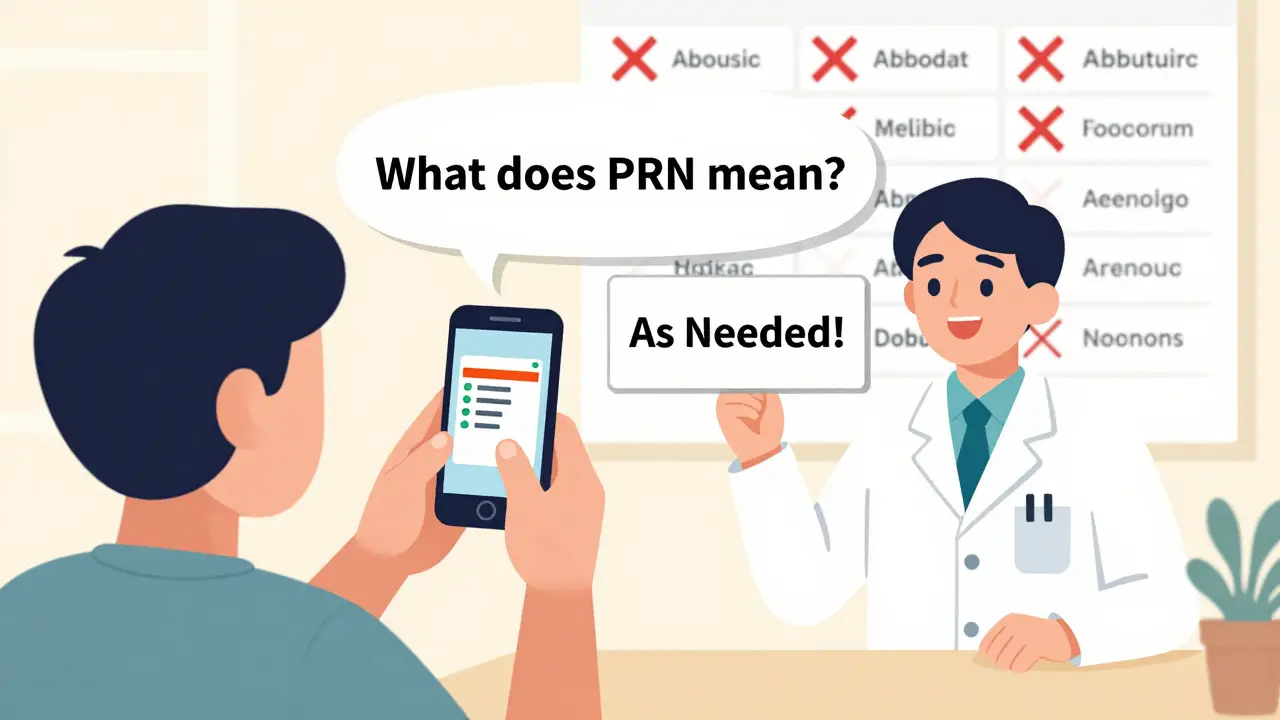
- PRN → as needed
- U → units
- MS → morphine sulfate
Some labels still have old abbreviations - especially if they came from a doctor using a paper script or an outdated electronic system. That’s why you need to double-check.
How Pharmacists Catch These Mistakes
Pharmacists don’t just hand out pills. They’re trained to spot red flags. Here’s how they protect you:- Automated alerts - When a prescription comes in with "U" or "q.d.", the pharmacy system flags it automatically. It won’t let the pharmacist process it until it’s changed.
- Second review - Every prescription goes through two checks. One by the tech, one by the pharmacist. If anything looks off, they call the doctor.
- Patient counseling - When you pick up your meds, the pharmacist is supposed to explain how to take them. If you hear "b.i.d." and say, "What does that mean?" - they’ll say, "Twice a day. Here’s how."
According to the National Association of Chain Drug Stores, 98.7% of major U.S. pharmacy chains now use automated systems to block dangerous abbreviations. That’s a huge improvement from 10 years ago.
What You Can Do to Stay Safe
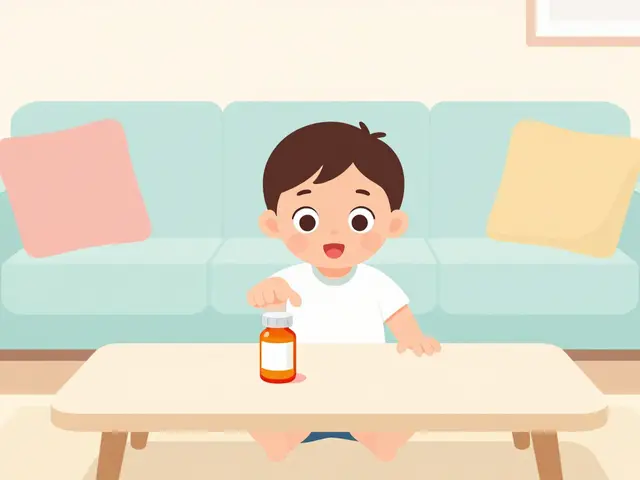
You’re not powerless here. You can protect yourself:- Always ask - If you see any abbreviation you don’t understand, ask the pharmacist to explain it. No shame in that. They’re there to help.
- Read the label - Don’t just glance. Compare what’s written on the bottle to what the doctor told you. If it says "twice daily" but you thought it was "once a day," speak up.
- Take a photo - Before you leave the pharmacy, snap a picture of the label. If you forget how to take it, you’ve got a backup.
- Know the red flags - If you see "U," "MS," "q.d.", or "o.d." on your label, don’t assume it’s correct. Ask if it’s been changed to plain English.
One pharmacist in Toronto told me last month: "I had a patient come in last week with a script that said ‘MSO4.’ We thought it was morphine sulfate. Turned out it was magnesium sulfate. We caught it because we always ask. That’s one mistake we didn’t make."
The Future: No More Latin
The writing is on the wall. The World Health Organization wants all prescription abbreviations in plain English by 2030. Canada, Australia, and Germany are already moving that way. The U.S. Pharmacopeia made it official in May 2024: all prescriptions must use English terms, with only a few exceptions like "mg" and "mL."Electronic systems are making this easier. Tools like Epic’s SafeScript and Cerner’s HealtheIntent now auto-convert abbreviations before the prescription even reaches the pharmacy. AI systems like IBM Watson’s MedSafety AI are getting 99.2% accuracy in translating old codes into clear language.
But change is slow. About 41% of community pharmacies still get prescriptions with old abbreviations. That’s why your role matters. If you ask questions, you’re not being difficult - you’re saving lives.
What’s Still Allowed (and Why)
Not all abbreviations are banned. Some are considered safe because they’re clear and rarely confused:- PRN - means "as needed." It’s used so often, and it’s hard to misread.
- mcg - micrograms. Used instead of "μg" because the Greek letter is hard to read.
- mg, mL, g - metric units. These are universal and not confusing.
- QOD - every other day. Still used in some places, but many pharmacies now write "every other day" to avoid confusion with "QD."
Even these aren’t perfect. Some experts argue that even "PRN" should be spelled out. But for now, these are the ones you’re most likely to still see - and they’re generally safe.
Why This Matters More Than You Think
This isn’t just about reading labels. It’s about trust. When you don’t understand your medication, you’re more likely to skip doses, take too much, or stop altogether. A 2023 study found that patients who understood their prescriptions were 57% more likely to take them correctly.And the cost? Medication errors from abbreviations cost the U.S. healthcare system $2.17 billion in 2023. That’s billions of dollars spent treating mistakes that could have been avoided with a few simple words.
So next time you get a prescription, don’t just take it. Read it. Ask about it. If something looks strange - even if it’s just one letter - say something. You’re not being annoying. You’re being smart.
What does Rx mean on a prescription?
Rx comes from the Latin word "recipe," which means "take." It’s not a symbol for a drug - it’s an instruction to the pharmacist: "Take this and prepare it." You’ll see it at the top of every prescription, no matter what the medicine is.
Is q.d. the same as daily?
Yes, q.d. means "quaque die," which is Latin for "every day." But because it’s often misread as q.i.d. (four times a day), hospitals and pharmacies now require it to be written as "daily." If you see q.d. on your label, ask if it’s been updated.
Why is U dangerous on a prescription?
"U" stands for units - like insulin units. But handwritten, it can look like a "4," a "0," or even a "40." One patient got 10 times their dose because "5 U" was read as "50." That’s why it’s now required to write out "units." Never trust a handwritten "U."
What does o.d. mean on an eye drop bottle?
o.d. stands for "oculus dexter," which means right eye. o.s. means left eye. But many people read o.d. as "overdose," which is dangerous. Most pharmacies now print "right eye" and "left eye" on labels to avoid confusion.
Can I ask my pharmacist to explain my prescription?
Absolutely. Pharmacists are trained to explain medications. You don’t need to be an expert to ask, "What does this mean?" or "How often should I take this?" If they don’t explain clearly, ask again. Your safety is worth it.
Are abbreviations banned in Canada?
Canada doesn’t ban all abbreviations, but it strongly discourages high-risk ones like U, MS, and q.d. Most pharmacies convert them to plain English on patient labels. The Canadian Institute for Safe Medication Practices recommends using full terms whenever possible.
Why do doctors still use Latin abbreviations?
Many learned them in medical school and still use them out of habit. Some electronic systems auto-fill them. Others use paper scripts that haven’t been updated. But as more hospitals switch to digital systems with built-in safety checks, these abbreviations are disappearing - slowly.
What should I do if I find a mistake on my prescription label?
Don’t take the medication. Call the pharmacy immediately. If they say it’s correct but you’re still unsure, call your doctor’s office. It’s better to wait 10 minutes than to risk taking the wrong dose.







Nikki Brown December 25, 2025
I can't believe we're still allowing Latin abbreviations in 2024. This isn't medieval medicine-it's a public safety crisis. If your doctor can't write 'daily' instead of 'q.d.', they shouldn't be licensed. I've seen people nearly die because of this lazy, archaic nonsense. It's criminal.
Peter sullen December 25, 2025
The pharmacovigilance infrastructure in the United States has undergone a remarkable evolution over the past decade, particularly with regard to standardized nomenclature in pharmaceutical labeling. The implementation of automated decision-support systems within dispensing pharmacies has demonstrably reduced iatrogenic error rates by an order of magnitude, as corroborated by peer-reviewed data from the Institute for Safe Medication Practices.
Steven Destiny December 25, 2025
Stop being so polite. If you see 'U' or 'MS' on your script, throw it back in their face. Don't wait. Don't ask nicely. Say, 'This is dangerous, fix it NOW.' That's how you protect yourself. The system won't change unless you scream loud enough.
Fabio Raphael December 27, 2025
I used to think I was just bad at reading labels, but after reading this, I realize it's not me-it's the system. I had a script with 'o.d.' last year and assumed it meant 'overdose.' I didn't take it for a week because I was scared. Turns out it was for eye drops. I wish someone had told me earlier. This stuff matters.
Amy Lesleighter (Wales) December 28, 2025
why do they still use all this latin stuff?? i mean like... its 2024. just say 'right eye' or 'twice a day'. why make it hard? i dont even know what q.d. means and im an adult. this is dumb.
Becky Baker December 29, 2025
America’s healthcare is still stuck in the 1800s? No wonder other countries laugh at us. We’ve got AI that can write poetry but can’t make a prescription readable? Fix it. Or get out of the 21st century.
Rajni Jain December 29, 2025
I came from India where we still see 'q.d.' on paper scripts too. But here, the pharmacist always explains it in Hindi or English. I think it’s not about the country-it’s about the pharmacy. Good ones fix it. Bad ones don’t care. Always ask. You’re worth it.
Natasha Sandra December 29, 2025
OMG I had no idea 'U' could be confused with '4' 😱 I just got my insulin script and saw '5 U'-I called the pharmacy right away. They fixed it to '5 units' immediately. THANK YOU for this post. I’m saving it. 💙
Erwin Asilom December 29, 2025
The most effective safeguard isn’t the technology-it’s the patient asking. The pharmacist’s counseling step is the last line of defense. If you don’t engage, the system fails. Don’t be shy. Ask. Even if it feels awkward. It’s your life.
Sumler Luu December 30, 2025
I appreciate the effort to explain this, but I’m still confused about 'PRN.' Is it really safe? I’ve seen it used for pain meds and anxiety meds-could someone take too much if they think 'as needed' means 'whenever I feel like it'?
sakshi nagpal December 31, 2025
This is a great summary. I work in public health in Delhi, and we see similar issues. Even in digital systems, legacy codes persist. The real solution is education-not just for patients, but for doctors still trained in old habits. We need mandatory refresher courses.
Sandeep Jain January 1, 2026
i never knew 'sc' could be confused with 'sl'... my grandma took her insulin by mouth once because the script said 'sc' and she thought it was 'sl'. she was fine but scared the hell out of us. this is wild.
roger dalomba January 2, 2026
Wow. A 1,200-word essay on why doctors can’t type. Groundbreaking.
Brittany Fuhs January 4, 2026
This is why America is falling behind. We let uneducated people make medical decisions. If you can’t read a simple Latin abbreviation, maybe you shouldn’t be taking pills. This isn’t a public health crisis-it’s a personal responsibility crisis.