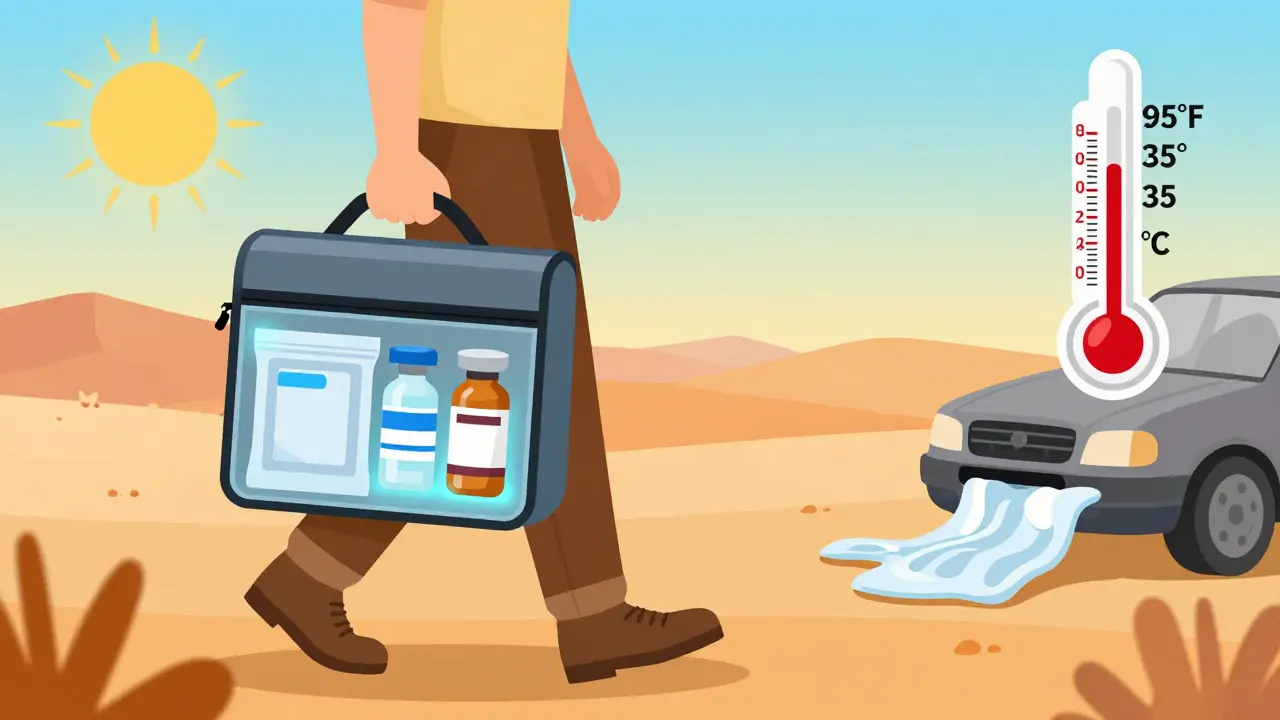
When you're traveling with medications like insulin, vaccines, or certain antibiotics, the weather outside can make all the difference between a dose that works and one that’s completely useless. It doesn’t matter how carefully you stored your pills at home - if they get too hot or too cold during transport, they can break down before you even take them. This isn’t just a theory. Real people have lost months of treatment because their insulin turned cloudy after sitting in a car on a 95°F day. Others had vaccines rendered useless after being left in a freezing delivery van overnight. The science is clear: temperature-sensitive medications have narrow safe zones, and crossing them can mean serious health risks.
What Temperature Ranges Matter for Your Medications?
Not all medications are the same. They fall into three main groups based on what temperature they need to stay safe:- Ambient (15°C-25°C): This is the sweet spot for most tablets, capsules, and some oral liquids. If you’re carrying aspirin, blood pressure pills, or antibiotics like amoxicillin, they’ll be fine in your purse or backpack - as long as you’re not leaving them on a dashboard in summer.
- Refrigerated (2°C-8°C): This is where things get serious. Insulin, many vaccines (like MMR or flu shots), biologic drugs, and some eye drops must stay cold. If these warm up, they lose potency fast. Insulin can degrade at 1.2% per hour above 25°C. A vaccine like MMR can lose 10% of its effectiveness every hour above 8°C. That’s not a slow fade - it’s a rapid failure.
- Cryogenic (below -150°C): Only a few specialized treatments, like certain mRNA vaccines or tissue samples, need this level of cold. Most travelers won’t encounter this, but if you’re transporting one, you need professional cold chain equipment - no DIY solutions here.
Check the label or ask your pharmacist. If it says "store in refrigerator," treat it like a perishable food item - because that’s exactly what it is.
Hot Weather: The Silent Killer of Medications
Summer heat is brutal on meds. Cars can hit 60°C on a 30°C day. That’s hotter than an oven. If you’ve ever left a bottle of insulin in a glove compartment, you’ve already taken a gamble.Here’s what actually works:
- Keep meds in your bag, not the car. Even if you’re parked in the shade, the inside of a car is a heat trap.
- Use an insulated lunch bag with two frozen gel packs. Studies show this setup can keep meds between 2°C and 8°C for up to 8 hours in 90°F weather.
- Avoid direct sunlight. Don’t let your meds sit near a window - UV exposure can also degrade some drugs.
- Never leave them unattended. A 2023 survey found that 68% of pharmacy-reported temperature excursions happened when packages were left outside delivery doors or in unattended luggage carts.
One traveler in Melbourne shared that her insulin became cloudy after a 45-minute car ride in 35°C heat. She didn’t know it was ruined until her pharmacist checked the batch. The damage was irreversible. That’s why you can’t rely on appearance alone. Degraded meds often look normal.
Cold Weather: When Freezing Isn’t Just Uncomfortable - It’s Dangerous
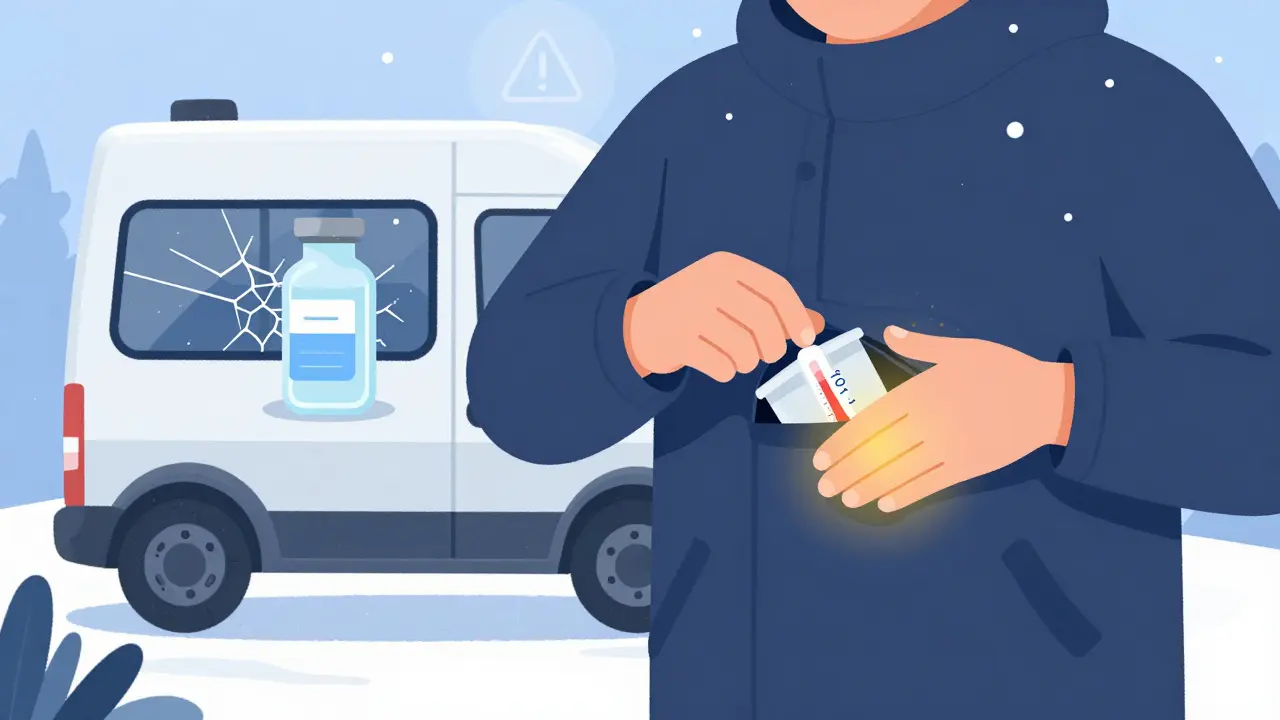
Cold weather is often overlooked. People think, "If heat ruins meds, then cold must help." Not true. Freezing can destroy the structure of liquid medications.Insulin, for example, can form clumps or crystals when frozen. Even if it thaws, it won’t work the same. Vaccines can lose stability. Some liquid antibiotics become ineffective after just one freeze-thaw cycle.
Here’s how to protect your meds in winter:
- Keep them close to your body. In a coat pocket or inside your jacket - your body heat is your best insulation.
- Avoid leaving them in unheated cars overnight. If you’re staying at a cabin or hotel with no heating, bring meds inside with you.
- Use insulated containers with thermal blankets. If you’re shipping meds in freezing conditions, wrap them in an insulated blanket and avoid exposing them for more than 5 minutes during transfers.
- Don’t use ice packs in freezing temps. They can turn into solid blocks and damage containers. Instead, use room-temperature gel packs or just rely on insulation.
A logistics manager at Pfizer reported a 17% spike in cold-related excursions during the 2022-2023 winter. Why? Transport vehicles weren’t designed for extreme cold, and drivers didn’t realize that even a 10-minute delay at a border checkpoint could freeze shipments.
What Packaging Actually Works?
Not all coolers are created equal. Here’s what’s out there:| Type | Temperature Range Maintained | Duration | Cost | Best For |
|---|---|---|---|---|
| Insulated Lunch Bag + Gel Packs | 2°C-8°C | 6-8 hours | $10-$20 | Day trips, short flights |
| Passive Cold Chain Box (e.g., TempAid 2.0) | 2°C-8°C | 48 hours | $80-$120 | Long flights, international travel |
| Active Cooling Unit (Battery-Powered) | Constant 4°C | Indefinite | $300-$600 | Extended travel, remote areas |
| Standard Plastic Container | None | Less than 2 hours | $5 | Ambient-only meds, short trips |
The TempAid 2.0, a popular travel case with 4.7/5 stars on Amazon, is often recommended by pharmacists. It’s lightweight for its capacity, holds meds at 2°C-8°C for two full days, and has been tested in real-world conditions - from Australian summers to Canadian winters. But it’s heavy for its size (3.2 lbs) and only fits 3-4 vials. Plan ahead.
The Last Mile Is Where Most Failures Happen
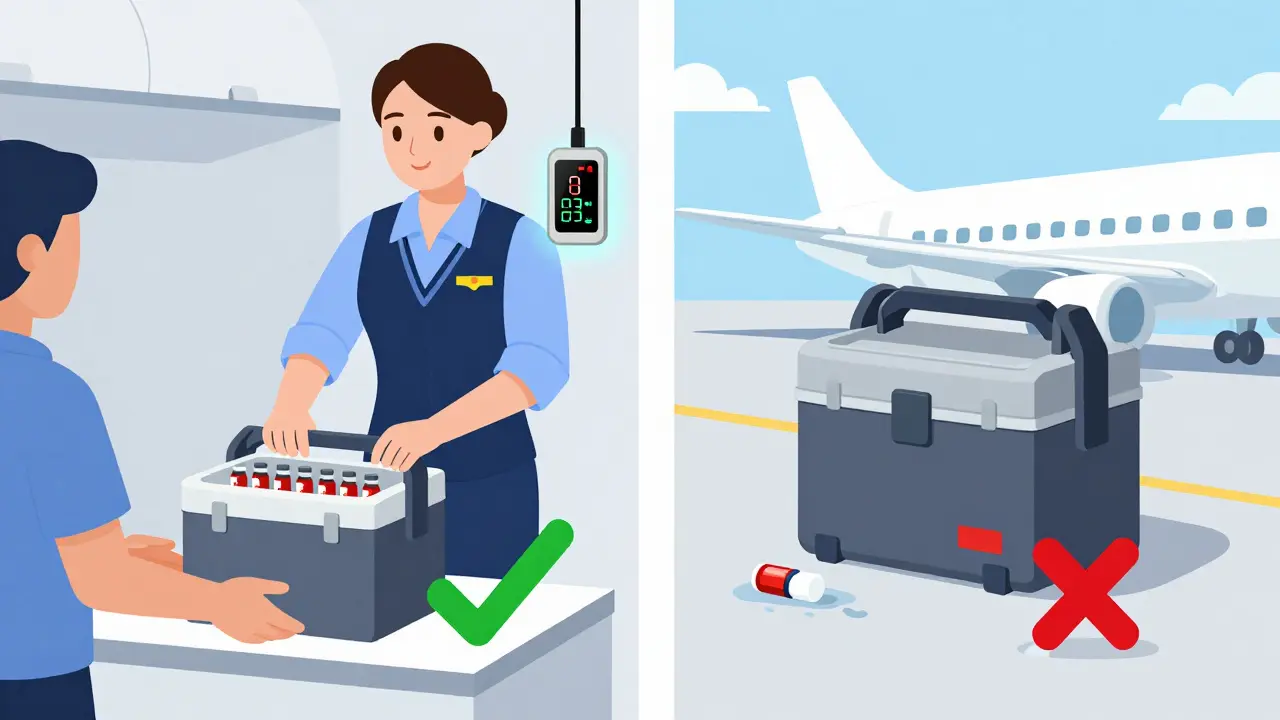
Here’s the shocking truth: most temperature excursions don’t happen during flights or long drives. They happen at the end.Think about it: you get off the plane, grab your bag, and leave your meds in the overhead bin while you wait in line. Or you arrive at your hotel, and the bellhop leaves your bag in the car while he checks you in. Or your delivery driver leaves your insulin on the porch in 40°C heat.
Studies show that 43% of all temperature excursions occur during final delivery. That’s why:
- Always hand your meds directly to a person - never leave them unattended.
- Ask airline staff to store your meds in the flight crew’s cooler. Most will do it if you ask politely.
- If you’re getting meds delivered, schedule it for a time when you’ll be home. Or leave a note: "Do not leave package outside. Must be kept cool."
One Reddit user wrote: "I thought my insulin was fine because it didn’t look broken. But after I used it, my blood sugar spiked. The pharmacist said it had been frozen during shipping. I never knew it was a risk."
Documentation and Monitoring: Don’t Skip This
If you’re carrying a high-value medication - like a $1,000 monthly biologic - you should consider a temperature data logger. These tiny devices record temperature every 15 minutes and store the data. Some even send alerts via Bluetooth if things go out of range.Pharmaceutical companies use them. You should too. The FDA says: "Quality is determined by maximum exposure, not average." A single hour above 25°C can ruin insulin. A thermometer that only shows the highest and lowest temp won’t catch that.
Even if you don’t use a device, keep receipts. If your meds are damaged, you’ll need proof of how long they were exposed - and where. Keep your boarding passes, delivery slips, and any labels that show dates and times.
What to Do If Your Medication Gets Too Hot or Too Cold
If you suspect your meds were compromised:- Don’t use them.
- Call your pharmacist or doctor immediately. They can tell you if the medication is still safe based on exposure time and type.
- Ask for a replacement. Most insurance plans cover emergency refills if you have documentation.
- Report the incident. If it happened during shipping, contact the courier. If it was at a pharmacy, report it to the health department. This helps improve systems.
Insulin that’s been frozen? Throw it out. Vaccines exposed to heat? Don’t risk it. Antibiotics that were left in a hot car? Replace them. It’s cheaper than a hospital visit.
Final Tips for Travelers
- Carry a copy of your prescription. It helps if customs asks why you’re carrying syringes or vials.
- Bring extra. Always have at least a 3-day supply on hand in case of delays.
- Know your destination’s climate. If you’re flying to Dubai in July, pack for 45°C. If you’re going to Alaska in January, prepare for -30°C.
- Don’t rely on airport security to keep your meds cool. They’ll scan them - but they won’t store them.
- Use the airport’s medical assistance desk. Many have refrigerated storage for passengers.
Climate change is making this harder. Heatwaves, snowstorms, and power outages are more frequent. What worked in 2020 might not work in 2026. Stay informed. Stay prepared.
Can I keep my insulin in the fridge while flying?
No. Airplane cargo holds can drop below freezing, which can damage insulin. Instead, carry it in a cooler with gel packs. Most airlines allow you to store personal medications in the cabin crew’s refrigerator - just ask.
What if I don’t have an insulated bag?
Use a thermos or insulated lunch bag with two frozen gel packs. Wrap the bag in a towel for extra insulation. Even a regular plastic container with a cold pack will help for short trips under 4 hours.
Do I need to declare medications at customs?
Yes, especially if you’re carrying syringes, injectables, or controlled substances. Always carry a doctor’s note or prescription. Some countries have strict rules - Australia, for example, requires a declaration for all prescription medications.
How long can vaccines last outside the fridge?
It depends. Most vaccines can last 1-2 hours at room temperature (up to 25°C), but after that, potency drops quickly. Some, like mRNA vaccines, degrade in as little as 30 minutes above 8°C. Always follow the manufacturer’s guidelines - they’re based on real stability testing.
Is it safe to use a regular cooler for meds?
Only if you’re using it properly. A regular cooler can work if you pre-chill it, use enough ice packs, and avoid opening it often. But for critical meds like insulin or vaccines, a validated pharmaceutical-grade container is safer. It’s designed to maintain temperature under extreme conditions.
Next Steps: What to Do Today
- Check your medications’ storage requirements. Look at the label or call your pharmacy.
- If you travel often, invest in one validated travel case like the TempAid 2.0.
- Practice your routine. Pack your meds the same way every time - don’t wing it.
- Share this info. Someone you know might be risking their health without knowing it.
Medications aren’t just pills. They’re your health. Treat them like something precious - because they are.


Ellen Spiers February 20, 2026
While the post contains a modicum of empirical data, it is fundamentally flawed in its methodological rigor. The assertion that insulin degrades at 1.2% per hour above 25°C is cited without primary source attribution - a critical lapse in scientific discourse. Furthermore, the TempAid 2.0 is lauded without acknowledging its lack of ISO 13485 certification for medical transport. The omission of ASTM D3103-17 standards for thermal performance testing renders the entire packaging comparison section scientifically vacuous. One cannot advocate for clinical-grade protocols while relying on Amazon reviews as empirical evidence.
Marie Crick February 20, 2026
You’re risking your life if you don’t treat meds like gold. I’ve seen people leave insulin in a glove compartment like it’s a bag of chips. That’s not negligence - that’s suicide waiting to happen.
James Roberts February 20, 2026
Okay, I’m gonna be real - this post was surprisingly helpful. I never realized how much damage a 10-minute car ride in the sun could do. I used to just toss my insulin in my backpack like it was a protein bar. Now I’ve got an insulated bag with two gel packs. And yeah, I know it’s a pain to carry, but I’d rather be inconvenienced than end up in the ER. Also, props to the guy who mentioned the flight crew fridge - I never even thought to ask. Thanks for not just scaring us, but actually giving us actionable steps. That’s rare.
Scott Dunne February 21, 2026
It is deeply concerning that this article, originating from a United States-based source, fails to acknowledge the superior European regulatory frameworks governing pharmaceutical logistics. The UK’s MHRA and Germany’s BfArM have long-established protocols for temperature-controlled transport - protocols that are not merely advisory but legally binding. The casual reference to "gel packs" and "lunch bags" as viable solutions is not merely inadequate - it is irresponsible. In Ireland, such practices would result in immediate suspension of distribution licenses. One must ask: is this article a guide or a public health hazard disguised as advice?
Amrit N February 23, 2026
man this was so usefull i never knew about the freezing thing with insulin. i always just kept mine in my bag. now i put it in my jacket pocket when its cold. also the part about delivery drivers leaving it on the porch? yeah i had that happen once. i was like "oh its fine" but then my sugar went crazy. lesson learned. thanks for the info dude
Liam Crean February 25, 2026
One thing this post didn’t address: what about people who can’t afford a TempAid 2.0? The $120 price tag is a luxury for many. I’ve seen people use a thermos with a warm water bottle wrapped in a towel - it’s not ideal, but it buys time. Maybe a footnote on low-cost alternatives? Not everyone has the budget for "pharmaceutical-grade." Just saying.
Chris Beeley February 27, 2026
Let me, a globally recognized authority in biomedical logistics (yes, I’ve consulted for WHO and the Gates Foundation), elucidate the profound inadequacies of this piece. You claim that "a single hour above 25°C can ruin insulin" - but have you considered the Arrhenius equation? The degradation kinetics are non-linear, and your oversimplification ignores activation energy thresholds, molecular conformational shifts, and aggregation pathways unique to zinc-insulin hexamers. Furthermore, the TempAid 2.0 is a toy. Real cryo-stable transport requires phase-change materials with eutectic points calibrated to 4.8°C, not some off-the-shelf Amazon gadget with a 4.7-star rating from 300 people who don’t know the difference between a vial and a cartridge. And don’t get me started on the "ice packs in freezing temps" comment - you’re treating cryogenic logistics like a camping trip. This is not advice. This is a public health manifesto written by someone who thinks "refrigerated" means "coolish."
Courtney Hain February 28, 2026
Okay, so let me get this straight - you’re telling us to use gel packs and insulated bags… but what if the government is secretly using this to track us? I’ve read that some of these "temperature loggers" have GPS chips embedded under the casing. And why is the FDA suddenly so concerned about insulin stability? Coincidence that they rolled out new tracking mandates right after the 2020 pandemic? I’m not saying it’s a bioweapon - but I’m also not saying it isn’t. My cousin’s neighbor’s cousin works at a pharmaceutical warehouse, and he says the vials are being tagged with RFID microchips that sync to a central database. They’re not just monitoring temperature - they’re monitoring who takes it, when, and for how long. And if you’re not using a data logger? You’re basically signing a waiver for your medical autonomy. This isn’t about safety. It’s about control.