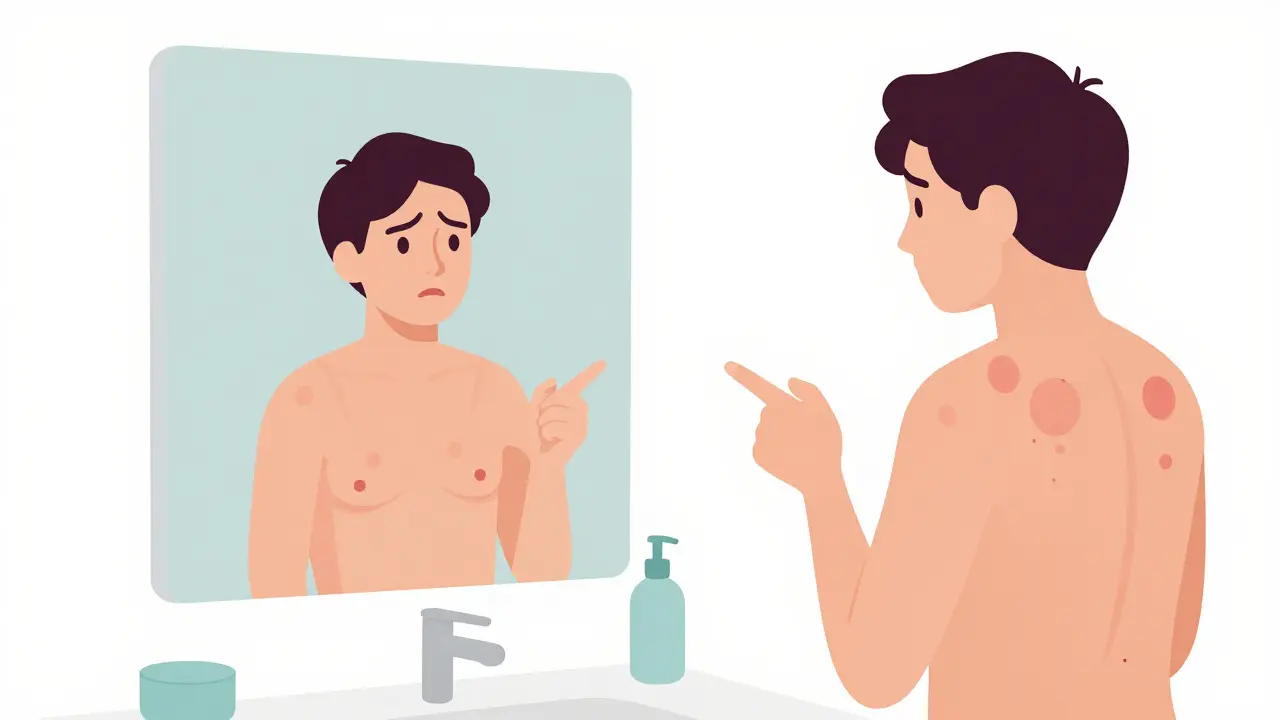
Drug Rash Symptom Checker
Select your symptoms and click "Analyze" to see potential reaction types.
Quick Guide to Drug Rash Types
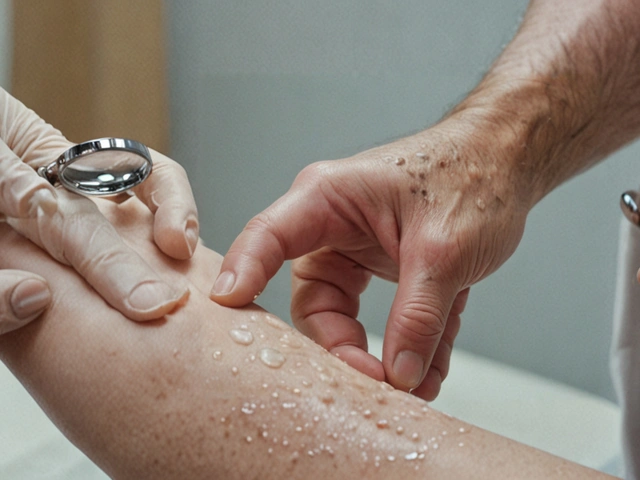
Not all rashes are created equal. The way your skin reacts depends on whether your immune system is overreacting or if the drug is simply irritating your tissues. Most people experience a morbilliform eruption-those small, symmetric red bumps that look like measles. These usually pop up 4 to 14 days after you start a new med and typically vanish within two weeks of stopping the drug. Then there are the more complex reactions. Some people develop hives (urticaria), which usually appear almost immediately and go away quickly. Others might get nummular dermatitis, which looks like coin-shaped plaques. These are often misdiagnosed as eczema (atopic dermatitis) in up to 40% of cases, which can delay the real fix: stopping the medication.| Reaction Type | Typical Onset | Key Symptoms | Severity / Outcome |
|---|---|---|---|
| Morbilliform | 4-14 Days | Symmetric red bumps, itching | Mild; resolves in 1-2 weeks |
| Urticaria (Hives) | Immediate (<1 hour) | Wheals, intense itching | Mild to Severe; clears in 24-48 hrs |
| DRESS Syndrome | 2-6 Weeks | Fever, swelling, organ inflammation | Severe; requires steroids |
| SJS/TEN | Variable | Widespread blisters, peeling skin | Critical; high mortality risk |
When a Rash Becomes an Emergency
While most drug rashes are mild, a small group of reactions called Severe Cutaneous Adverse Reactions (SCARs) are devastating. The most notorious is Stevens-Johnson Syndrome (SJS), which can lead to Toxic Epidermal Necrolysis (TEN). These conditions cause the top layer of skin to die and shed, effectively leaving the body without its primary shield. SJS carries a mortality rate of 5-15%, and TEN is even higher, reaching up to 35%. Another serious condition is DRESS Syndrome (Drug Reaction with Eosinophilia and Systemic Symptoms). Unlike a simple rash, DRESS is a multiorgan attack. It often starts weeks after you begin a medication, making it hard to link the two. You'll typically see a high white blood cell count (specifically eosinophils) and systemic symptoms like high fever and swelling. It’s most common with antiepileptics like carbamazepine or allopurinol. If you see widespread blistering, feel your skin peeling off in sheets, or experience swelling of the face and throat, do not wait for a doctor's appointment. Go to the emergency room immediately.
Common Culprits and High-Risk Triggers
Certain drugs are more likely to trigger these responses than others. Penicillins are the biggest offenders, causing roughly 10% of all drug rashes and 80% of severe allergic drug reactions. Sulfonamides and anticonvulsants also sit high on the list. It's not always a traditional allergy, though. Some people have non-allergic reactions. For example, about 10-15% of people using opiates experience symptoms that mimic an allergy but don't actually involve the immune system. Similarly, photosensitivity occurs in about 8-10% of cases, where a drug like doxycycline or hydrochlorothiazide makes your skin hypersensitive to sunlight, resulting in a severe sunburn-like rash. Your personal health profile also matters. If you have a viral infection like HIV or Epstein-Barr, you're 5 to 10 times more likely to have a severe reaction to antibiotics. Age is another factor; people taking five or more medications (polypharmacy) have a 35% lifetime risk of developing a drug rash, compared to just 5% for those on one or two meds.How to Handle a Suspected Reaction
If you suspect your medication is causing a breakout, the first rule is: don't just stop taking your meds. This is especially dangerous for things like seizure medications, where abrupt cessation can trigger a medical crisis. Instead, call your doctor immediately. For mild reactions, doctors often suggest simple skin soothing: lukewarm baths with non-soap cleansers and applying emollients within three minutes of drying off to lock in moisture. Over-the-counter 1% hydrocortisone cream can help with itching. However, for severe cases, you might need prescription-strength clobetasol or systemic prednisone to calm the immune system. Diagnosing the cause is a bit of a puzzle. In patients taking multiple drugs, doctors might have to stop every single medication one by one to figure out which one is the villain. The good news is that drug allergy testing has improved. For instance, skin testing for penicillin can now correctly identify true allergies 95% of the time, meaning many people who *think* they are allergic can actually tolerate the drug safely.
Genetic Risks and Future Outlook
Science is now finding that some of us are genetically predisposed to these reactions. For example, people with the HLA-B*1502 genotype (common in Southeast Asian populations) have a 1,000-fold higher risk of developing SJS when taking carbamazepine. Similarly, the HLA-B*5801 genotype increases the risk of allopurinol reactions by 580-fold in Han Chinese individuals. This means that in the future, a simple blood test before you get a prescription could prevent a life-threatening rash entirely.How do I know if my rash is a drug allergy or just a skin irritation?
Drug allergies usually appear as symmetric red bumps or hives and often occur shortly after taking the medicine. However, a non-allergic reaction can look similar. The main difference is that allergies involve the immune system creating antibodies. If you have facial swelling or trouble breathing, it's likely a severe allergic reaction (anaphylaxis) and requires immediate emergency care.
Does a drug rash always go away once I stop the medication?
In about 90% of cases, drug rashes resolve within one to two weeks after you stop the causative agent. However, severe reactions like DRESS syndrome may require weeks of corticosteroid therapy to fully resolve, and SJS/TEN requires intensive hospital care to manage skin loss and prevent infection.
Can I be allergic to a medicine I've never taken before?
Yes. You can be sensitized to a drug without knowing it. Trace amounts of certain medicines can exist in food supplies or the environment, which may prime your immune system. When you finally take the full medication, your body recognizes it as a threat and triggers a reaction.
Which medications are the most common causes of skin rashes?
Penicillins are the most frequent culprits, followed by sulfonamides (sulfa drugs), anticonvulsants (like carbamazepine), and allopurinol. NSAIDs like ibuprofen can also cause non-allergic skin reactions in some people.
What should I do if I develop a rash while on multiple medications?
Contact your healthcare provider immediately. Because you are on several drugs, it can be difficult to pinpoint the cause. Your doctor may need to systematically discontinue medications to identify the trigger. Do not stop essential medications (like those for blood pressure or epilepsy) without medical supervision.




mimi clouet April 13, 2026
Actually, you should also keep an eye out for photosensitivity! ☀️ Some meds make your skin way more reactive to the sun, which can look exactly like a rash but is actually a chemical reaction. Just a heads up for everyone! 🌸✨
Haley Moore April 14, 2026
Ugh, the lack of nuance here is just... typical. 🙄 Like, imagine not knowing that some of these reactions are actually systemic and not just "skin deep." It's honestly embarrassing that we have to spell this out in 2024. 💅
Tabatha Pugh April 15, 2026
I've seen this happen to so many people who don't even bother reading their pamphlets. I once had a coworker who thought she had a seasonal allergy but it was actually a reaction to a blood pressure med she'd been on for three weeks. Most people are just oblivious to their own bodies and it's honestly kind of concerning how many of you just blindly trust a script without checking for cross-reactivity with other compounds you might already be taking.
Mary Johnson April 15, 2026
This is exactly what they want us to think-that it's just a "reaction." Wake up! Big Pharma designs these side effects to make you dependent on second-tier medications to "treat" the symptoms of the first one. It's a closed loop of profit. They don't want you knowing the real cause or how to detox properly because a healthy person who doesn't need ten different creams isn't a customer. They're literally poisoning our epidermal layers to sell us the cure! Stop trusting the system!
Princess Busaco April 16, 2026
I find it absolutely quaint that people believe a simple table can encapsulate the multifaceted agony of a drug-induced eruption, especially when most practitioners are too hurried to distinguish between a simple morbilliform rash and something as catastrophic as Stevens-Johnson Syndrome, which, let's be honest, is basically a death sentence if you're not in a burn unit within the first hour of the first blister appearing. I've spent years studying the intersection of pharmacology and dermatology, and the sheer audacity of suggesting this clears up in "one to two weeks" for everyone is practically a lie by omission given the idiosyncratic nature of human immunology. It's truly a tragedy that we live in an era of medical oversimplification where a few bullet points are expected to replace a comprehensive diagnostic workup by a board-certified specialist who actually cares about the patient's systemic inflammatory response rather than just slapping some hydrocortisone on a disaster zone.
Catherine Mailum April 18, 2026
wow someone really woke up and decided to write a whole novel about skin bumps lol... truly tragic
Rim Linda April 19, 2026
Omg I literally had this last year and it was the worst experience of my entire life!! 😭 I looked like a strawberry and I couldn't even sleep because the itching was so bad!!! 😱
Olivia Lo April 19, 2026
The pharmacological etiology of these eruptions often mirrors a Type IV hypersensitivity reaction, though the phenomenological experience for the patient is far more chaotic. We must balance the clinical necessity of the medication with the systemic burden of the adverse cutaneous event. It's a delicate equilibrium between therapeutic efficacy and iatrogenic harm, and while the discourse here is passionate, we should maintain a stoichiometric approach to the data presented.