Desensitization Eligibility Checker
Check Your Eligibility
This tool helps determine if you might be eligible for medication desensitization based on medical criteria. Desensitization is only appropriate when:
2. No safe, effective alternative drug exists
3. Your condition is serious enough that avoiding the drug puts your life at risk
Result
When a life-saving medication makes you break out in hives, swell up, or struggle to breathe, stopping the drug seems obvious. But what if that drug is the only thing that can treat your infection, cancer, or autoimmune disease? That’s where desensitization comes in-not as a last resort, but as a carefully controlled medical strategy to let you safely take the drug you need.
What Desensitization Actually Does
Desensitization isn’t about curing your allergy. It’s about temporarily turning off your body’s extreme reaction to a specific drug. Think of it like slowly introducing a tiny spark to a pile of dry leaves-instead of a firestorm, you get a controlled burn. The process works by giving you tiny, increasing doses of the drug over hours, training your immune system not to overreact. It’s temporary. Once you stop taking the drug, your sensitivity returns. That means you’ll need to go through it again if you need the same drug later. This isn’t experimental. It’s been used since the 1960s, and today, hospitals like Brigham and Women’s in Boston have standardized protocols that work in 95-100% of cases when done right. Success rates are highest for immediate reactions-those that hit within minutes to an hour after dosing. That includes hives, low blood pressure, wheezing, or anaphylaxis triggered by antibiotics, chemotherapy, or monoclonal antibodies.When Desensitization Is the Right Choice
You don’t just walk into a clinic and ask for it. Desensitization is only considered when:- There’s no safe, effective alternative drug available
- The drug you’re allergic to is significantly more effective than anything else
- Your condition is serious enough that avoiding the drug puts your life at risk
Two Types of Protocols: Fast and Slow
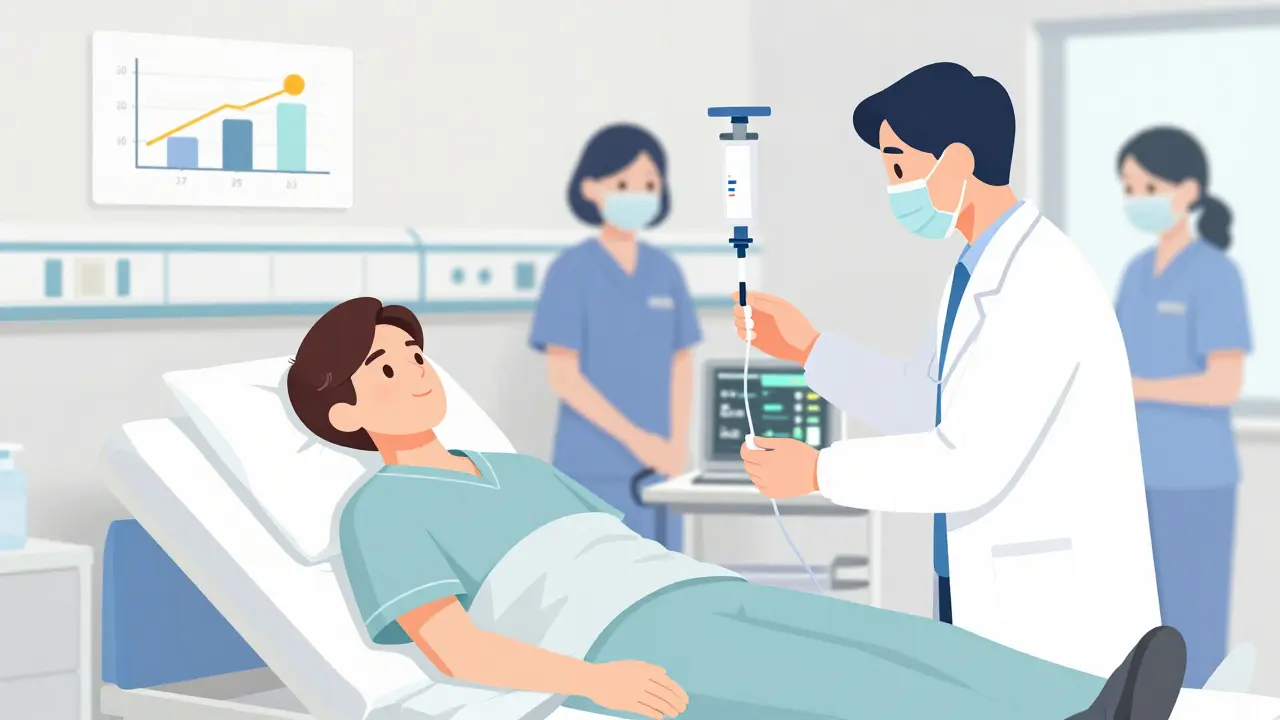
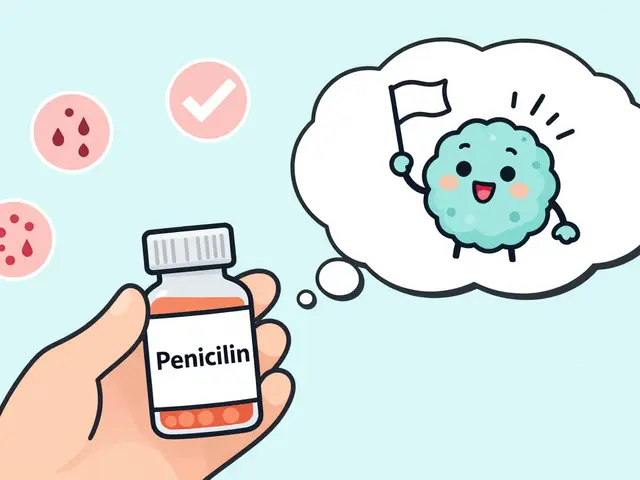
There are two main ways to do this: rapid and slow desensitization. Rapid Drug Desensitization (RDD) is used for immediate reactions. It’s done intravenously, with doses doubled every 15 minutes. At Brigham and Women’s, it’s a 12-step process that takes 4-6 hours total. The first dose is just 1/10,000th of the full therapeutic dose. By the end, you’re getting the full dose. In one study of 42 patients allergic to penicillin, every single one completed their full course of antibiotics with only mild side effects like flushing or itching in 8% of cases. No deaths. No anaphylaxis. Slow Drug Desensitization (SDD) is for delayed reactions, often with skin rashes that appear days later. These are trickier. There’s no universal protocol. Dosing intervals can be hours or even days apart. Aspirin and NSAID desensitization often take 2-3 days because each dose increase needs a long wait. Oral routes are common here. IV is rare. Success rates drop to 30-40% for these cases, which is why doctors avoid them unless absolutely necessary.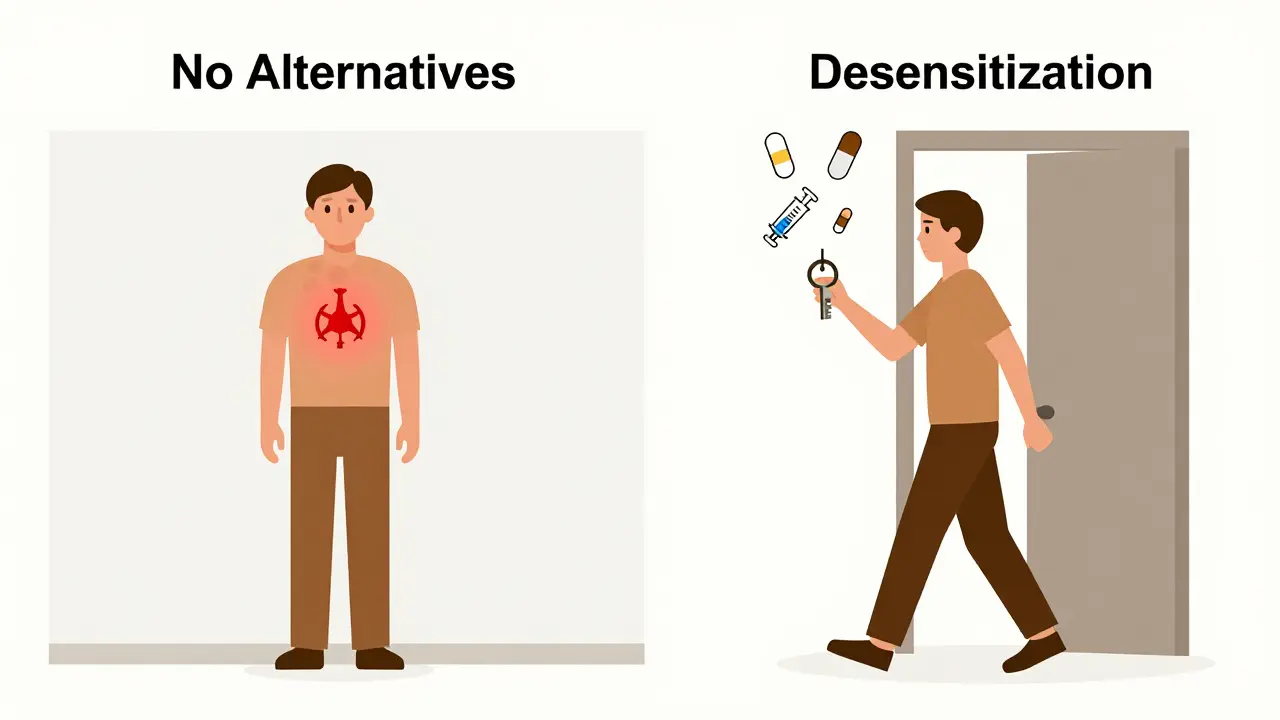
How It’s Done-And Who Should Do It
This isn’t something a general practitioner should try. Desensitization requires:- An allergist or immunologist with specific training
- A team of nurses trained in anaphylaxis response
- A facility with full resuscitation equipment-epinephrine, oxygen, IV access, monitors
Why It Beats Other Options
Some doctors try to avoid desensitization by using premedication-giving antihistamines or steroids before the drug. But that doesn’t work well. In one study, 10% of cancer patients on taxanes still had severe reactions even with premedication. Desensitization cut that to under 2%. Substitution is another option. But cross-reactivity is a real problem. If you’re allergic to penicillin, you might also react to cephalosporins-up to 20% of the time. That leaves you with fewer good options. Desensitization bypasses that entirely. And let’s not forget the bigger picture: antibiotic resistance is rising. The CDC says 35,000 people die in the U.S. each year from infections that won’t respond to standard drugs. If you’re allergic to the one drug that still works, desensitization might be your only path to survival.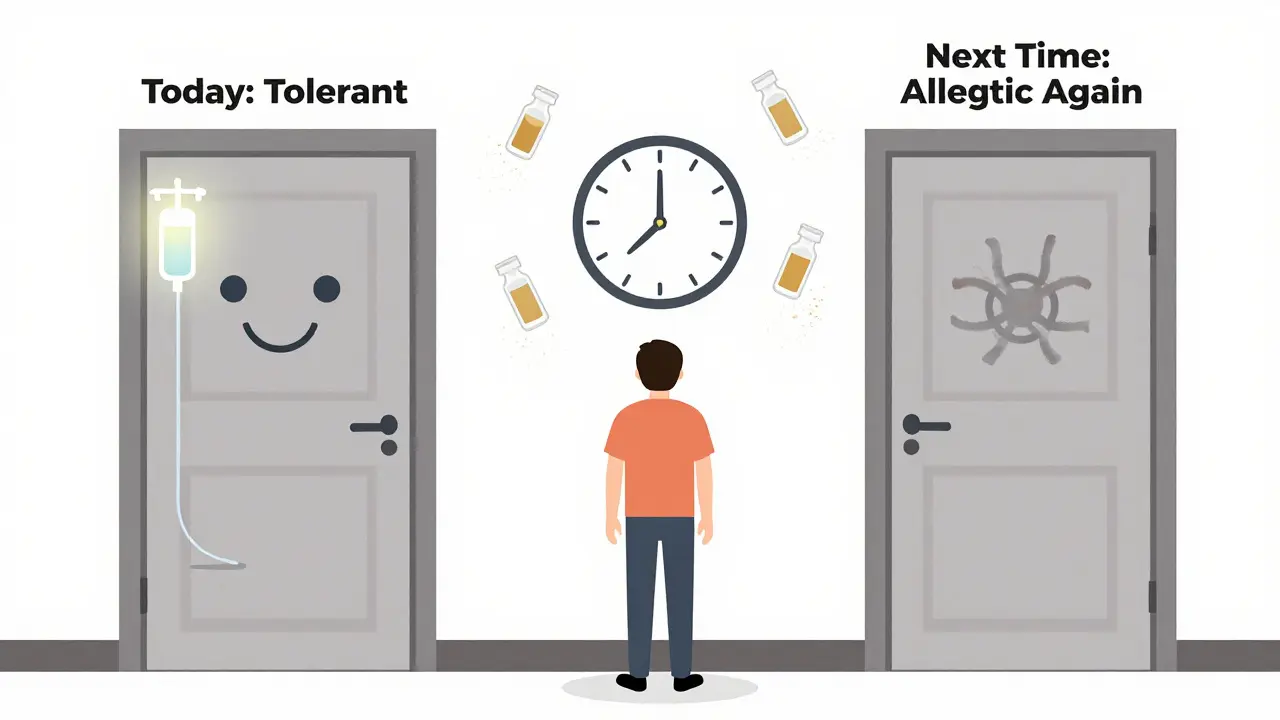
The Catch: It’s Not Perfect
Yes, it works. But it’s not simple.- It’s temporary. You’re not cured. You’ll need to repeat it every time you need the drug.
- It’s time-consuming. An IV antibiotic desensitization takes 4-6 hours. Oral aspirin can take days.
- It’s expensive. Each procedure requires nearly 6 hours of staff time-4.2 nursing hours and 1.8 physician hours. Medicare only covers 60% of the cost.
- It’s risky if done wrong. In untrained hands, the risk of death triples.
What’s Next?
The field is evolving fast. In 2023, the AAAAI released standardized national protocols, replacing 12 conflicting hospital guidelines. That’s a big step toward consistency. New research is exploring biomarkers-like basophil activation tests-that can predict with 89% accuracy whether someone will respond to desensitization. That means less guessing, more precision. There are even early trials for home-based desensitization. For stable patients who’ve already completed one round successfully, doctors are testing if they can safely continue doses at home under remote monitoring. Early results show 92% success. In the next five years, experts predict genetic and immune profiling will determine who needs desensitization, and which protocol will work best for them. This isn’t just about surviving an allergy-it’s about personalizing treatment at the molecular level.Final Thoughts
Desensitization isn’t magic. It’s medicine-precise, demanding, and powerful. It’s not for every allergic reaction. But for the right person, at the right time, it’s the difference between life and death. Between getting the treatment you need, and being locked out of care because of a label on your chart. If you’ve been told you’re allergic to a drug that’s essential to your treatment, ask your doctor: “Is desensitization an option?” Don’t assume it’s too risky. Ask if your hospital has a trained allergist who’s done at least 15 of these procedures. Ask if they use standardized kits and checklists. Because when the stakes are this high, the protocol matters as much as the drug.Can desensitization cure a drug allergy?
No, desensitization does not cure a drug allergy. It only creates temporary tolerance during the procedure. Once you stop taking the drug, your immune system returns to its previous sensitivity. You’ll need to repeat the process each time you need that medication again.
Is desensitization safe?
Yes, when performed by trained specialists in a properly equipped facility. Success rates for immediate reactions are 95-100%, and severe reactions during the procedure occur in less than 2% of cases. However, if done by untrained staff or without proper monitoring, the risk of serious complications increases significantly.
What drugs are commonly desensitized?
Common drugs include penicillin and other beta-lactam antibiotics, chemotherapy agents like paclitaxel and carboplatin, monoclonal antibodies (e.g., rituximab, trastuzumab), and aspirin or NSAIDs for patients with asthma or chronic hives. The protocol varies by drug type and reaction history.
Can I try desensitization at home?
Currently, home-based desensitization is only available in clinical trials for patients who have already successfully completed a full in-hospital protocol and are stable. It is not standard practice. Never attempt to self-desensitize-this can be fatal.
How long does a desensitization procedure take?
Rapid desensitization for IV drugs typically takes 4-6 hours. Oral desensitization for aspirin or NSAIDs can take 2-3 days, with doses spaced hours or days apart. Slow desensitization for delayed reactions may extend over multiple visits.
What if I react during the procedure?
If a reaction occurs, the team stops the infusion, treats the symptoms (with antihistamines, steroids, or epinephrine), and waits until you stabilize. Then they restart at a lower dose and proceed more slowly. Most reactions are mild and manageable. Severe reactions are rare when protocols are followed.
Who performs desensitization?
Only board-certified allergists or immunologists with specialized training in desensitization protocols. The procedure must be supervised by a team including trained nurses and conducted in a setting equipped to handle anaphylaxis, such as a hospital or specialized allergy clinic.
Are there alternatives to desensitization?
Yes-drug substitution, premedication with antihistamines or steroids, or avoiding the drug entirely. But substitution often fails due to cross-reactivity (e.g., penicillin to cephalosporins), and premedication has a 10-40% failure rate. Desensitization remains the most effective option when the drug is essential and no alternatives exist.



Kevin Kennett January 28, 2026
Let me tell you something-this is the kind of stuff that saves lives, but hospitals act like it’s some secret club. I had a cousin go through this for paclitaxel. They almost lost her because her oncologist didn’t even mention desensitization until she was in the ER with full-blown anaphylaxis. Why the hell is this not standard info? If you’re allergic to chemo, you deserve to know this is an option, not a Hail Mary.
Jess Bevis January 29, 2026
Penicillin desensitization: 4-6 hours. Worth it.
matthew martin January 30, 2026
Man, this whole thing is wild when you think about it. Your body’s basically screaming ‘NOPE’ at a lifesaving drug, and medicine goes ‘nah, let’s whisper to it until it calms down.’ It’s like negotiating with a toddler who’s having a meltdown over broccoli-but the broccoli is the only thing keeping you alive. And the fact that it’s 95% effective? That’s not luck. That’s science doing its damn job. I’ve seen people cry after finishing it-not from pain, but because they realized, ‘Oh. I’m gonna live.’
Also, the idea of home-based desensitization? That’s next-level. Imagine doing this in your pajamas with your cat on your lap, monitored by a nurse on Zoom. Feels like sci-fi, but it’s happening. We’re moving from ‘one-size-fits-all’ medicine to ‘your immune system gets a custom playlist.’
And yeah, it’s expensive. And time-consuming. But if you’re choosing between losing your job because you can’t take the drug or spending six hours hooked up to an IV… I know which one I’d pick. Hell, I’d do it twice a week if I had to.
Also, shoutout to the nurses who sit there watching vitals like hawks. They’re the real MVPs. No one writes songs about them. But they’re the ones holding the line when your body tries to turn on you.
And the part about T-cell reactions being off-limits? Good call. You don’t mess with Stevens-Johnson. That’s not an allergy-that’s your skin declaring war. Desensitization ain’t gonna stop that. Respect the boundaries, folks.
Bottom line: This isn’t magic. It’s not even ‘cool medicine.’ It’s just… necessary. And the fact that it exists? That’s kind of beautiful.
Jeffrey Carroll January 30, 2026
While the clinical efficacy of rapid drug desensitization is well-documented, one must also consider the logistical and systemic barriers to its widespread implementation. The requirement for specialized personnel, dedicated infrastructure, and continuous monitoring imposes substantial constraints on resource-limited institutions. Furthermore, the transient nature of induced tolerance necessitates repeated interventions, which may strain both patient and provider capacity over time.
It is imperative that healthcare systems prioritize the standardization of protocols and the training of frontline staff to ensure equitable access. Without systemic support, this life-saving intervention remains inaccessible to many who stand to benefit most.
doug b January 31, 2026
You don’t need a fancy degree to get this: if the drug saves your life and nothing else works, you do it. No excuses. Hospitals need to stop treating this like a bonus feature and start treating it like part of the playbook. Ask your doc: ‘Can I desensitize?’ If they look confused, find a new doctor.
Katie Mccreary January 31, 2026
Wow, so now we’re giving people drugs they’re allergic to just to ‘train’ their body? What’s next, forcing people to eat peanuts until they stop being allergic? This is just medicine playing god. Someone’s gonna die because a nurse messed up the dilution. And who pays for all this? You think insurance is gonna cover 6 hours of staff time? Please. This is just another way to bill more.
SRI GUNTORO February 1, 2026
How can we allow such risky procedures when there are natural remedies? Why not try turmeric, acupuncture, or prayer? Modern medicine is too obsessed with chemicals and IV drips. God gave us bodies to heal themselves-if only we had faith instead of fear.
Rose Palmer February 2, 2026
It is imperative to underscore the critical importance of institutional adherence to standardized desensitization protocols as delineated by the American Academy of Allergy, Asthma & Immunology. The documented reduction in adverse events through the implementation of electronic checklists and dedicated allergist oversight represents a paradigm shift in patient safety. Furthermore, the economic burden associated with this procedure must be contextualized against the long-term cost savings derived from avoiding prolonged hospitalizations, ICU admissions, and treatment failures due to suboptimal alternatives. We must advocate for expanded reimbursement policies to ensure equitable access.
Howard Esakov February 3, 2026
Wow, so you’re telling me we’re basically doing ‘immune system boot camp’? 🤯 This is the most elite, high-stakes, nerdy medicine I’ve ever heard of. Like, imagine your T-cells are in a cult and you’re the cult leader whispering, ‘You’re safe, you’re safe, you’re safe…’ 😎 I’m not even mad that it costs $5k. If I’m alive at the end of it? Worth every penny. Also, home-based? Next level. I’d do it in my bathtub with Spotify on. 🚿🎶